Could the lithium-ion battery in your laptop or phone become a risk during a flight? A study tested battery fires to find out what happens onboard.
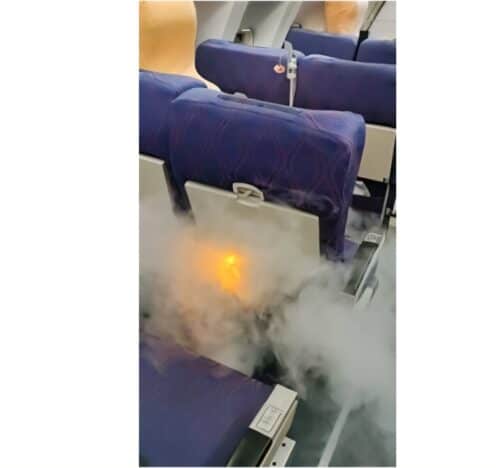
Current limits on lithium-ion batteries carried in personal electronic devices (PEDs) remain sufficient to keep air travel safe, according to a study by researchers from the Fraunhofer Institute for High-Speed Dynamics, Ernst-Mach-Institut (EMI), the Fraunhofer Institute for Building Physics (IBP), and Airbus. The research found that aircraft ventilation systems can limit passengers’ exposure to smoke and toxic gases during battery fires, while existing battery capacity limits continue to reduce safety risks.
The project examined what happens when lithium-ion batteries fail inside aircraft cabins and cockpits. Researchers conducted fire tests using laptops, tablets and smartphones in battery testing facilities, an Airbus A320 cabin mock-up and a flight test facility designed to replicate aircraft ventilation conditions. The experimental data were then combined with computer simulations to assess the risks posed by smoke, heat and toxic gases.
The researchers found that the amount of heat and gas released during a battery failure depends on the battery’s energy capacity. Based on the tests and simulations, they concluded that the current 100 watt-hour (Wh) limit for personal electronic devices carried on board remains appropriate, even as newer devices approach that threshold.
During the experiments, the team measured the release of gases including carbon dioxide, carbon monoxide, formaldehyde, hydrogen fluoride and hydrogen chloride. Simulations showed that aircraft ventilation diluted these gases quickly enough to keep exposure below health-related safety limits. Harmful concentrations were not occur beyond two seats from the burning device, while smoke remained largely confined to the immediate area because of the cabin’s air exchange rate.
The project also evaluated emergency procedures and safety equipment used to handle lithium-ion battery fires. Fire extinguishers tested during the study put out the flames, but none of the battery containment bags prevented smoke and flame leakage completely. Cabin crew members who tested the equipment recommended that containment bags should be ready for immediate use without requiring assembly.
The study also reviewed current emergency procedures, which recommend extinguishing the flames, cooling the overheating device with a non-alcoholic liquid and, where possible, placing it in a container filled with water to prevent further thermal runaway. The researchers said the findings support current aviation safety measures while identifying areas where onboard equipment and emergency procedures could be improved.