

A new control system uses machine learning to distinguish intentional turns from instability and provide stabilisation support only when needed.
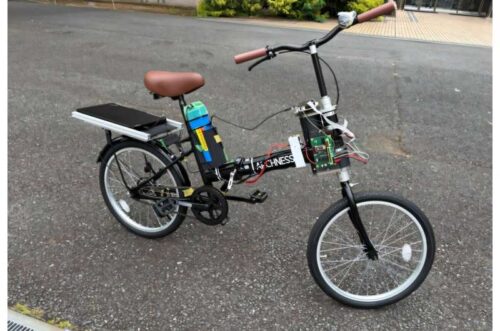
Researchers at Shibaura Institute of Technology (SIT), Japan, have developed a control system that is capable of distinguishing between intentional cornering and instability in two-wheelers, offering stabilisation assistance when needed. The team hopes that their system will enhance safety and eventually find applications in electric bicycles, electric motorcycles, bike-sharing services and delivery vehicles.
The research was carried out by Associate Professor Hiroaki Kuwahara and master’s student Shota Tsukase, and it focuses on solving a problem with the existing stability-control systems that respond only to vehicle motion.
“We believed that haptic technology could do more than provide force feedback—it could help us understand a rider’s intentions,” says Kuwahara. “By analysing the interaction between the rider and the vehicle, we aimed to create a mobility system that provides support only when it is truly needed.”
In order to do this, the researchers have designed a steer-by-wire bicycle where the handlebars are electronically linked to the front wheel of the bicycle. The system features an intent classification framework based on machine learning using a Long Short Term Memory (LSTM) neural network. Prior to training the model, the researchers have performed a classification of riding data using the K-means clustering method into three cases: riding straight ahead, cornering and instability.
The LSTM model used data collected from riding experiments to analyse the parameters such as steering angle, bike speed, roll angle, lateral acceleration, and reaction torque. The results showed that the framework could differentiate between intentional cornering and instability situations, and provide stabilisation support only when instability occurs.
“Because two-wheeled vehicles naturally lean during turns, it is essential to distinguish between intentional maneuvers and instability that could lead to a fall,” explains Kuwahara. “Our system uses information from the vehicle and rider interactions to make that distinction and provide stabilisation support only when necessary.”