A zinc energy storage device stores more than seven times the charge of similar systems. See how a 3D-printed design makes it possible.
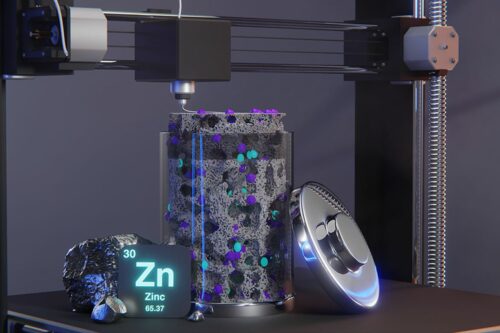
Researchers at UCLA have developed a zinc-ion hybrid energy storage device with a 3D-printed electrode that stores more than seven times the charge of comparable zinc-ion hybrid systems. The technology is designed for grid-scale energy storage, where systems must deliver high power, recharge quickly, operate for decades, and remain cost-effective.
Unlike lithium-based systems, the device uses zinc, which is around 100 times more abundant, easier to mine, and easier to recycle. According to the researchers, zinc-ion hybrid technology could complement existing energy storage solutions used for renewable energy.
The device combines two types of energy storage. One electrode works like the energy-storing electrode in a lithium-ion battery, while the other uses a carbon-based electrode similar to a supercapacitor, which can charge and discharge quickly and has a long operating life.
To increase energy storage, the research team created a 3D-printed carbon electrode with a honeycomb-like structure containing billions of microscopic pores. The electrode was produced using a UV-curable resin, followed by heat treatment and gas processing to leave behind a conductive carbon framework. The porous structure was then coated with vanadium oxide, a material used for energy storage.

The large internal surface area allows the electrode to hold more charge than conventional designs. According to the researchers, flattening one gram of the material would produce a surface area roughly equal to 10 tennis courts.
Tests showed that the zinc-ion hybrid device stored more than seven times the charge of similar hybrid capacitors while retaining 82% of its capacity after 1,500 charge-discharge cycles.
The study also introduced a 3D-printed test cell for evaluating energy storage devices. Many laboratories currently use open beaker setups, which allow electrolyte evaporation and can produce inconsistent measurements because electrode positions vary between experiments.
The test cell uses a sealed design to prevent electrolyte loss and includes fixed slots to maintain a consistent distance between electrodes. This improves measurement accuracy and makes test results easier to reproduce.
In comparison tests, standard carbon electrodes evaluated in the 3D-printed cell retained 98% of their charge after 1,500 cycles. The same electrodes tested in a conventional open-cell setup failed in fewer than 100 cycles. The researchers said the printable test cell could provide a low-cost method for more consistent battery and capacitor testing across research laboratories.