

A chip combines power control and wheel-speed sensing in one device, reducing parts, saving space, and helping build electronic brake systems more easily.
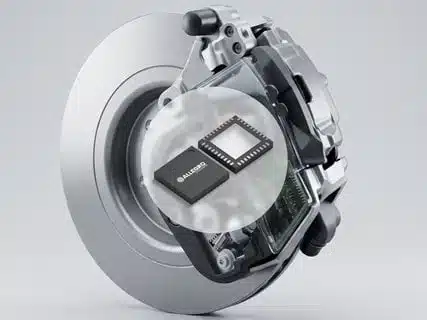
Automotive engineers developing brake-by-wire systems can now use a single chip for both power management and wheel-speed sensing. Allegro MicroSystems has launched the A81415, an ASIL-D-certified power management IC (PMIC) that integrates a wheel-speed sensor interface, reducing the number of components required in electromechanical braking (EMB) systems.
The PMIC replaces the combination of a safety PMIC, a separate wheel-speed decoder, and several discrete power components commonly used in brake-by-wire designs. By integrating these functions, it removes the need for up to nine external components, helping reduce semiconductor bill-of-materials costs by up to US$4 per vehicle while freeing more than 50% of the usable PCB area for other electronics.
The integrated wheel-speed sensor interface supports standard 2-level, 2-level Pulse Width Modulation (PWM), and 3-level AK communication protocols, including high-resolution versions. Wheel-speed signals are decoded inside the PMIC and transferred to the microcontroller over a Serial Peripheral Interface (SPI), eliminating the need for a separate decoder IC and reducing processing latency.
The device also combines a buck-boost pre-regulator, five low-dropout (LDO) regulators, and a single-inductor power architecture that does not require external switches or diodes. It provides low-noise power rails that can be used with Allegro’s XtremeSense TMR angle sensors for motor commutation and brake clamping-force measurement.
Built on Allegro’s automotive grade-0 process, the PMIC is qualified to ASIL-D and AEC-Q100 standards. It includes dual watchdogs and built-in fault handling to support functional safety requirements in automotive braking systems.
Brake-by-wire systems are increasingly being adopted in software-defined and electric vehicles because braking functions are controlled electronically rather than through mechanical linkages. Electronics located near the wheels must continue operating reliably despite vibration, temperature changes, and electrical disturbances, making compact, integrated, and safety-certified power solutions increasingly important for future vehicle platforms.
Click here for the original announcement.