

A graphene-assisted mid-infrared photonic crystal biosensor could enable rapid, non-invasive oral cancer detection through highly sensitive optical analysis of tissue properties.
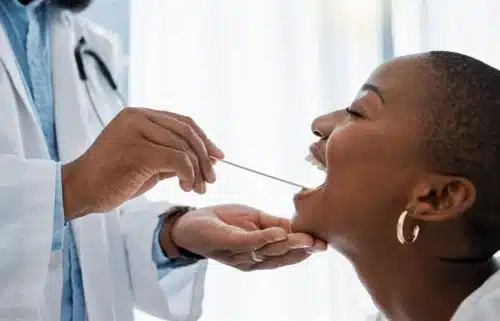
Researchers have proposed a graphene-assisted mid-infrared photonic crystal biosensor that could improve the early detection of oral cancer through rapid, label-free optical sensing. Published in Scientific Reports, the study presents a theoretical design that analyses subtle changes in the refractive index of oral tissues to distinguish healthy tissue from cancerous lesions without requiring invasive procedures.
The biosensor uses a one-dimensional multilayer photonic crystal structure incorporating a graphene layer and alternating dielectric materials that act as Bragg mirrors. At its centre is a defect cavity containing oral tissue or fluid. As the optical properties of tissue change during cancer development, the resonant wavelength within the cavity shifts, allowing the sensor to detect these differences with high precision. Operating in the mid-infrared region also enhances sensitivity because many biological molecules exhibit characteristic vibrational signatures at these wavelengths.
Computer simulations showed the proposed device achieved a refractive-index sensitivity of approximately 1,629.8 nm/RIU with near-perfect linearity, alongside a high quality factor and a low detection limit. Electric-field modelling demonstrated strong confinement of light within the sensing cavity, while fabrication-tolerance analysis indicated that small variations in layer thickness had minimal impact on performance, suggesting the design could remain reliable under realistic manufacturing conditions.
Unlike conventional diagnostic methods such as visual examinations, imaging and tissue biopsies, the proposed biosensor aims to provide a rapid, non-invasive alternative capable of identifying early-stage biochemical changes before obvious physical symptoms appear. If experimentally validated, the compact chip could be incorporated into portable diagnostic devices that analyse small oral fluid or tissue samples, supporting faster clinical decision-making and earlier intervention.
The researchers note that the work remains entirely theoretical. No physical prototype has yet been fabricated or tested using biological samples or patients. Future research will focus on building the device, validating its performance experimentally and integrating it with microfluidic sample-handling systems. The underlying platform could also be adapted to detect other disease-related biomarkers, including glucose, creatinine and viral particles, broadening its potential biomedical applications.