




A 3D-printing method creates objects that change images when pressed or turned, showing whether they are used properly without electronics.
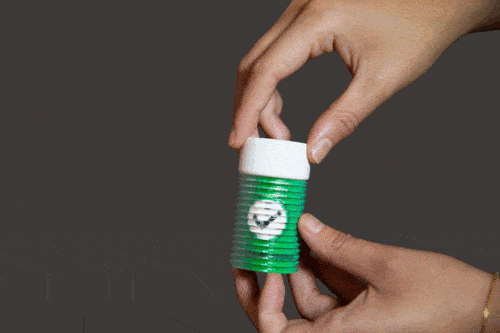
Researchers at the Massachusetts Institute of Technology (MIT) have developed ShiftLens, a 3D-printing system that enables objects to change their appearance when pressed, turned, or slid without using electronics. The system prints optical layers and mechanical components together, allowing objects to display different images or symbols through movement instead of sensors, displays, or electronic circuits. It can be used in safety, packaging, and industrial applications.
The researchers say the approach converts user-created designs into 3D-printable models. Users only need to provide the images and the shape of the object, while the software generates the optical structures and mechanical parts needed to create the changing visual effects. The tool allows users without expertise in optics or mechanical engineering to create interactive objects.
The system uses a layer of lenticular lenses placed over a patterned image layer. As the lens layer shifts during movement, different parts of the underlying image become visible, causing the object’s appearance to change. Maintaining alignment between the optical layers, mechanical parts, and printed graphics was one of the engineering challenges during development.
The researchers demonstrated the technology with several prototypes. One example is a chemical bottle that displays a green check mark when its cap is securely tightened and switches to a red warning symbol if the cap is loose, helping prevent chemical spills. Another prototype is a tic-tac-toe game in which rotating a knob changes each square to display an X, an O, or a blank space.
Beyond laboratory safety, the technology could be used for warning signs, packaging that indicates whether fasteners loosen during shipping, and industrial equipment that identifies faulty or leaking connections. Since the system does not rely on electronic components, it can be used in environments where electronics may be damaged by water, chemicals, or mechanical stress.
The researchers also believe the technology could simplify prototyping for engineering, architecture, and design. Future work will focus on reducing the amount of user input required to create objects and expanding the range of mechanical interactions that can trigger changes in appearance.

