See how this reference design helps engineers build robot audio systems with voice capture, AI support, and microphone arrays.
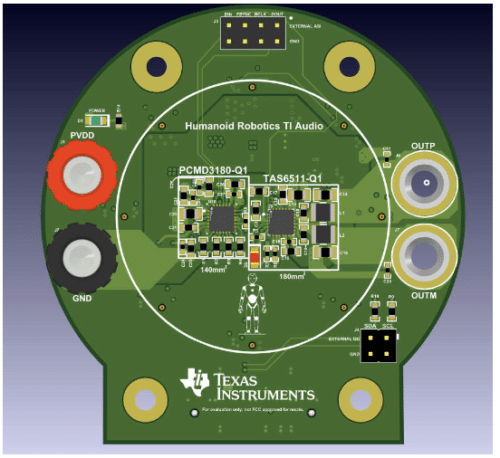
As humanoid robots become more capable, their audio systems are expected to do much more than simply play sounds. They must capture speech accurately, identify where a voice is coming from, communicate clearly in noisy environments, and interface with AI processors for speech recognition and decision-making. Texas Instruments’ (TI) TIDA-060054 Humanoid Robotics Audio Subsystem Reference Design gives design engineers a ready-made platform for building robot audio systems, reducing the need to develop the hardware from scratch.
For design engineers, one of the biggest advantages is the ability to build advanced microphone arrays. Multiple microphones positioned around a robot’s head allow algorithms to determine the direction of incoming sound, reduce background noise, and improve speech recognition accuracy. Instead of handling multiple audio streams independently, the reference design combines all microphone inputs into a single synchronized stream, reducing processor workload and simplifying software development.
The design can also serve as a starting point for voice-controlled robots used in factories, warehouses, healthcare facilities and service environments. Engineers can integrate speech-recognition software or AI models with the audio subsystem to enable robots to respond to spoken commands, hold conversations or detect emergency calls even in noisy surroundings. Since the board provides standard digital interfaces, it can be connected to a wide range of embedded processors and AI computing platforms.
Power design has also been addressed in the reference platform. It accepts an input supply ranging from 4.5V to 19V and includes onboard power regulation for the audio devices. This makes it suitable for battery-powered robotic systems as well as larger robots operating from higher-voltage power rails. Programmable digital volume control also allows software to adjust speaker output without additional analog circuitry.
Although developed for humanoid robots, the same architecture can be adapted for many intelligent edge devices. Autonomous mobile robots, industrial inspection robots, collaborative robots, smart kiosks and voice-enabled machines that require multiple microphones and high-quality audio output can all benefit from the design. Engineers can also use it as a validation platform to test beamforming, noise suppression, voice activity detection and AI-based audio processing before developing a custom production board.
The reference design also demonstrates how multiple audio building blocks—including microphone interfaces, audio amplifiers, clock generation, power management and digital communication—can be integrated into a compact subsystem. This gives engineers a proven starting point for developing reliable audio hardware while reducing the time spent on board-level integration and debugging.
TI has tested this reference design. It comes with a bill of materials (BOM), schematics, assembly drawing, printed circuit board (PCB) layout, and more. The company’s website has additional data about the reference design. To read more about this reference design, click here.