

A hydrogen-fueled engine combines optimised combustion, dedicated injectors, turbocharging, and electronic control to deliver diesel-like torque for medium-duty vehicles with near-zero tailpipe CO2 emissions for broader commercial truck integration.
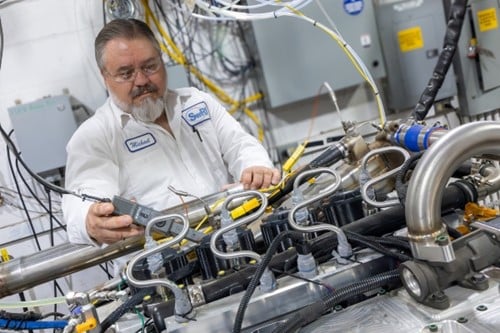
Southwest Research Institute (SwRI) has completed development of a spark-ignited hydrogen internal combustion engine (H2-ICE) for medium-duty commercial vehicles, combining hydrogen-specific combustion hardware with an electronically controlled powertrain. The engine is designed to deliver diesel-like torque and performance while producing near-zero tailpipe CO2 emissions.
The development is particularly relevant to vehicle electronics and powertrain engineers because hydrogen combustion introduces control challenges that differ from conventional gasoline or diesel operation. Hydrogen burns faster and can increase the risk of pre-ignition and combustion instability, requiring tighter coordination between fuel injection, airflow, ignition, and engine-control strategies.
The team developed the engine through single-cylinder and multi-cylinder stages, initially concentrating on combustion and injection strategies before addressing system-level integration. The final design is based on a pent-roof-style engine architecture originally developed for gasoline combustion but modified for hydrogen operation.
A key change is the modified port geometry, which improves airflow and accommodates hydrogen’s faster combustion characteristics. A larger intake valve further improves volumetric efficiency, while dedicated hydrogen fuel injectors are used to deliver the fuel required for the combustion process. These changes work alongside a turbocharger to provide the airflow and boost needed to achieve torque characteristics comparable to those of diesel engines.

The engine also incorporates a SwRI-designed and calibrated engine control system. This electronic control layer is important for coordinating the hydrogen injection and combustion process while maintaining stable operation across changing engine conditions. For engineers developing hydrogen powertrains, such a control architecture can be as important as the mechanical changes because combustion behaviour must be managed dynamically.
The completed engine can be installed in a medium-duty commercial truck chassis, positioning the technology as an alternative to conventional diesel powertrains without requiring a completely different vehicle architecture. The approach also builds on SwRI’s earlier hydrogen-engine work, including conversion of a natural-gas engine to hydrogen operation and development of a Class 8 hydrogen-powered demonstration vehicle.
SwRI has previously demonstrated that turbocharging can significantly improve hydrogen-engine performance. Its heavy-duty H2-ICE achieved 440 hp, 1,760 lb-ft of peak torque, and 44 per cent peak efficiency after a turbocharger upgrade. The latest medium-duty platform extends this development toward practical commercial applications.