




Researchers have developed an AI model that recreates human reading behaviour, opening possibilities for personalised text, smarter glasses and improved augmented reality.
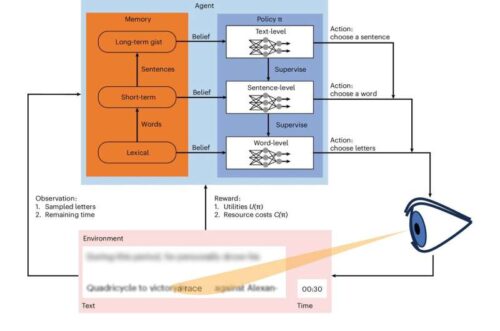
Researchers at Aalto University and international partner institutions have developed an AI model that captures how people decide where to look while reading. The model uses reinforcement learning to recreate human reading choices, potentially enabling personalised text and more adaptive augmented-reality displays.
The research addresses how readers allocate their attention as they move through words, sentences and paragraphs. Rather than simply copying eye-tracking patterns from large datasets, the model is designed around the psychological mechanisms involved in reading and understanding text.
Its approach is based on resource rationality: readers constantly decide where to direct their attention to gain as much understanding as possible within the available time. The model makes gaze-allocation decisions at three levels — word, sentence and text — while accounting for characteristics such as language, memory capacity and reading speed.
For example, a fast reader with strong memory may move quickly between paragraphs, while someone with poorer memory may look back through previously read material. Researchers trained the model using millions of texts and AI-based reinforcement learning, allowing it to learn strategies for directing attention.
Reader characteristics can also be incorporated as adjustable parameters. The researchers tested whether the model could form an internal description of text and use it to decide where additional information was needed.
The work could have practical applications in personalised reading tools and smart glasses. Text could potentially be paced, reformatted or presented differently according to an individual’s needs. The researchers also suggest applications involving complex legal writing, support for people with dyslexia or low language proficiency, and real-time situations where information needs to be understood without causing distraction.
The study, published in Nature Human Behaviour, involved researchers from Aalto University, The Hong Kong University of Science and Technology, City University of Hong Kong and the National University of Singapore.

