A reference design helps build fragrance diffusers with mist control, water sensing, touch buttons, lights, and fan control.
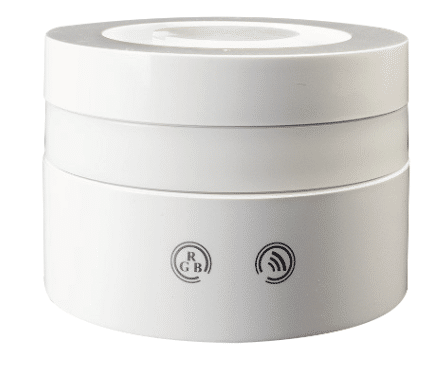
Fragrance Diffuser Overall Appearance
Holtek’s 3MHz/5V/5W fragrance diffuser reference design provides the main hardware and software functions needed to develop an ultrasonic fragrance diffuser. It supports atomizer driving, frequency tracking, water-shortage detection, touch controls, RGB lighting, and fan control. The design can be adapted for home, car, and portable fragrance diffuser products.
The design can be used as a starting point for products that turn liquid into a fine mist while keeping the atomizer operation under control. It uses a PWM signal to drive a three-pin inductor boost circuit, which then drives the atomization film. The approach directly controls the MOS transistor through the PWM signal and reduces heat dissipation requirements, allowing the external MOS transistor heatsink to be omitted.
A key function is frequency tracking. The MCU includes a 9-bit adjustable oscillator for fine frequency adjustment. During operation, the frequency tracking circuit changes the PWM frequency from high to low while measuring the current. When the target current is reached, that frequency is registered as the operating frequency. This provides a way to maintain the required atomizer operating point.
The reference design also includes capacitance-based water detection to protect the atomizer when the tank is empty. Holtek provides a software library for this function. The required water-detection parameters can be configured in software, while the working-state detection function can switch the atomizer on or off based on the touch input and water-shortage status.
The user interface can be customised through the two touch keys included in the design. One key controls atomization, while the other controls the RGB lighting modes. The lighting section uses three integrated timer modules to generate PWM signals for the LEDs. The supplied software supports seven lighting modes, including gradual colour change and individual red, yellow, green, cyan, blue, and violet modes.
The MCU can also directly drive a MOS transistor through its PTP output, with an output current of up to 150mA. This removes the need for additional driver components in this part of the circuit. The software structure includes separate routines for system setup, user-function initialisation, frequency tracking, touch processing, RGB control, and working-state detection, providing a base that can be modified for product-specific functions.
The PCB reference covers the atomizer driver, RGB LED, fan, touch-key, and water-detection circuits. For the atomizer section, Holtek recommends keeping the circuit area small, using thick traces for high-current paths, and maintaining a complete ground layer. These guidelines can be followed when adapting the design to a different board layout.
In the reported tests, the atomizer consumed 3.9W, the fan 0.4W, and RGB lighting 0.2W, while the average mist output was 10mL/h. The design also passed the reported conducted and radiated disturbance tests.
Holtek has tested this reference design. It comes with a bill of materials (BOM), schematics, assembly drawing, printed circuit board (PCB) layout, and more. The company’s website has additional data about the reference design. To read more about this reference design, click here.