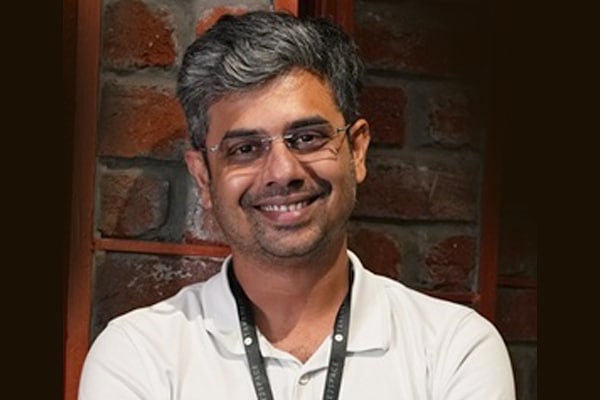
A space startup aims to build orbital data centres, letting users run AI models and store data on satellites while also supplying satellite hardware worldwide. In an interview, Ronak Kumar Samantray of TM2Space Technologies Pvt Ltd spoke to Nidhi Agarwal from Electronics For You about turning satellites into computing platforms.
Q. Can you tell us about your company?
A. Our goal is to build data centres in space by developing satellites equipped with graphics processing units (GPUs) and storage that operate in low Earth orbit (LEO). Through this satellite constellation, we will offer computing and storage as a service to customers. To achieve this, we have built the company as a vertically integrated space technology provider. A satellite has more than 20 subsystems, including power management, attitude control, onboard computing, communication and power distribution. We design and manufacture all of these in-house except for the solar cells and propulsion system.
As a result, we have two business lines. The first is our space-based compute and storage service, while the second is the sale of our satellite hardware to other companies in the space industry. Our satellite hardware is already being used by customers in India, Australia, Bulgaria, the UK, South Korea, the US, Spain and several other countries because it is designed for continuous operation and is cost-effective. Our compute and storage service, called OrbitLab, is a new concept globally. We successfully demonstrated the technology in 2024, and customers have been using our sandbox environment. Although the demonstration payload has now been deorbited, our next satellite, MOI One, is scheduled for launch in October 2026, after which the compute and storage service will again become commercially available.
Q. Can you explain your product lineup and how these products work together? Also, what is your business model?
A. Our platform combines software and hardware. For enterprise customers, commercial users, and researchers, the main product is OrbitLab, where users log in, upload their artificial intelligence (AI) models, and task our satellites. The hardware consists of our MOI (My Orbital Infrastructure) satellite series, including MOI-1, MOI-2, and MOI-3, which are built by us. Unlike traditional satellite operators such as Maxar or Planet Labs, which only provide satellite imagery, our satellites allow customers to upload and run their own AI models directly in orbit. As the satellite passes over a target location, it captures the data, processes it onboard, runs the AI inference, and delivers the final result instead of raw imagery. For example, a potato chip company can upload its crop health AI model to monitor thousands of hectares of potato farms, and the satellite directly returns the crop health index without the company having to buy and process large volumes of satellite data.
Our business model is based on selling onboard computing time rather than satellite imagery. We charge $2 per minute for customers to use the satellite’s compute capability. Since one satellite orbit lasts about 100 minutes, a full orbit costs around $200. Customers are paying to run their AI inference end-to-end in space, from data capture to processing and analysis, instead of simply receiving raw satellite images.
Q. Which product in your portfolio stands out the most, and what makes it different from what others offer?
A. Every product we build is innovative, but the one that stands out is our space-based data centre platform powered by OrbitLab. It provides users with direct access to our satellites through a web interface, where they can log in, upload their own AI models or Docker containers, task satellites and execute AI workloads directly in space. For example, a user monitoring cotton crops in Rajasthan can select the area of interest, choose the required spectral bands, identify the satellite orbit passing over that region, and run the AI model onboard the satellite. We also sell satellite orbits as a service, allowing customers to schedule and execute their workloads on specific passes.
What makes this platform unique is that, although several companies in the US are developing space-based data centres, customers cannot directly access or use those systems. OrbitLab is designed to make satellites open and accessible to everyone. To simplify the experience further, we have developed the OrbitLab Assistant, a large language model (LLM) trained specifically on the platform. It answers questions about OrbitLab, explains its applications across industries, and even helps users write code, making the platform usable for both developers and non-coders. Instead of downloading satellite data to Earth and processing it later, users can run AI models directly on the satellite in real-time—a capability that, to our knowledge, no other company currently offers.
Q. Can you explain the difference between OrbitLab and OrbitVault, and who they are designed for?
A. OrbitVault is our latest offering. The idea came from the growing need for secure data storage after recent conflicts showed that data centres can become military targets. With OrbitVault, users can store mission-critical data as a backup on our satellites. Our main customers are the banking, financial services and insurance (BFSI) and defence sectors because they handle critical data that is essential for decision-making. However, the service is not limited to them. OrbitVault is actually part of OrbitLab, so anyone using OrbitLab can create a storage bucket, upload data, and sync it to a satellite. For example, if someone wants to securely store Bitcoin private keys, instead of keeping them on a local device, they can store them on a satellite through OrbitVault. Since it is a storage service, we charge based on usage, with pricing starting at $400 per terabyte per month.
Q. Who are your target customers for your hardware products?
A. Our hardware products, such as the mission computer, star tracker, and other satellite subsystems, are designed for satellite builders. Our customers include companies that develop and build their own satellites. In India, many space startups purchase components from us because building an entire satellite hardware stack from scratch takes time. Different customers buy different subsystems depending on their mission requirements, such as the onboard computer (OBC) or attitude determination and control system (ADCS). Our customers include companies such as Orbitt Space, Skyroot, GalaxEye, Cosmos Server, and All Space.
We also have an educational initiative that helps students learn about satellite technology. Schools wanted hands-on satellite kits for teaching, so we developed educational products and worked with a network of certified space educators. These educators use our kits to teach students how satellites are built and how space systems work.
Q. What inspired you to start the company, and is there a story behind its name?
A. After my previous startup was acquired by Reliance in 2019, I started thinking about what to build next. Having started coding at the age of 10 and always being interested in electronics, I believed the future would lie at the intersection of software and hardware rather than software alone. Around the same time, India’s 2020 space policy opened the sector to private companies, while falling launch costs driven by reusable rockets made it practical to deploy large numbers of assets in orbit. When I studied the industry, I found that most companies were focused on Earth observation, while satellite internet had already proven that space infrastructure could be offered as a service. What was missing was computing and storage in space. As future missions expand to the moon and beyond, it would not be practical to send all data back to Earth for processing, so we decided to build satellites designed specifically for orbital computing and storage.
The company’s name reflects our belief that space infrastructure should be open to everyone, not just governments, scientists or large organisations. Just as anyone can access cloud computing today, we wanted anyone with an idea to be able to use computing resources in orbit without unnecessary barriers. We are not interested in deciding which projects deserve access; our goal is to provide the infrastructure and let people innovate. That vision led us to build OrbitLab, a web-based platform that allows users to access computing resources in space. It also required working closely with the Indian government to demonstrate that the platform had the necessary security and privacy safeguards, making it the first private initiative in India to place orbital computing infrastructure that users can access through a web dashboard.
Q. How is processing data directly in orbit technically different from conventional cloud computing?
A. From a computing perspective, there is no difference. Compute is compute, whether it runs on Earth, underwater, or in space. The same processing tasks can be performed in orbit just as they are in a conventional cloud data centre. The real difference is not in how the computation works, but in where the data is processed.
Processing data in orbit means customers do not have to download massive amounts of raw satellite imagery to Earth. Instead, the data is analysed in space, and only the final results are transmitted. For example, if a customer is monitoring the health of 1,000 farms, they would receive a small table or spreadsheet with the health index of each farm instead of downloading thousands of high-resolution images. This reduces data transmission from gigabytes or terabytes to just a few bytes, significantly lowering download costs and improving efficiency.
Q. How does your satellite platform differ from traditional Earth observation satellites, and how do you handle software updates and AI model deployment once the satellites are in orbit?
A. Traditional Earth observation satellites are mainly designed to capture the highest possible image resolution for surveillance and imaging applications. Our approach is different. We intentionally keep the image resolution lower because our focus is not on producing better pictures but on processing data in space. Instead of allocating most of the satellite’s power and resources to advanced cameras, we prioritise onboard computing by integrating high-performance GPUs. While conventional Earth observation satellites typically include only small, low-power AI modules for tasks such as cloud detection or data filtering, our satellites are built to maximise computing capability so they can perform more complex AI workloads directly in orbit.
To support this, we have developed all of our satellite subsystems from the ground up, giving us complete control over both the hardware and software. Every subsystem is designed to support over-the-air (OTA) updates, enabling us to remotely deploy software updates and AI models even while the satellite is in orbit. This ensures that the satellite’s capabilities can continue to evolve throughout its operational life.
Q. What AI architectures does your platform support for space-based AI workloads, and how do you simplify AI deployment for customers?
A. Our platform supports multiple AI architectures depending on the customer’s requirements, including convolutional neural networks (CNNs), recurrent neural networks (RNNs), and large language models (LLMs). We provide software libraries that allow customers to develop and deploy their own CNN- or RNN-based vision models directly on the satellite. We also work with partners such as ESA to host geospatial LLMs like TerraMind, which is pre-installed on the satellite and is designed specifically for Earth observation applications.
Beyond AI models, we provide the complete software pipeline needed to process satellite imagery. Since satellites generate raw image data, we include libraries for radiometric and atmospheric corrections to convert it into analytics-ready images. We also provide Digital Elevation Models (DEMs), allowing users to overlay satellite images on 3D maps of the Earth for advanced analysis. This means customers can either deploy their own AI models, use the onboard LLM if they are not familiar with vision AI, or simply access fully processed data without spending time on image preprocessing.
Q. How accurate is the AI model in space compared to the one running on the ground?
A. Accuracy is one of the main factors we considered while choosing the hardware for our satellites. To ensure customers get the same results in space as they do on the ground, we use the same data centre-grade NVIDIA GPUs that they already trust in their own data centres. This allows them to upload their existing AI algorithms directly to the satellite without creating new models for space. Since the AI processing happens on the same class of hardware, customers can expect consistent performance and accuracy between ground-based and in-orbit computing.
Q. Are there any limitations in processing AI workloads onboard?
A. The limitation is infrastructure capacity. For example, if a satellite contains 10 GPUs, it can only support workloads that fit within those 10 GPUs. If a customer requires 20 GPUs, we cannot support that workload until more infrastructure is deployed. This is similar to terrestrial cloud providers. If Amazon web services (AWS) has only a certain amount of data centre capacity in a region, it cannot immediately serve demand beyond that capacity. Infrastructure expands over time as demand grows.
Q. What level of onboard autonomy is required for orbital computing systems?
A. Ideally, the satellite should operate with 100% autonomy. Every function, such as battery charging, power management, and fault handling, is pre-programmed. The goal is to eliminate operational costs after launch. Unlike terrestrial data centres, which have both capital expenditure (CAPEX) and operational expenditure (OPEX), a space data centre mainly involves CAPEX. If operational costs can be reduced to nearly zero, the business becomes more profitable. Space naturally encourages this approach because physical intervention is impossible once the satellite is in orbit.
Q. What design challenges arise when integrating high-performance AI accelerators into a small satellite platform?
A. The biggest challenge is maximising power within a limited mass. Our 15kg satellite consumes about 120W, while most satellites of similar size operate at only 50–60W. The key question is how to maximise watts per kilogram by fitting more solar cells into the same form factor without increasing mass. Launch providers charge around $12,000 per kilogram, regardless of the components onboard, so every kilogram matters.
Q. How have you addressed power challenges?
A. We redesigned the satellite architecture. Our satellite has one-meter solar panels on both sides connected through an in-house developed motorised solar drive system. As the satellite changes orientation, the panels automatically track the sun to maximise energy generation. Such solar drive arrays are normally used only on much larger satellites, so we had to develop this solution ourselves for a small satellite platform.
The individual components are not necessarily new, but the way they have been adapted for this form factor is different. Satellites have existed for decades, and larger missions, such as those by the National Aeronautics and Space Administration (NASA), have used similar concepts. However, those missions are expensive and cost is not their primary concern. In our case, performance and cost must always be balanced.
Q. How do you balance computing performance, power consumption, and thermal management in orbit?
A. The balance is achieved mainly through the satellite’s architecture rather than by compromising on computing performance. A key principle is that the surface area needed to capture 1kW of solar energy is larger than the area needed to radiate 1 kW of heat. By designing the satellite so that one side continuously faces the Sun while the opposite side faces deep space, it can generate power and dissipate heat at the same time. Since deep space has a background temperature of about 4 Kelvin (around -269°C), the cold-facing side acts as an effective heat sink.
With this approach, the satellite can keep high-performance processors such as GPUs running continuously while efficiently radiating excess heat into space. Instead of trading off computing power against thermal limits, the focus is on designing the satellite to manage both effectively. This is why orbital data centres are becoming a common direction across the industry, with multiple companies pursuing similar architectures for space-based computing.
Q. How do you optimise AI inference for limited power and bandwidth in space?
A. Our philosophy is not to force customers to optimise for low power. Instead, we maximise the available power so GPUs can operate continuously. The satellite is designed to support high GPU power requirements. Customers should not have to think about power constraints, just as AWS customers do not worry about the underlying power infrastructure.
Q. Space is a high-radiation environment. How do you ensure the reliability of AI models running in space?
A. We address this challenge by protecting the hardware from radiation. Our first mission, the radiation shielding experiment module (RSM), focused on testing a radiation protection material that we developed for satellites. This material reduces the amount of radiation reaching the onboard electronics, which improves the reliability of the computing system and helps AI models run more consistently in the harsh space environment.
Q. What radiation effects pose the greatest risk to onboard computing systems, and how do you mitigate them?
A. We use shielding materials that significantly reduce the amount of radiation entering the satellite. As a result, the onboard GPUs experience much lower radiation exposure than they normally would in orbit. At the software level, we also implement data integrity algorithms that detect corrupted bits and correct them, helping maintain reliable computing despite radiation.
Q. What cybersecurity measures are required for space-based computing?
A. Cybersecurity is critical because data is transmitted through radio frequency (RF) signals. We use post-quantum cryptography (PQC), which ensures that communication between Earth and the satellite remains secure even against future quantum computers. PQC makes the data exchange quantum-safe.
Q. What are the biggest challenges in deploying GPU-based computing systems in space, and how are you addressing them?
A. Deploying GPU-based computing systems in space involves several engineering challenges. The first is radiation, as high-energy particles from solar activity can cause bit flips that corrupt data. Thermal management is another issue because there is no air or water in space, so heat can only be removed through conduction or radiation. Power generation is also a challenge. Most satellites use gallium arsenide solar cells because they are efficient, but they are much more expensive than silicon cells, making large-scale deployment difficult. Another challenge is networking a constellation of satellites, where high-speed laser communication is needed for data exchange between satellites.
Beyond the hardware, software is equally important. Simply placing GPUs in orbit and renting them out is not enough. Customers need a platform that makes building and deploying applications easy, similar to how cloud providers offer managed services instead of just servers. We are building that software runtime through our OrbitLab platform. It is comparable to the cloud management consoles used by major cloud providers, providing an interface that allows users to access and manage space-based computing infrastructure easily. Creating this user experience is a key part of our intellectual property.
Q. What are the biggest engineering challenges your startup is currently solving?
A. One major challenge is replacing gallium arsenide with silicon. Gallium arsenide performs well but is very expensive. Silicon, on the other hand, typically survives only about six months in orbit because of radiation. We are working on increasing silicon’s lifespan so it can reliably operate in space. Another challenge is developing optical satellite communication. As we move toward satellite constellations, we need laser-based communication links between satellites, and that technology is still under development.
Q. Do you manufacture your products in-house or use a contract manufacturer?
A. We don’t use a contract manufacturer. Instead, we work with a network of around 40 specialised vendors for different processes such as computer numerical control (CNC) machining, coatings, and fasteners. We design every component ourselves and distribute different parts to different vendors. No single vendor manufactures the complete product.
We follow this model mainly to reduce supply chain risk and protect our intellectual property. Rather than giving the entire design to one manufacturer, we split each product into multiple components and have them made by different vendors. For example, a wheel may consist of five separate parts, each produced by a different supplier. The components are then brought to our headquarters in Hyderabad, where we assemble the final product. This ensures that no one in the supply chain knows the complete product they are helping build.
Q. How do you test and validate the satellite hardware?
A. We use facilities provided by IN-SPACe. Satellite testing equipment is expensive, so IN-SPACe has established a technical centre in Ahmedabad where startups can access thermal vacuum chambers, vibration tables, shock testing equipment, and other facilities at affordable rates. The government has ensured that startups across the ecosystem have access to these testing and qualification facilities.
Q. Have you faced any operational challenges after launching satellites into orbit? How do you resolve them?
A. If you have written the satellite software yourself, you understand every system behaviour. Whenever an issue occurs, you trace it back and send commands from the ground station. One important design principle is exposing every onboard function as a command that can be controlled remotely because physical access is impossible after launch. The communication module is especially critical. If communication fails, the satellite effectively becomes inaccessible, even if every other subsystem is functioning properly. Every board and function must therefore be controllable through commands so that engineers can diagnose and resolve problems remotely.
Q. Have you received any government support?
A. Both the central government and India’s space ecosystem have supported startups through seed programs, seed grants, the research, development and innovation (RDI) Fund, and the Antriksh Fund. While these are not very large investments of hundreds of millions of dollars, funding below ₹500 million is reasonably accessible. The private investment ecosystem has also improved significantly. Unlike the early 2020s, raising $5-6 million, or even a funding round below $10 million, is no longer very difficult.
Q. What revenue did the company generate in the previous financial year?
A. The company is only two years old. Last financial year, revenue was about ₹50 million. This financial year, we expect it to reach around ₹120 million.
Q. What are your plans for scaling this technology in the coming years?
A. We have developed this technology in-house, and our first satellite, MOI-1, is scheduled for launch in October 2026. To expand the system, we have raised $5 million, which will support the development of a four-satellite architecture launching during 2027–2028. These will be 150 kg-class satellites, growing the constellation from MOI-1 to MOI-5. This funding will help us build and deploy the complete constellation.
Q. How will AI influence the demand for space-based computing infrastructure?
A. AI is the main driver behind the need for orbital data centres. Computing has evolved from personal computers (PCs) to on-premises servers, cloud computing, big data platforms, blockchain GPU farms, and now AI model training. Training large AI models requires enormous amounts of energy, and the demand for backend computing continues to grow. In the future, humanoid robots will further increase this demand because they will rely on intensive backend processing for digital world simulations and decision-making. Since these backend workloads do not require real-time interaction with users, they can be shifted to orbital data centres, while users continue to receive only the final processed results. As computing demand and energy consumption keep increasing, relying only on terrestrial data centres will become increasingly difficult over the next two decades.
Q. How do you see quantum computing and orbital computing intersecting in the future?
A. Today, quantum computing mainly affects our business through quantum-safe cryptography. In the future, superconducting quantum computers may benefit from operating in space because they require extremely low temperatures. Space naturally provides temperatures around -200°C, reducing cooling requirements. However, quantum computing itself is still largely in the research stage. It will likely become commercially mature on Earth first before moving into orbit. Looking several decades ahead, any form of large-scale computing that exceeds Earth’s infrastructure limits may eventually move to environments such as undersea facilities, underground sites, mountains, or orbit.
Q. Do you face any competition in India?
A. Competition is beginning to emerge. Pixxel has announced a partnership with Serverum to develop a data centre node, and a Hyderabad-based startup called Orbit Grid is also working on orbital data centres. I see this as positive because it validates the market opportunity. Three months ago there were no Indian players in this space. Today there are already a few, and I expect four or five companies to enter over the next two to three years. Globally, there are currently around eight companies pursuing orbital data centres.
Q. How can the ecosystem support your company? Are you looking for partnerships?
A. We actively collaborate with startups across India’s space ecosystem. For example, EON Space is our optics partner, and Astro develops our S-band communication system. We intentionally work with startups whose products may not yet be space-qualified because we believe in sharing risk and helping strengthen the ecosystem. We co-develop technologies with several startups and build long-term partnerships based on mutual trust.
Q. What are your plans for future growth?
A. Competition in space computing is becoming global. Companies such as Elon Musk’s ventures, Google, and several others are pursuing similar opportunities. We want India to remain competitive rather than becoming dependent on foreign orbital computing infrastructure. Our immediate goal is to launch a 50kW satellite by 2029. We already have funding to build up to a 5kW satellite by 2028. The next step is scaling from 5kW to 50kW with a 2.5-ton satellite, for which we are currently raising a Series A round. If successful, it would be a global first.
Q. Are you considering an initial public offer (IPO) in the future?
A. Yes. Ideally, it could happen around 2029 or 2030, although the timing depends on business growth. Revenue will ultimately determine IPO readiness. Reaching around ₹10 billion in revenue would be an appropriate milestone. An IPO is particularly important in the aerospace industry because being publicly listed significantly increases trust among government agencies, public sector organisations, and private customers.