




A new semiconductor device gives AI hardware short-term memory while naturally clearing older inputs, potentially enabling faster, lower-power processing for edge applications in real time.
1 / 1
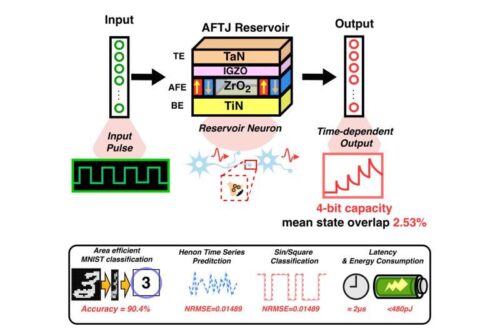
Operating principle of the antiferroelectric tunnel junction (AFTJ) device, in which the current state varies according to the input history when voltage is applied and naturally returns to its original state over time after the voltage is removed. The research team used this “natural forgetting” characteristic to continuously process time-series information without a separate reset process.
Seoul National University researchers have developed an antiferroelectric tunnel junction (AFTJ)-based semiconductor device that can process recent information while naturally discarding older data. The approach turns the physical process of ‘forgetting’ into a computational function, potentially improving low-power artificial intelligence (AI) systems that handle continuously changing signals.
The technology is designed for time-series information, including speech, electrocardiogram signals and environmental sensor data. Such information needs to be interpreted in the context of immediately preceding inputs rather than treated as isolated values.
Conventional AI hardware can face speed and power-efficiency limitations because data repeatedly moves between memory and computing units. Reservoir-based systems can also require separate reset processes to remove previous states, creating additional demands for short-term memory management.
To address these challenges, the researchers developed a two-terminal device using zirconium oxide and amorphous indium gallium zinc oxide. Its antiferroelectric behaviour allows the device to return spontaneously to its original state after an applied voltage is removed.
The researchers adjusted the material composition so that small changes in its state could be detected through differences in current. The device could distinguish 16 possible combinations of four-bit inputs as separate current states, demonstrating its ability to retain and process recent information.
By combining nonlinear transformation, short-term memory and natural resetting within one device, the research expands the options available for low-power time-series AI hardware.
The technology could eventually support edge AI systems processing voice commands, wearable biosignals and environmental or industrial sensor data close to where information is generated. Further device miniaturisation and array-level integration could improve processing speed and energy efficiency.
The researchers also suggest that the approach could help AI hardware analyse complex patterns and predict changing values, including applications involving fluctuating data. Future work will focus on reducing device area and validating the technology at array and circuit levels.
The findings were published in Advanced Science, with the researchers continuing work on antiferroelectric-based neuromorphic devices and physical reservoir computing.


