





TU Graz researchers propose battery-design guidelines using replaceable covers, modular construction, and improved cooling to make EV batteries safer, repairable, and easier to recycle.
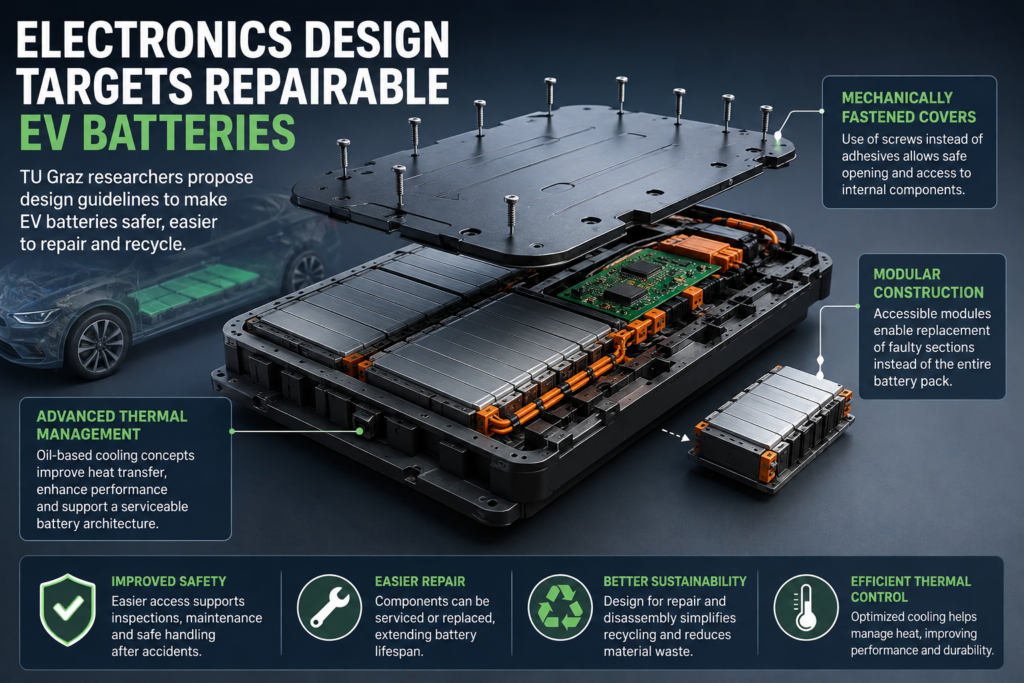
Researchers at Graz University of Technology (TU Graz) have developed design guidelines aimed at making electric-vehicle traction batteries safer to service, easier to repair, and more suitable for recycling. The approach addresses a growing engineering challenge: modern battery packs must simultaneously deliver electrical performance, thermal management, mechanical protection, and long service life, while many current designs make access to internal components difficult.
The research focuses on changing how battery packs are physically constructed rather than treating repairability as an afterthought. One key recommendation is replacing permanently bonded components with mechanically fastened connections. Using screws instead of adhesives can allow technicians to open battery housings and reach individual components without destroying the enclosure, potentially simplifying maintenance and reducing material waste.
Another important design element is the battery’s thermal-management system. TU Graz researchers propose oil-based cooling concepts that can improve heat transfer while supporting a more serviceable battery architecture. Thermal management is particularly important because battery cells generate heat during charging and discharging, while excessive temperatures can affect performance, ageing, and safety.
The proposed guidelines also consider modular battery construction. Separating the pack into accessible modules could allow damaged or degraded sections to be serviced instead of requiring replacement of an entire battery assembly. This can improve the practical lifetime of the electronic and electrochemical components while reducing the quantity of material discarded during repairs.
The technology has applications across electric cars and other battery-powered vehicles where high-voltage battery systems must withstand mechanical loads, temperature variations, and demanding operating conditions. Standardised design principles could also make batteries easier for emergency responders to handle after accidents and simplify later dismantling and recycling.
The E-Track research highlights a broader shift in EV battery engineering: designing packs not only for energy density and performance, but also for serviceability and end-of-life processing. TU Graz says the concepts are intended to improve safety, repairability, and sustainability across the battery’s lifecycle.

