A Bluetooth LE module supports Bluetooth 6, long-range communication, distance measurement, and multiple wireless protocols for IoT and industrial devices.
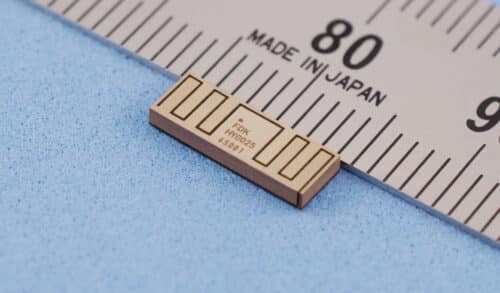
FDK Corporation has announced the development of the HY0025, an ultra-compact Bluetooth Low Energy (Bluetooth LE) module. It is the third product in FDK’s series of Bluetooth LE modules designed to occupy one of the smallest board areas in its class.
The HY0025 uses SASP technology developed by Toshiba Corporation. The technology allows the antenna to be formed on the shielded package on the top surface of the module. This removes the need for a large keep-out area around the antenna, helping the module achieve one of the smallest board-level occupied areas in the world. The company says the module is suited for wirelessly transmitting data from a wide range of sensors used in physical AI and healthcare applications.
The HY0025 uses Nordic Semiconductor’s nRF54L15 SoC and complies with Bluetooth 6. Along with conventional Bluetooth LE communication, the module supports long-range communication through Coded PHY. It also supports Channel Sounding, which enables accurate distance measurement between devices. These capabilities can support applications that use location and distance information.
The module integrates an Arm Cortex-M33 processor operating at 128 MHz, along with 1.5 MB of NVM and 256 KB of RAM. These resources support applications that require wireless functions and security features.
The HY0025 provides a maximum output power of +8 dBm and receiver sensitivity of -96 dBm. It can operate across a temperature range of -40°C to +105°C, allowing it to be used in harsh environments, including industrial and automotive applications.
Beyond Bluetooth LE, the module supports multiple wireless protocols, including Thread, Matter and Zigbee. This allows it to be used in different IoT applications and smart infrastructure systems.
With the HY0025, FDK aims to provide wireless connectivity for the growing requirements of IoT applications, where sensors, devices and systems need to exchange data wirelessly.
Click here for the original announcement.