




Inflatable tubes form moving structures with built-in pneumatic actuators that lift loads, control movement, and allow the material to be reused.
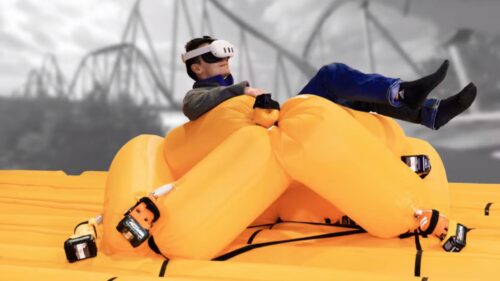
Researchers at the Hasso Plattner Institute have developed AirForce, a fabrication system that uses inflatable tubes to build structures with built-in movement. The system creates structures that can support loads without a rigid frame, conventional joints, or separate pneumatic cylinders.
A demonstration is a 50-foot-long, 25-foot-high animatronic T. rex weighing about 60 kg. Inflatable sections act as actuators for its jaw, tail, and body. The researchers also built a six-degree-of-freedom motion platform that can lift people.
AirForce uses parts of the same continuous tube for both the structure and its actuators. This reduces the number of separate mechanical parts needed to build the structure.
The system uses three actuator designs. Buckling actuators straighten when pressurised and push their endpoints apart. Muscle actuators expand in diameter while becoming shorter, creating a pulling force. Telescoping actuators extend when inflated and produce the highest force. Tests measured peak forces of 480 N, 1,420 N, and 2,330 N, respectively.
The researchers increased the tube cross-section by three times and replaced fin seals with lap seals. These changes allowed the tubes to operate at four times the pressure used in earlier systems. Custom blowers provide about 50 times more airflow than the compressors used in previous systems.
Each blower uses a Domel 714-series motor, an ESP32-C3 controller, a pressure sensor, and a 40 V, 2.5-Ah battery. Closed-loop pressure control maintains the required pressure and reduces power use after the target is reached. Depending on the pressure, the battery provides about 15 to 45 minutes of operation.
Designers create structures in Blender using an AirForce plugin. The software routes the tube through the modelled truss and allows selected sections to be converted into actuators. For large structures, it divides the design according to the available tubing rolls and marks locations for ties, seals, air inlets, and blowers.
Assembly does not require specialised equipment. The tubing is laid out on the ground, sections are separated using Velcro ties, and blower inlets are installed. Much of the assembly can be done while the structure is flat, allowing one person to assemble large structures.
When the structure is no longer needed, it can be deflated and folded for transport. The tubing can also be untied and reused in another structure, leaving almost all of the material available for another design.

