

In connector sourcing and wire harness selection, a crimp is more than simply “squeezing a wire with a crimping tool.” More accurately, a crimp is an electrical and mechanical connection formed by mechanically compressing a conductor to a terminal or contact. In actual sourcing contexts, buyers may see the term crimp used to refer to a crimp contact, a crimp terminal, or simply a crimp shape. If these three meanings are not clearly distinguished first, it becomes easy to make mistakes in selection, alternative part evaluation, BOM creation, and RFQ submission.
What are the different types of crimps used in electrical work?
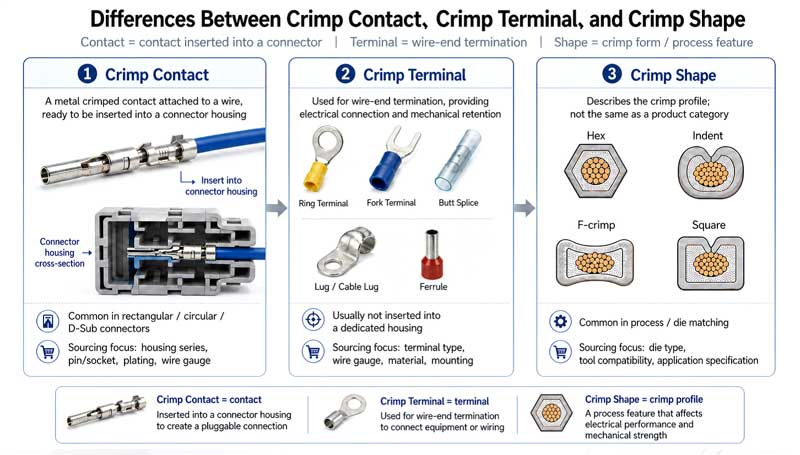
In electrical and connector applications, common crimps generally fall into three categories: crimp contacts, which are inserted into connector housings to form a mating contact system; crimp terminals, which usually refer to wire-end terminations such as ring terminals, fork terminals, butt splices, lugs, and ferrules; and crimp shapes, such as hex, indent, F-crimp, and square, which describe the crimp cross-section rather than a specific product category. For buyers, distinguishing among these three terms is more important than simply understanding the physical crimping action.
Crimp Contacts vs Crimp Terminals
In connector sourcing, crimp contact and crimp terminal are often used interchangeably, but their application positions and selection priorities are not the same.
A crimp contact generally refers to a metal contact that is first crimped onto a wire and then inserted into a connector housing. It is commonly used in systems such as rectangular connector housings, circular connectors, and D-Sub connectors. These parts usually do not complete a connection on their own, but instead function as part of a connector system. Therefore, when sourcing a crimp contact, buyers must look beyond wire gauge range and also confirm the matching housing series, contact size, pin or socket type, retention structure, and plating version.
A crimp terminal, by contrast, is more commonly used for wire-end termination and typically does not need to be inserted into a dedicated connector housing. Common forms include ring terminals, fork terminals, butt splices, lugs, and ferrules. These are often used in terminal block wiring, power connections, grounding connections, and wire splicing. For this category, sourcing priorities usually focus on wire gauge range, terminal structure, material, and mounting method rather than housing compatibility.
Another easy point of confusion is crimp shape. Terms such as hex, indent, F-crimp, square, and trapezoidal describe common crimp profiles the crimp profile or cross-section, not a product class. In other words, an F-crimp is not a type of terminal, and a hex crimp is not a type of contact; they are simply crimping forms used by different products.
Quick Crimp Term Reference
| Term | Meaning | Where buyers usually verify | Common sourcing risk |
|---|---|---|---|
| Crimp contact | A contact crimped onto a wire and then inserted into a connector housing | Datasheet, series specification, housing page | Choosing the wrong series, causing housing fit failure or unstable contact |
| Crimp terminal | A terminal used for wire-end termination | Datasheet, product catalog, MPN description | Mistaking a wire-end terminal for a connector contact |
| Crimp shape | Crimp cross-section shape, such as hex or F-crimp | Process documentation, tool instructions, application manuals | Treating crimp shape as the product type |
| Wire gauge | Supported wire size range, usually shown in AWG or mm² | Datasheet, part description | Out-of-range wire size leading to poor crimps |
| Conductor type | Conductor construction, such as solid wire, stranded wire, or tinned copper wire | Datasheet, cable specification | Mismatched conductor structure affecting crimp quality |
| Contact plating | Contact finish, such as tin or gold | Datasheet, series specification | Wrong plating choice affecting contact reliability |
| Housing compatibility | Compatible connector housing or series | Connector family specification | Similar appearance but incompatible series |
| MPN | Manufacturer part number | Manufacturer page, datasheet, distributor page | Incomplete quote model causing wrong-part purchasing |
Why Crimp Type Matters Before Ordering
Confirming crimp type before ordering is not just a terminology issue. It is fundamentally a matter of assembly feasibility, compatibility, and procurement accuracy.
The first item to confirm is wire gauge. Many crimp contacts and crimp terminals are only suitable for a specific wire size range. For example, one part may support only 22–24 AWG, while another may fit 18–20 AWG. If the wire specification falls outside the allowed range, the crimp barrel may not match, which can directly affect crimp quality and assembly stability.
The second item is conductor type. Solid wire, standard stranded wire, fine-stranded wire, and tinned copper wire do not perform identically in crimping. If the datasheet clearly limits conductor construction, buyers cannot focus only on wire size and ignore conductor type.
Next come terminal/contact material and contact plating. Material determines the base mechanical and electrical performance, while plating affects interface stability, corrosion resistance, and compatibility with mating parts. In connector contact sourcing in particular, tin plating, selective gold plating, and full gold plating differ significantly in both cost and application, and they usually cannot be treated as simple equivalents.
For crimp contacts, housing compatibility is also a critical checkpoint before ordering. Whether a contact can be inserted into a specified housing depends not only on size, but also on contact series, retention structure, contact size, and the corresponding cavity design. Many parts that look similar are not actually interchangeable.
When sourcing crimp contacts and crimp terminals, use the manufacturer part number as the baseline, verify the wire gauge range and compatible housing, and only then add the part to a BOM or submit it in an RFQ.
Pre-Order Sourcing Checklist
Before adding crimp contacts or crimp terminals to a BOM or RFQ, it is recommended to verify the following items one by one:
⦁ Confirm that the MPN is complete, including the series, specification, plating version, and packaging method.
⦁ Review the original datasheet rather than relying only on page titles or simplified parameter summaries.
⦁ Verify the wire gauge range and confirm that the wire specification matches the product.[1]
⦁ Check conductor type, including whether the application involves solid wire, stranded wire, or fine-stranded wire.
⦁ Confirm that the terminal/contact material meets the target application requirements.
⦁ Verify contact plating to avoid mating or life-cycle issues caused by plating differences.
⦁ For crimp contacts, confirm that housing compatibility fully matches the connector series.
⦁ Check whether recommended crimp process requirements are provided, such as recommended tools, crimp height, or inspection criteria.
⦁ When evaluating alternates, do not compare only size; compare wire range, plating, material, and series compatibility as well.
⦁ Before placing a final order, have engineering, purchasing, and processing teams confirm against the same datasheet.
Why Datasheets and MPNs Matter More Than “Similar Names”
In electronic component distribution, many purchasing errors do not come from choosing the wrong category altogether. They come from buying parts that have similar names but different actual specifications. This is especially common with crimp contacts, which often look very similar in appearance, even though actual usability is determined by details such as the following:
⦁ Whether the housing series is the same.
⦁ Whether the supported wire range is the same.
⦁ Whether the contact is a pin or a socket.
⦁ Whether the plating system is the same.
⦁ Whether the part supports automated crimping or a specific process.
⦁ Whether the part includes a sealing structure or insulation support design.
In connector sourcing, MPNs and datasheets are therefore the core basis for determining whether a part can be sourced, substituted, and assembled. For buyers, spending a few extra minutes verifying specifications up front is usually far more cost-effective than dealing with rework, wrong parts, or lead-time delays later.
Procurement Recommendation
If you are selecting crimp contacts or crimp terminals for a project, a more reliable approach is to confirm the MPN, review the datasheet, verify the wire gauge range, and check the compatible housing before adding the part to a BOM or RFQ.
On distributor platforms such as Unikeyic, buyers can review the datasheet first, verify availability, and then submit a BOM for cross-checking against project requirements. This helps reduce selection errors and provides a stronger basis for later alternate-part evaluation and volume purchasing decisions.
Main Types of Crimps Used in Electronics
In electronic component selection, wire harness design, and connector sourcing, crimp is not a single concept. It is a group of terms closely tied to wire termination, contact structure, and connector systems. For engineers and procurement teams, what matters is not simply whether a crimping action exists, but which crimp type is being used, what terminal or contact style it corresponds to, what wire gauge it supports, and whether it can mate correctly with the intended housing or mating connector.
If crimp is understood only as “compressing the wire,” it becomes easy to overlook the differences among open-barrel crimps, closed-barrel crimps, ferrules, and D-Sub crimp contacts during actual sourcing. By the time the part reaches BOM review, alternate evaluation, or RFQ submission, those differences can directly affect assembly compatibility, rating alignment, and long-term maintenance risk.
How do various crimp types differ in application?
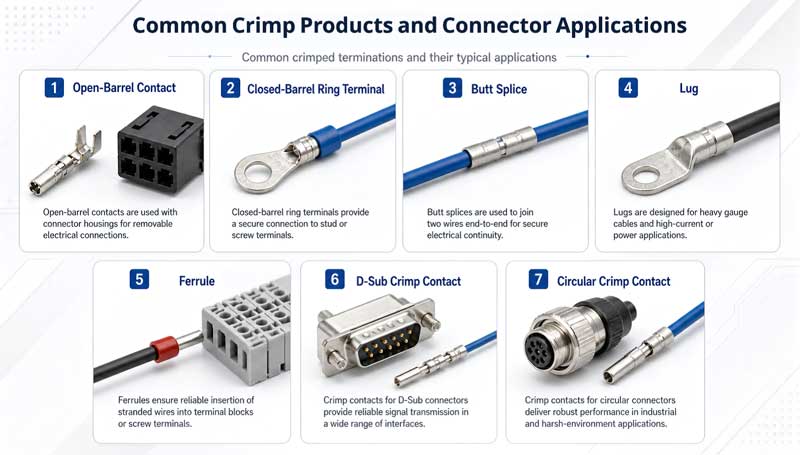
The core difference among crimp types is the connection structure they serve. Open-barrel crimps are common in connector contacts and wire harness signal contacts, especially where the contact must be inserted into a housing. Closed-barrel crimps are more common in wire-end terminations such as ring terminals, butt splices, and lugs. Ferrules are mainly used for stranded wires going into terminal blocks. D-Sub and circular crimp contacts are part of specific interface systems and must match the corresponding shell, insert, housing, or contact series. In other words, differences among crimp types are not just visual; they also determine which datasheet checkpoints matter and what sourcing path should be used.
Open-Barrel and Closed-Barrel Crimps
F-crimp is a common type of open-barrel crimp profile, and it is widely used in electronics and wire harness connector types applications. It is typically used for connector contacts, especially in automotive harnesses, industrial signal harnesses, and rectangular connector contacts that must be crimped onto a wire and then inserted into a housing. Its typical structure supports both the conductor and the insulation separately. For that reason, buyers must confirm not just the contact appearance, but also wire gauge range, contact style, plating, termination style, and whether the part matches the specified connector housing.
A closed-barrel crimp is more common in wire-end termination products such as ring terminals, butt splices, and lugs. Compared with open-barrel structures, its crimp barrel is closed and is often used in power wiring, grounding, or wire splicing. For this category, the most important datasheet fields often include conductor size, barrel size, current rating, voltage rating, terminal material, and insulation type. In essence, open-barrel structures are more closely associated with contacts inside connector systems, while closed-barrel structures are more closely associated with standalone wire-end terminations.
Ring, Fork, Spade, Butt Splice, Lug, and Ferrule Crimps
Among common wire-end terminals, ring, fork, spade, butt splice, lug, and ferrule products do not follow the same sourcing logic. Ring, fork, and spade terminals are mainly used for screw-type or stud-type connections, so buyers should focus on hole size, terminal width, wire range, and whether an insulation sleeve is present. Butt splices are used for joining two wires in the middle, so conductor range, insulation form, and installation environment matter more. Lugs are commonly used with larger conductor cross-sections or higher-current paths, so buyers should also check material, barrel size, and mounting hole dimensions.
Ferrules are a particularly important crimp category in electronic control cabinets and terminal block applications. They are mainly used for stranded wires going into terminal blocks and can help reduce strand splaying, messy terminations, and unstable clamping. During selection, buyers should focus on ferrule length, supported wire size, whether an insulation collar is included, and whether the ferrule fits the clamping structure of the target terminal. For insulated crimp terminals and non-insulated crimps, decisions should be based on insulation type, wire gauge, housing clearance, heat shrink compatibility, and the application environment. Insulated versions are usually used for basic insulation protection and strain relief, while non-insulated versions are more common in space-constrained applications, after-installation heat shrink processes, or specific assembly workflows.
Crimp Types and Sourcing Notes
| Crimp type | Typical component | Common application | Key datasheet checks | Related Unikey category |
|---|---|---|---|---|
| Open-barrel / F-crimp | Connector contact | Wire harness, signal contacts | Wire gauge, contact style, plating, housing compatibility | Rectangular Connector Contacts |
| Closed-barrel | Ring terminal, butt splice, lug | Wire-end termination, power wiring | Barrel size, conductor range, current/voltage rating, material | Terminals / Wire Termination |
| Insulated crimp | Insulated ring/fork/spade terminal | Field wiring, basic insulation protection | Insulation type, wire range, terminal style | Insulated Terminals |
| Non-insulated crimp | Non-insulated terminal/contact | Space-constrained applications, follow-up heat shrink | Material, plating, termination style | Non-Insulated Terminals |
| Ferrule | Wire ferrule | Stranded wire into terminal blocks | Wire size, ferrule length, insulation collar | Ferrules |
| D-Sub / circular crimp contact | Interface contact | Signal and industrial interface systems | Contact series, shell/insert match, mating connector | D-Sub Connectors / Circular Connectors |
Connector Contacts for Housings and Interfaces
Once the discussion moves into connector sourcing, the focus of crimp is no longer just terminal form. It becomes a matter of how the complete connector system fits together. Rectangular connector contacts are often used in board-to-wire, wire-to-wire, and industrial control harnesses. When sourcing them, buyers must confirm not only wire gauge, but also compatible housing, contact series, pin or socket type, contact plating, and the matching mating connector. This step is especially critical for open-barrel crimp contacts, because many contacts that appear similar cannot actually share the same housing.
The selection logic for D-Sub crimp contacts and circular crimp contacts is even stricter. These products typically serve specific interface systems and must match the shell, insert arrangement, contact size, and defined series. Procurement teams should not search for these parts using a broad keyword such as “crimp contact” alone. They should verify manufacturer, MPN, housing family, and mating interface together. For this reason, open-barrel crimp contacts are better associated with Rectangular Connector Contacts, while contacts plus housings align more naturally with Rectangular Connector Housings, and industrial cable or signal/control interfaces extend more naturally to Circular Connectors and D-Sub Connectors.
When Non-Insulated Crimps Make Sense
In many electronics and industrial applications, a non-insulated crimp is actually the more appropriate choice. One typical scenario is limited space, such as inside a connector, within a compact terminal area, or in a harness design with strict outer-diameter control. Another common scenario is when the system already includes follow-up protection, such as heat shrink, a protective sleeve, shielding wrap, or system-level insulation, in which case the presence of a built-in sleeve on the terminal is not the only priority.
Some assembly processes also prefer non-insulated structures because they are easier to overwrap, visually inspect, or integrate into a specific process flow. For buyers, the key is not simply whether the part has insulation. The real checkpoints are terminal type, wire gauge, heat shrink compatibility, contact plating, operating temperature, housing clearance, and application environment. Non-insulated does not automatically mean unsafe, and insulated does not automatically mean better. Actual suitability is still determined by the specific datasheet, assembly process, and equipment environment.
Items to Confirm Before Ordering:
⦁ Confirm whether the part is an insulated crimp or a non-insulated crimp, rather than judging only by color or appearance.
⦁ Review the insulation material, sleeve/collar structure, and wire range in the datasheet.
⦁ Verify that the wire gauge matches the actual wire specification.
⦁ Confirm that current rating, voltage rating, and operating temperature meet the application requirements.
⦁ Check housing clearance, especially in connectors or compact terminal spaces.
⦁ If a non-insulated option is used, confirm whether a compatible heat shrink solution is required.
⦁ Check whether contact plating matches the target environment.
⦁ State clearly in the RFQ whether insulated, non-insulated, or a follow-up heat shrink protection option is required.
In actual sourcing, a more reliable approach is to search by manufacturer part number or MPN first, then compare insulation material, wire range, temperature rating, and contact plating using the datasheet, and only then move into the RFQ stage. For projects that need to distinguish among insulated, non-insulated, and heat shrink compatibility options, this process supports better specification comparison and reduces later assembly and alternate-part errors.
Crimp Shapes, Tools, and Contact Compatibility
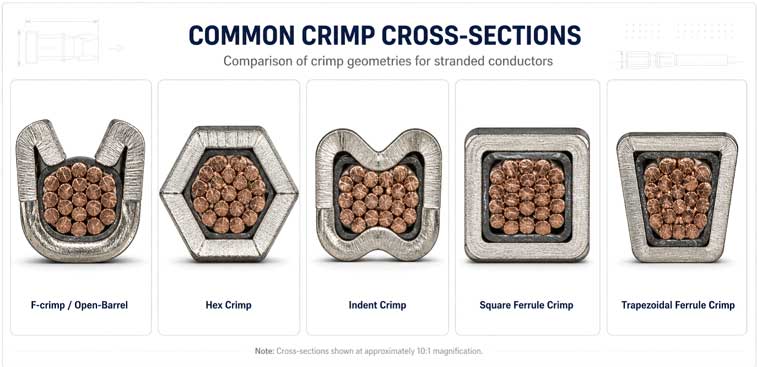
In connector sourcing and wire harness applications, many people confuse crimp type with crimp shape. In reality, crimp type refers more to the product category, such as a crimp contact, terminal, or ferrule. Crimp shape refers to the geometry after crimping, such as F-crimp, hex, indent, square, or trapezoidal. This distinction matters because when sourcing crimp contacts, stable assembly and inspection results are often determined not by the appearance of the terminal itself, but by whether it matches the specified tool, die, wire gauge, and contact series.
Pre-Order Review Checklist
⦁ Confirm that the manufacturer and MPN are complete, rather than ordering based only on a series name or generic description.
⦁ Verify the crimp type and terminal/contact style to determine whether the part is a wire-end terminal or a connector contact.
⦁ Check the wire gauge range, and if needed confirm that AWG and mm² markings are consistent.
⦁ Review current rating and voltage rating, but interpret them in the context of the original datasheet and the actual system application.
⦁ Confirm contact material, terminal material, and contact plating to avoid conductivity or environmental mismatches caused by material differences.
⦁ For insulated crimp terminals, verify insulation type; for non-insulated options, confirm whether follow-up heat shrink or a protective sleeve is required.
⦁ For connector contacts, compatible housing, mating connector, mounting/termination style, and contact series must all be checked.
⦁ Alternate part evaluation must not rely only on appearance or category name; the datasheet, interface system, and critical dimensions must also be compared.
In actual purchasing workflows, a more reliable approach is to review the datasheet by MPN first, then browse related products and check current stock, and submit the RFQ only after key parameters have been confirmed. For projects involving crimp contacts, terminals, housings, and interface connectors at the same time, a datasheet-centered sourcing path usually supports better collaboration between engineering and purchasing than a simple category-name search.
Insulated vs Non-Insulated Crimps
The difference between insulated and non-insulated crimps should not be reduced to whether there is “a plastic outer sleeve.” When sourcing crimp terminals or crimp contacts, this distinction affects insulation material, sleeve/collar structure, housing clearance, heat shrink compatibility, operating temperature, current/voltage rating, and the real application environment. Insulated crimps are typically used where basic insulation protection, reduced short-circuit risk, or some degree of strain relief is needed. Non-insulated crimps are more often used in space-constrained designs, applications requiring follow-up heat shrink, shielding processes, or specific assembly flows. Regardless of which one is chosen, buyers should always return to the datasheet and application specification to verify wire gauge, terminal type, contact resistance, ratings, and installation limits.
How do insulated and non-insulated crimps differ in performance?
Insulated crimps typically include a plastic sleeve or insulation collar. Their main value is that they provide basic insulation protection, reduce short-circuit risk between adjacent conductors or metal structures, and improve strain relief to some extent. However, insulated does not automatically mean “higher rated” or “more reliable.” Buyers still need to confirm insulation material, wire gauge, terminal type, current rating, voltage rating, operating temperature, and housing clearance. If the application involves vibration, moisture, nearby heat sources, or tight space limits, the insulation sleeve must also be checked to ensure that it does not interfere with assembly clearance, bend radius, or later maintenance.
Insulated vs Non-Insulated Crimps Comparison
| Feature | Insulated crimp | Non-insulated crimp | Procurement note |
| Basic structure | Includes a plastic sleeve or insulation collar | No external insulation sleeve | Confirm terminal type and installation space first |
| Insulation method | Provides basic insulation protection | Relies on follow-up heat shrink or system-level protection | Check insulation material or the post-processing plan |
| Strain relief | Usually more direct | Depends on terminal structure and follow-up process | Do not judge only by appearance |
| Space usage | Usually larger | Usually more compact | Verify housing clearance |
| Follow-up processing | More convenient as an integrated option | Better for customized overwrap, shielding, or heat shrink | Confirm the assembly process |
| Key sourcing focus | Wire range, temperature rating, sleeve material | Heat shrink compatibility, plating, space | Always use the datasheet as the final reference |
What tools are required for different types of crimps?
Different types of crimps usually require different crimping tools and dies. At the sourcing stage, the main concern is not choosing a certain tool brand, but confirming whether tool compatibility, die type, wire gauge range, and contact series match the datasheet or manufacturer application specification. Open-barrel contacts commonly use F-crimp structures. Ferrules often use square or trapezoidal crimp forms. Some closed-barrel contacts may correspond to hex or indent options. Recommended tooling, quality inspection criteria, and the related contact series should be verified first.
Hex, Indent, F-Crimp, Square, and Trapezoidal Shapes
Common crimp shapes are essentially descriptions of crimp cross-sections or crimp profiles, not names of major product categories. F-crimp is also commonly called open-barrel crimp and is often used for connector contacts, especially in wire harnesses, rectangular connector contacts, automotive applications, and industrial signal harnesses. It usually acts on both the conductor area and the insulation support area, so buyers should check wire gauge, contact style, plating, and contact series together.
Hex crimp is more often used for lugs, larger terminals, and power connections. Indent crimp is common in some closed-barrel contacts. Square and trapezoidal crimps are more common in ferrules or terminal block wiring applications. It is important to note that similar shapes do not mean parts are interchangeable. Even if two contacts look similar, different die forms, crimp windows, or series definitions can lead to pull-out force and contact resistance that fail to meet the design requirement.
Crimp Shape and Tool Matching Checklist
| Crimp shape | Typical contact or terminal | Tooling check | Datasheet field to verify |
| F-crimp / open-barrel | Connector contact | Whether an open-barrel die is required | Wire gauge, contact series, application specification |
| Hex | Lug, larger terminal | Whether a hex die matches | Conductor size, tooling recommendation |
| Indent | Some closed-barrel contacts | Whether a specific indent tool is required | Contact style, inspection criteria |
| Square | Ferrule | Whether the ferrule crimp tool is appropriate | Ferrule size, wire range |
| Trapezoidal | Ferrule / terminal block termination | Whether a specific die form is required | Terminal block application, wire gauge |
Matching Tool, Die, Wire Gauge, and Contact Series
When sourcing crimp contacts, buyers cannot rely only on terminal appearance or product images. More important is whether the die type matches the crimp shape, whether the wire gauge falls within the datasheet range, and whether the contact series matches the housing system. Many contact problems are not caused by a completely wrong model number. They come from wire size deviation, mismatched die contours, or contact series that do not fit the compatible housing, eventually causing abnormal crimp height, poor wire retention, or higher-than-expected contact resistance.
Before ordering, it is recommended to focus on the following items:
⦁ Confirm whether the datasheet or application specification lists recommended tooling.
⦁ Verify that the die type matches the crimp shape, rather than assuming hex, F-crimp, and square forms are interchangeable.
⦁ Check the wire gauge range and confirm that the conductor construction meets the requirement.
⦁ Verify contact series, compatible housing, and mating interface.
⦁ Check whether pull-out force requirement, contact resistance, and quality inspection criteria are given.
⦁ When evaluating alternates, compare not just appearance but also series, crimp form, and process requirements.
In actual sourcing, a more reliable method is to confirm recommended tooling, compatible housing, and wire gauge range using the MPN, datasheet, and application specification first, and then compare specifications, verify availability, and submit a quote request based on project needs. For BOM and RFQ workflows processed through distributors such as Unikeyic, this path is more practical for engineering verification and pre-production specification confirmation.
How to Choose Crimps for BOM and RFQ Sourcing
In electronic component procurement, crimp is not a generic small part that can be judged by appearance alone. For connector contacts, wire-end terminals, and matching housings, whether a part can be ordered, assembled, and substituted is usually determined not by whether it “looks similar,” but by whether the MPN, datasheet, wire gauge, contact type, housing compatibility, and electrical rating all match.
The core of choosing crimps for BOM and RFQ sourcing is therefore not finding a single “best” crimp, but turning technical identification into an executable procurement process: confirm the original part number first, review the datasheet next, verify the mating system, and then bring complete information into the BOM and RFQ. The purpose is to avoid ordering the wrong contact, terminal, or housing, or evaluating alternates only by shape, color, or broad category name.
Datasheet Specs Buyers Should Confirm
Before entering the RFQ stage, the first priority should not be price but the datasheet. For crimp contacts and crimp terminals, buyers should at least verify the following fields: MPN, manufacturer, wire gauge / AWG / mm², contact type, contact gender (pin/socket), compatible housing, current rating, voltage rating, contact plating, and operating temperature. These details affect not only assembly fit, but also contact reliability, environmental suitability, and future alternate-part flexibility.
For rectangular connector contacts, compatible housing often matters more than appearance. Many contacts look similar in size, but if contact series, retention structure, or pin/socket type do not match, they may not fit the intended housing at all. For terminal products, special attention should be paid to wire gauge, current rating, plating, and operating temperature range, because these directly affect wire match and application limits.
Which crimp type is best for securing wires?
There is no “best crimp type” for all scenarios. The right choice depends on wire gauge, terminal/contact design, housing compatibility, tooling, electrical ratings, and the application environment. For connector contacts, the priority is confirming that the contact series matches the housing system. For terminals such as ring, fork, and butt splice products, the priority should be wire range, ratings, and the installation interface rather than the product name alone.
BOM/RFQ Checklist for Crimp Contacts and Terminals
| RFQ field | Why it matters | Example input | Risk if missing |
| MPN | Confirms the exact part number and version | ABC1234-01 | Easy to quote the wrong series or plating version |
| Manufacturer | Prevents confusion with similar part numbers from different brands | TE Connectivity | Mistaking a similar part for an equivalent |
| Quantity | Affects quote, MOQ, and packaging | 5,000 pcs | SPQ or price break cannot be judged |
| Crimp type | Distinguishes contact, terminal, and ferrule | Open-barrel contact | Incorrect product category selection |
| Wire gauge | Confirms supported wire size range | 22–24 AWG | Crimp barrel mismatch |
| Contact gender | Distinguishes pin vs. socket | Socket | Wrong mating orientation |
| Housing series | Determines whether the contact can fit the housing | Series X housing | Contact and housing incompatibility |
| Plating | Affects interface performance and environmental suitability | Tin / Gold | Distorted alternate comparison or wrong life expectation |
| Ratings | Confirms current and voltage limits | 5 A / 250 V | Application parameters not met |
| Compliance | Meets project and regional requirements | RoHS / REACH | Incomplete compliance documentation |
| Acceptable alternatives | Defines alternate boundaries | Same housing series only | Wrong substitution causing rework |
RFQ Fields That Prevent Wrong Crimp Parts
A high-quality RFQ does more than generate a quote. More importantly, it reduces wrong-part risk. In actual procurement, the recommended sequence is to search the original model by manufacturer part number first, review the datasheet second, confirm the mating/housing system third, and submit the RFQ or BOM last. This sequence may sound basic, but many sourcing errors occur precisely when the first and third steps are skipped.
When submitting an RFQ, buyers should provide complete information instead of vague descriptions. At a minimum, this should include quantity, manufacturer, MPN, crimp type, wire gauge, contact gender (pin/socket), housing series, plating, current rating, voltage rating, operating temperature, acceptable alternatives, lead time requirement, and RoHS/REACH documentation if the project requires it. If these fields are missing, the supplier may not be able to determine whether the request is for the original model, a contact compatible with a certain housing, or only a same-category terminal.
For B2B projects, special attention should be paid to multi-part linkage within the same connector system when submitting a BOM. For example, rectangular connector contacts often need to be checked together with specific housings. If only the contact is described and the housing series is omitted, the result may be a quotable part that still cannot be assembled.
Comparing Alternative Crimp Contacts
When comparing alternative crimp contacts, the most common mistake is to focus only on appearance, color, or crimp shape. What should really be compared is the MPN, manufacturer, wire gauge range, contact gender, pin/socket type, compatible housing, contact plating, current rating, voltage rating, operating temperature, and whether the part remains consistent with the original mating connector system. Only when these key conditions are similar does substitution become a realistic discussion.
At the procurement level, MOQ/SPQ, stock availability, unit price/volume pricing, and lead time confirmation must also be compared. However, those commercial factors should be evaluated only after technical compatibility has already been established, not the other way around. For crimp contacts, the cost of a wrong alternate often does not appear at the quote stage. It appears later in failed housing insertion, harness rework, field replacement, or reliability risk.
Detailed Checklist Before Ordering:
⦁ Search by MPN first, rather than by generic product names alone.
⦁ Open and read the datasheet instead of relying only on titles or simplified parameter summaries.
⦁ Verify wire gauge / AWG / mm² and confirm the actual wire specification.
⦁ Determine whether the part is a contact or a terminal, and identify the exact crimp type.
⦁ Check contact gender and confirm whether the part is a pin or a socket.
⦁ Confirm compatible housing and the mating system, especially for rectangular connector contacts.
⦁ Verify current rating, voltage rating, and operating temperature.
⦁ Confirm that contact plating matches the project’s application requirements.
⦁ If alternates are acceptable, compare specifications first and only then compare price and lead time.
⦁ Before submitting the RFQ, complete the quantity, lead time, compliance, and acceptable-alternative fields.
In actual sourcing, a more reliable path is to view the datasheet first, then check current stock or availability, and request a quote or submit the BOM only after key parameters are confirmed. If the project involves housing compatibility, alternate-part judgment, or series matching, the full specification should be defined before inquiry so that distributors such as Unikeyic can verify the request against the MPN, datasheet, and acceptable alternate limits.
Unikeyic supports connector and crimp component sourcing with extensive inventory coverage, verified specifications, and supply chain support for engineers and procurement teams.
Reliability Checks for Crimped Connections
In connector selection, wire harness design, and electronic component procurement, a reliable crimped connection is never just about “choosing the right terminal.” It also depends on whether wire gauge, contact or terminal, tooling, conductor preparation, crimp location, contact plating, insulation support, environmental protection, housing retention, and strain relief all match one another. If any one of these elements is mismatched, the part number may still be correct while contact instability, poor wire retention, abnormal temperature rise, or degraded environmental performance develops later.
That is why discussions about crimp reliability should not focus on “which crimp is strongest.” They should return to the datasheet, the manufacturer application specification, the actual environment, and the inspection requirement. For procurement and engineering teams, the most valuable step is to define vibration, corrosion, moisture, temperature, retention, and sealing needs before ordering, rather than waiting until assembly issues or field failures force rework.
Vibration, Corrosion, Moisture, and Temperature
The long-term reliability of a crimped connection depends first on the environment it must face. Vibration continuously tests wire retention, housing retention, and strain relief. If the wire size is mismatched or support is insufficient, a contact may pass initial continuity checks but later develop mechanical fatigue or unstable contact under long-term vibration. Corrosion is more strongly related to contact plating, exposed conductor interfaces, and environmental contamination. In industrial sites, outdoor equipment, or damp conditions, plating and sealing structures often matter more than appearance.
Moisture risk usually cannot be judged from the terminal body alone. Buyers also need to confirm whether sealing, heat shrink, or another form of environmental protection is present. Operating temperature cannot be judged by a single number in a catalog title either. It must be evaluated together with current load, insulation material, and the actual installation environment.
Which crimp types provide the best resistance to vibration and corrosion?
No crimp type can be defined as “best for vibration” or “best for corrosion” without reference to the application. Open-barrel contacts with appropriate insulation support, connector systems with sealing structures, suitable contact plating, and heat shrink or environmental seals may be more relevant in certain applications, but the final decision must still be based on the datasheet, application specification, and actual environmental requirements.
Crimp Reliability Review Checklist
| Risk | What to check | Datasheet or RFQ note |
| Vibration | Wire retention, housing retention, strain relief | State whether continuous vibration or shock is present |
| Moisture | Sealing, heat shrink, environmental protection | Indicate whether the environment is outdoor, damp, or condensation-prone |
| Corrosion | Contact plating, material match, exposed interfaces | Indicate salt spray, contaminants, or corrosive gas if relevant |
| Wire pull-out | Pull-out force, wire gauge, crimp location | Specify wire size and retention requirement clearly |
| Overheating | Contact resistance, current load, operating temperature | Describe current load and thermal environment |
| Wrong housing | Compatible housing, contact series, retention feature | State the housing system clearly in the RFQ |
| Wrong wire gauge | AWG / mm², conductor type | Avoid vague phrases such as “suitable wire” |
Quality Checks Without Turning This Into a How-To Guide
Reliability checks for crimped connections do not need to become a full operation manual, but they do need to focus on several key points. First, the conductor, contact, and tool must match. If the wire size is wrong, crimping pressure may become unbalanced, which can affect both contact resistance and wire retention. Second, the focus of inspection should be on the result rather than the motion itself, such as pull-out force, the wire retention condition, whether the crimp location is correct, whether insulation support is adequate, and whether housing retention meets system requirements. Third, no environmental suitability judgment should be made without referring to the manufacturer application specification.
What are the best practices for ensuring a reliable crimp connection?
The most practical way to ensure a reliable crimp connection is not to look for a “universal terminal.” It is to confirm that wire specification, contact or terminal, tooling, crimp location, plating, insulation support, and environmental protection all match one another. For procurement and engineering teams, the more useful action is to review the datasheet and manufacturer application specification, confirm the inspection requirement, and clearly state vibration, moisture, temperature range, outdoor exposure, industrial equipment, and similar application conditions in the RFQ, rather than judging only by product appearance or category name.
Reliability Information to Add Before Ordering
⦁ State whether the application involves vibration, shock, moisture, condensation, or outdoor exposure.
⦁ Specify the operating temperature range rather than writing only “room temperature” or “industrial environment.”
⦁ Define the wire specification clearly, including AWG/mm² and conductor type.
⦁ Confirm contact plating, sealing needs, and whether heat shrink is required.
⦁ For connector contacts, add the housing system and retention requirement.
⦁ Include the inspection requirement in the RFQ instead of sending only a part number with no operating context.
In actual sourcing, a more reliable process is to review the datasheet and manufacturer application specification first, compare specifications against the project environment, and request a quote only after key parameters are confirmed. For projects involving industrial equipment, damp conditions, or long-term vibration, the earlier reliability requirements are written into the RFQ, the more effectively wrong-part risk and application risk can be reduced later.
FAQ: Types of Crimps for Electronics Buyers
In electronic component procurement, crimp-related questions usually go beyond “what is this terminal called.” For buyers, what matters more is evaluating crimp type, wire gauge, crimp contact / crimp terminal, compatible housing, datasheet, MPN, and RFQ details together. The following FAQ set can be used to address common search-driven questions.
Q1: What are the different types of crimps used in electrical work?
In electronics sourcing, common crimp types include crimp contacts, crimp terminals, ferrules, and structures such as open-barrel, closed-barrel, insulated, and non-insulated crimps. Different types correspond to different wire gauges, tooling requirements, and application interfaces, so buyers should verify the datasheet and MPN before ordering.
Q2: How do various crimp types differ in application?
Crimp contacts are usually used in connector housings, crimp terminals are more common for wire-end termination, and ferrules are often used when stranded wire enters a terminal block. These application differences should not be judged by appearance alone, but by electrical rating, environmental rating, and housing compatibility as well.
Q3: What tools are required for different types of crimps?
Different crimp types typically require different tooling and dies, but buyers should not focus only on the tool name. More importantly, they should confirm that the tooling matches the wire gauge, contact series, and manufacturer application specification.
Q4: How do insulated and non-insulated crimps differ in performance?
Insulated crimps are usually used where basic insulation protection and some degree of strain relief are needed. Non-insulated crimps are more common in space-constrained applications or where follow-up heat shrink will be added. Selection should also consider operating temperature, insulation structure, housing clearance, and installation space.
Q5: What are the best practices for ensuring a reliable crimp connection?
There is no single “best practice” that applies outside the application context. A more reliable method is to confirm wire gauge, contact or terminal type, tooling, plating, housing retention, and environmental conditions, and then define the key application requirements in the RFQ.
For connector sourcing, buyers can use Unikeyic to review datasheets, compatible parts, and RFQ details by MPN.