




A compact reference design helps engineers implement USB Type-C Power Delivery with autonomous sink control, configurable power profiles, and input protection for up to 100 W applications.
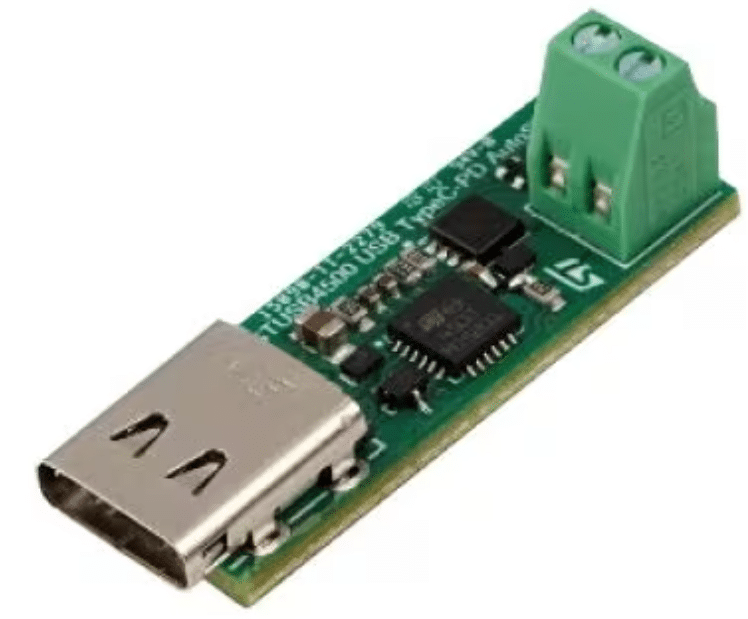
The STREF-SCS001V1 reference design from STMicroelectronics provides design engineers with a compact starting point for adding a USB Type-C Power Delivery (USB PD) sink interface to equipment that traditionally relies on a DC barrel connector. The design is intended to simplify migration to USB Type-C while supporting power delivery for applications requiring up to 100 W, with a maximum operating point of 20 V at 5 A. It is built around the STUSB4500QTR standalone USB PD sink controller, which handles USB PD negotiation without requiring a dedicated microcontroller.
At the core of the design, the STUSB4500 manages the Type-C port and negotiates an appropriate power profile with the connected USB PD source. The reference design is therefore useful when engineers need to replace a conventional DC input with a USB Type-C interface while retaining controlled power negotiation. The design can operate as a USB PD sink and is configured to request predefined power profiles from the source. The associated documentation describes default profiles of 5 V/1.5 A, 15 V/1.5 A and 20 V/1.0 A, with the 20 V/1.0 A profile given the highest priority in the reference configuration.
Protection is another important aspect for designers working on Type-C power inputs. It incorporates short-to-VBUS protection rated up to 28 V, helping protect the input circuitry against abnormal connection conditions. The design also includes a status LED for indicating the operating power condition, providing a straightforward visual indication during development, evaluation and debugging. These features allow engineers to examine both the power-negotiation behaviour and protection implementation before adapting the circuit to a product-specific PCB.
The design can also reduce development effort by providing a tested architectural example for Type-C power input implementation. Rather than developing the USB PD sink circuitry from the ground up, engineers can use the schematic and layout resources as a baseline and adapt component selection, connector placement, power-path design and mechanical dimensions to their application requirements. ST also lists EVAL-SCS001V1 as the corresponding evaluation board based on the STUSB4500QTR, providing an industrialised version of the reference platform.
Overall, the design is useful as a practical design reference for engineers moving from barrel-jack power inputs to USB Type-C. Its combination of autonomous USB PD sink control, configurable power negotiation, short-to-VBUS protection, compact implementation and available PCB-design resources provides a straightforward foundation for developing USB Type-C-powered products.
For hardware development, ST provides the design resources needed to reproduce or modify the reference implementation. It includes the schematic pack, bill of materials, Gerber manufacturing files and an Altium library. This gives engineers access not only to the functional circuit but also to PCB-design information that can be used as a starting point for a customised implementation. The reference design is particularly relevant for engineers developing embedded equipment, consumer electronics, industrial devices, accessories and other products where a USB Type-C power input can replace a dedicated DC power connector.

