




Researchers have developed an ultrathin semiconductor that can be repeatedly programmed, erased and reconfigured with light, pointing towards more adaptable electronic devices in the future.
Researchers at Princeton Engineering have developed an ultrathin semiconductor material that can repeatedly change its electronic and optical properties when exposed to light. The few-molecules-thick material could support more adaptable sensors, optoelectronic devices and future computing technologies.
Unlike conventional semiconductors, whose properties are largely fixed after manufacturing, the new material responds dynamically to different wavelengths of light. This allows its conductivity and optical response to be programmed, erased and reprogrammed, potentially enabling electronic functionality to be changed after fabrication.
The researchers combined a superthin semiconductor with light-responsive molecules that alter their structure when exposed to different wavelengths. These changes modify the semiconductor’s electronic properties, providing a way to control its behaviour without permanently fixing it during manufacturing.
The work addresses a long-standing challenge in electronics, where continued miniaturisation has made further improvements increasingly difficult. Rather than relying solely on making semiconductor devices smaller, researchers are exploring materials that can provide greater adaptability and functionality.
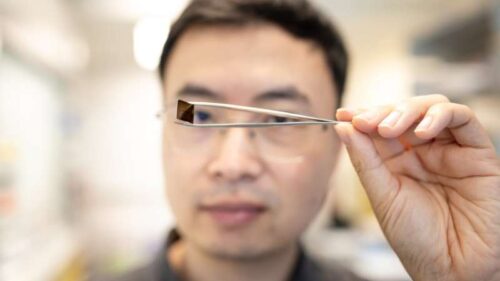
The team has produced a uniform piece of the semiconductor measuring about one inch square. Using the material, researchers have built arrays of programmable electronic switches, representing a step towards larger integrated systems.
The approach could eventually allow electronic devices to be dynamically reconfigured after they are manufactured. The researchers are also working to connect the programmable switches into circuits, which could provide a fundamental building block for more complex electronic systems.
The research therefore points towards a different approach to electronics: creating devices whose properties are not permanently determined during fabrication. By using light as a programming mechanism, the material could offer a route towards electronics that are more flexible and responsive to changing requirements.

