

Researchers have developed a durable flexible photodetector that improves near-infrared response after bending, potentially supporting wearable sensors, healthcare and future optoelectronic systems.
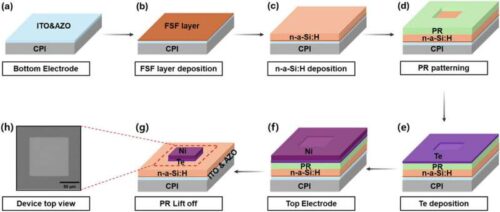
A research team at the Korea Institute of Materials Science (KIMS) has developed a flexible near-infrared photodetector designed to improve performance after repeated bending. The device, based on a hydrogenated amorphous silicon structure, reportedly achieved about a 5.1-fold increase in photoresponsivity and a 2.6-fold improvement in detectivity compared with a conventional structure.

The photodetector also maintained more than 90% of its initial photoresponsivity after 4,000 bending cycles, demonstrating mechanical durability for flexible-device applications. It can detect light across a broad wavelength range from 400 to 1,600 nanometres, widening its potential uses.
The researchers focused on controlling material quality and the internal electric-field structure rather than introducing a new light-absorbing material or substantially modifying the photoreactive layer. This approach is intended to improve performance without adding complex fabrication processes, potentially helping to reduce manufacturing costs and support future commercialisation.
The device uses a heterojunction structure involving hydrogenated amorphous silicon, phosphorus-doped amorphous silicon and an electron-transport layer. The team also introduced a front-surface-field layer between the transparent electrode and the n-a-Si:H layer. This electric-field structure helps guide photogenerated carriers towards the electrode while suppressing electron-hole recombination, reducing electrical signal losses.
The work is aimed at flexible optoelectronic applications where mechanical durability is important. Because the semiconductor structure is compatible with conventional CMOS manufacturing processes, the researchers say it could be suitable for large-area fabrication on flexible substrates.
Potential applications include wearable healthcare devices, medical diagnostic sensors, optical communication receivers, and image sensors for autonomous vehicles and robots. The researchers expect the technology to contribute to next-generation flexible optoelectronic platforms combining large-area manufacturing with low-power operation.