

Zhejiang University researchers have created graphene fibres that combine exceptional strength with thermal conductivity of up to 1,720 W/m·K.
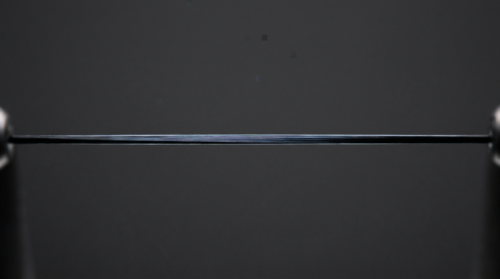
A research team at Zhejiang University in Hangzhou has reported graphene fibres that combine high strength with high thermal conductivity. The study was carried out by researchers including Senping Liu, Jinhe Wang and Yiwei Zhang, with Peng Li, Dingyi Pan, Chao Gao and Zhen Xu serving as corresponding authors. Graphene fibres have traditionally involved a trade-off: fibres optimised for strength often conduct heat poorly, while those designed for high thermal conductivity can be more prone to breaking.

The method is called ultrahigh-ratio drawing during wet spinning. Two-dimensional graphene oxide sheets behave like a polymer melt when suspended in a viscous solvent, allowing the team to draw the forming fibre by up to eleven times its original length. This stretching aligns the graphene sheets along the fibre axis, while a subsequent high-temperature annealing step removes structural defects. The alignment is central to the result: heat travels through graphene as lattice vibrations called phonons, and misaligned sheets scatter these vibrations at their boundaries. Straightening and aligning the sheets reduces that scattering, allowing heat to travel more efficiently through the fibre.
The fibres achieve a thermal conductivity of up to 1,720 watts per metre per kelvin (W m⁻¹ K⁻¹), alongside a tensile strength of 5.9 gigapascals (GPa) and a Young’s modulus of 963 GPa. They also reach an electrical conductivity of 1.3 megasiemens per metre, combining mechanical strength, stiffness, electrical conductivity and heat transport in a single fibre.
Copper, the default heat spreader in electronics, has a thermal conductivity of roughly 400 W m⁻¹ K⁻¹, while aluminium is around 237 W m⁻¹ K⁻¹. The reported graphene fibre therefore conducts heat about four times better than copper while being far lighter. Commercial graphite heat-spreader sheets can reach thermal conductivities from several hundred to around 1,500 W m⁻¹ K⁻¹ in the in-plane direction, but they are designed primarily for heat spreading rather than carrying mechanical loads. By comparison, commercial high-performance carbon fibres typically offer tensile strengths in the 3.5-7 GPa range, depending on the grade.

This is a laboratory-scale result, with the paper reporting controlled synthesis and characterisation rather than a pilot production line. According to the team, the combination of properties comes from the polymer-like viscoelastic behaviour of two-dimensional sheets in viscous solvents. Wet spinning is, in principle, a continuous manufacturing process, which makes scale-up worth considering, but it does not guarantee commercial production. The high-temperature annealing step is also energy-intensive and could become a major cost factor. Engineers designing thermal systems should also note what the fibre does not solve: it transports heat efficiently along its length but does not eliminate thermal resistance across joints. Interface resistance between the fibre and a semiconductor die or heat sink would still remain a critical limitation in real assemblies.
Thermal management is becoming an increasingly important constraint for Indian electronics, particularly in high-temperature environments where ambient temperatures above 40°C can derate power supplies, affect lithium-ion battery performance and increase cooling requirements in data centres and battery energy storage systems. A lightweight, flexible material that can transport heat at up to four times the thermal conductivity of copper could be particularly useful where conventional heat sinks cannot simply be made larger, including two-wheeler chargers, rooftop solar inverters and telecom equipment cabinets. Indian researchers are already addressing the same challenge from the system side: IIT Gandhinagar has received support for indigenous cooling technologies targeting electric vehicles and AI data centres, while IIT Madras researchers have published work on pulsating heat pipes. Graphene fibre represents a materials-side approach to the same problem. Commercial availability of graphene fibres with the combination of thermal and mechanical performance reported in this study is not yet widely established in India, while no specific Bureau of Indian Standards specification currently covers the qualification of high-performance graphene fibres for thermal-management applications.
For more information, click here.