

A new gallium nitride approach could raise power electronics voltage limits, improve efficiency and support smaller systems for electric vehicles, renewables and AI infrastructure alike.
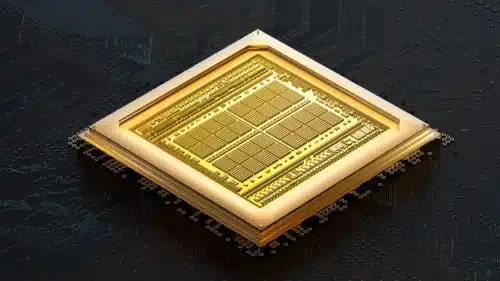
Researchers at EPFL’s POWERlab have developed a gallium nitride (GaN) power-device design that demonstrated breakdown voltages above 3.9kV, potentially extending the technology into higher-voltage applications. The work addresses a key limitation that has restricted GaN electronics to lower voltage ranges.
The researchers used GaN’s natural polarisation properties rather than relying on intentionally doped materials to balance electrical charge. By engineering the layers to create closely matched sheets of mobile electrons and holes, they formed both a two-dimensional electron gas (2DEG) and a two-dimensional hole gas (2DHG).
The charge balance is designed to prevent charge from accumulating in one vulnerable area when a transistor switches off. This helps the electric field spread more evenly through the device, reducing the risk of breakdown at high voltages.
Measurements showed the 2DEG contained about 1.03 × 10¹³ electrons per square centimetre, while the 2DHG contained about 1.05 × 10¹³ holes per square centimetre, a difference of less than 2 per cent. The resulting Schottky barrier diodes achieved breakdown voltages above 3.9kV while maintaining a specific on-resistance as low as 4.7 mΩ cm².

The devices also maintained breakdown voltages above 3.3kV at temperatures reaching 125°C. During repeated high-voltage operation, dynamic on-resistance increased by less than 15 per cent at up to 3kV.
Transistor versions sustained 3.5kV in normally-on operation and 3.4kV in normally-off operation, although their dynamic on-resistance was separately tested only up to 650V because of measurement-related parasitic effects.
The researchers say the approach could support more compact, efficient power conversion for electric vehicles, renewable-energy systems and energy-intensive artificial intelligence (AI) data centres. However, the devices remain laboratory demonstrations, and the substrate used currently limits their maximum breakdown voltage.