





Nuvi is an open-source desk companion built around the Arduino UNO Q, combining six servos, animated eyes and the Piper voice engine for an interactive desktop device.
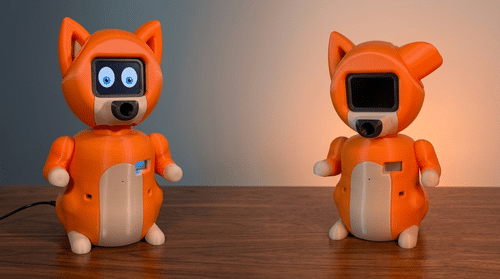
By the end of this build, makers can assemble a desk companion less than 30 centimetres tall that listens to commands, responds aloud and moves its arms, ears and neck. The project runs from a single Arduino UNO Q, combining Linux-based processing with real-time microcontroller control on one board.
The UNO Q uses a Qualcomm Dragonwing QRB2210 processor running Debian Linux alongside an STM32U585 microcontroller on the same PCB. The Linux side handles higher-level software and computational workloads, while the microcontroller manages hardware interfaces and time-sensitive control. This division allows Nuvi’s physical movements to be handled separately from its Linux-based applications.
Called Nuvi, the project was created by Luca Di Lorenzo. Its design includes a 3D-printed enclosure, four conventional servos for the arms and ears, two serial bus servos for the neck, an animated eye display, capacitive touch inputs, a proximity sensor and a temperature and humidity sensor.
The dual-processor architecture is central to the build. The STM32U585 handles tasks such as servo control, capacitive-touch sensing and sensor inputs, while the Dragonwing QRB2210 runs Debian Linux and the higher-level software stack. Separating these functions means Linux-side processing does not directly determine the timing of the robot’s servo movements.
Nuvi’s speech pipeline combines Gemini with the Piper voice engine. Gemini is used to interpret spoken input and generate a response, while Piper handles text-to-speech conversion locally on the UNO Q. This means the generated response does not need to be sent to a separate cloud-based text-to-speech service.
The Gemini component, however, means Nuvi should not be described as a completely offline conversational robot. Gemini requests require network connectivity when the cloud-based service is used. The local Piper component therefore provides on-device speech synthesis, but it does not make the complete speech-understanding and response pipeline independent of network services.
The mechanical and visual elements provide Nuvi’s physical response. Four servos operate the arms and ears, while two additional serial bus servos control the neck. Its display provides animated eyes and different expressions, while capacitive touch and proximity sensing allow the robot to react to interaction. The combination gives the project a physical interface rather than limiting it to a voice assistant running on a development board.
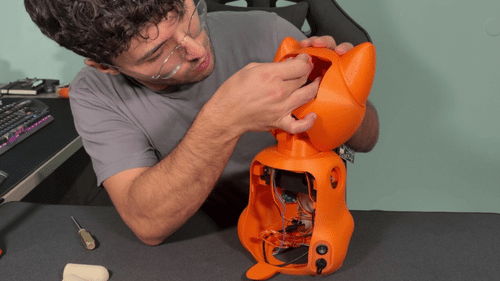
To build Nuvi, makers first print and assemble the enclosure using the project’s 3D files, paying attention to the mounting points for the servos and display. The four conventional servos can then be installed for the arms and ears, followed by the two serial bus servos used for the neck. Servo horns should be centred before the mechanisms are attached so that the available movement range can be calibrated without forcing the joints against the enclosure.
The UNO Q is then connected to the eye display, capacitive-touch inputs, proximity sensor and temperature and humidity sensor. The project software is installed across the board’s Linux and microcontroller environments, after which the speech components can be configured. Gemini requires the appropriate credentials and network access, while Piper provides the local speech output. The servo travel limits should then be calibrated to prevent the moving parts from hitting the enclosure during operation.
Nuvi is described as being less than 30 centimetres tall. The available project information does not establish measured response latency, peak current with all six servos operating or idle power consumption, so these figures should not be presented as measured specifications. The power supply also needs to accommodate the combined requirements of the UNO Q and multiple servos, particularly during simultaneous movement.
The six-servo architecture provides a useful starting point for further experimentation. A possible next step would be to replace the cloud-dependent Gemini stage with a smaller local model running on the Dragonwing processor. Comparing response latency, processing load and power consumption could show how much of Nuvi’s conversational workload can be moved entirely on-device.
For students and makers, Nuvi demonstrates how a single board can combine Linux-level AI workloads with deterministic microcontroller control in a compact physical-AI project. It also provides a practical platform for experimenting with local speech synthesis, robotics, sensors and human-machine interaction without requiring separate computers for each function.
For more information, click here.
