






New 8MP automotive image sensor improves HDR imaging, reduces LED flicker, cuts power consumption, and supports compact ADAS exterior cameras for safer driving applications worldwide.
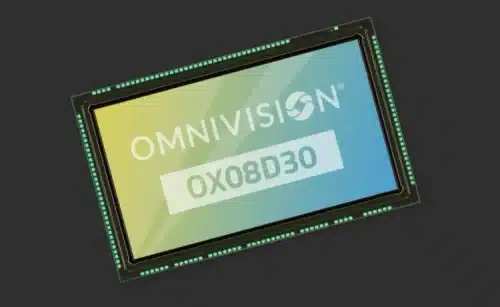
OMNIVISION has announced the OX08D30, an 8-megapixel CMOS automotive image sensor designed for advanced driver assistance systems (ADAS) and autonomous-driving exterior cameras. The sensor uses the company’s TheiaCel technology to extend single-exposure dynamic range, helping reduce LED flicker and temporal sampling artefacts while maintaining image quality in challenging lighting conditions.
The OX08D30 combines 2.1-micron pixels with lateral overflow integration capacitor (LOFIC) technology and dual conversion gain HDR processing. This architecture enables the sensor to capture a wider range of brightness levels while improving the visibility of high-intensity LED sources such as traffic lights and illuminated road signs.
According to OMNIVISION, the sensor can support enhanced detection ranges of up to 200 metres and offers improved low-light performance, high-temperature stability, and colour accuracy for automotive exterior imaging. It also provides 20% lower power consumption and is 50% smaller than other image sensors in its class, supporting more compact camera designs.
The device uses the company’s a-CSP package and is available in a 92-pin configuration. It offers an 8MP resolution of 3840×2160 pixels, a 40fps full-resolution frame rate, MIPI interface, rolling shutter operation, and HDR capabilities. It is also pin-to-pin compatible with the earlier OX08D10 sensor, allowing designers to reuse elements of existing camera architectures.
Samples of the OX08D30 are available, and the sensor is already in mass production. OMNIVISION is positioning it for forward-facing ADAS cameras and autonomous-driving systems where compact dimensions, lower power consumption, HDR performance, and reduced LED flicker are important design requirements.
The sensor was announced at AutoSens Europe 2026 in Barcelona, where OMNIVISION demonstrated its automotive imaging capabilities.
