






The new 1.1MP sensor combines infrared sensitivity, embedded processing, compact packaging, and improved sharpness to support affordable driver and occupant monitoring across vehicle platforms worldwide.
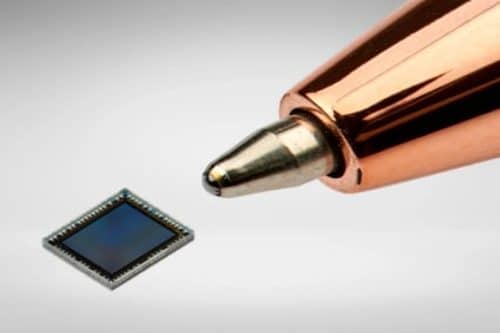
STMicroelectronics has introduced the ST SafeSense VD56GA, a 1.1MP automotive image sensor designed for infrared in-cabin sensing and driver and occupant monitoring. The sensor combines improved infrared sensitivity, compact integration, and embedded image processing to help OEMs and Tier 1 suppliers deploy monitoring systems across higher-volume vehicle platforms while controlling system costs. Samples are available now.
The sensor uses ST’s DeepNIR backside-illuminated pixel architecture, optimised for near-infrared imaging. ST reports 35% higher modulation transfer function (MTF) sharpness and nearly 60% higher quantum efficiency compared with the previous generation. This enables the sensor to deliver improved image quality for demanding applications, including cameras installed behind displays.
VD56GA uses a compact 3.7 × 3.2mm CSP package, making it suitable for space-constrained automotive camera modules. Its 1.1MP monochrome global-shutter architecture uses 2.43μm pixels and supports operation at up to 60 frames per second. ST specifies 41% absolute quantum efficiency at 940nm, supporting infrared imaging with low-power illumination.
The device also integrates several image-processing functions, including automatic exposure, dark calibration, defective-pixel correction, cropping, mirror or flip readout, and piecewise-linear processing. These functions can reduce the requirement for external image-processing resources, helping simplify camera designs and shorten development cycles. RAW and YUV output options provide flexibility across different electronic architectures and software environments.
For automotive integration, VD56GA supports ISO 26262 requirements for functional safety and ISO/SAE 21434 cybersecurity considerations, while its automotive-grade design targets extended operating conditions. The sensor is intended for driver monitoring, occupant monitoring, and other in-cabin sensing applications where compact dimensions and infrared performance are important.
ST says the sensor can also help reduce complete camera-module costs by supporting lower-cost optics, simplified infrared illumination, less demanding optical filtering, and integrated processing.
