






More than 140,000 home batteries supplied 580 MW to California’s grid during a heatwave, showing how residential energy storage can operate as a large virtual power plant.
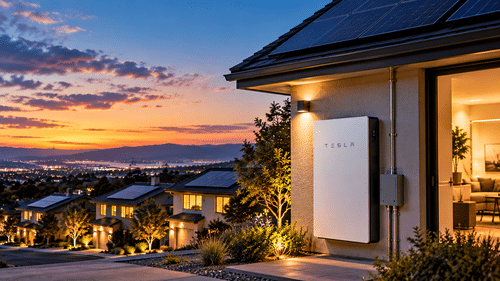
More than 140,000 batteries installed in ordinary homes acted as a single virtual power plant during a California heatwave this month. Solar company Sunrun and Tesla said the batteries delivered 580 MW to the grid for three hours on the evening of 9 September 2026, in what the companies described as the largest residential battery dispatch of its kind.
Evening hours can put additional pressure on the electricity grid as solar generation falls while air-conditioning demand remains high. Coordinating batteries already installed in homes allows stored electricity to be dispatched during these peak periods, providing additional grid capacity without relying solely on conventional generation. Participating homeowners can also receive compensation for making their stored energy available.
Each participating home had rooftop solar and a battery capable of storing electricity generated during the day. The companies connected the batteries through software to form a virtual power plant (VPP) — a network of distributed energy-storage systems that can be coordinated and dispatched as a single resource.
When California’s wholesale electricity price crossed a predefined trigger level, the fleet was instructed to discharge. Instead of relying on one large power station, the grid could draw electricity from thousands of batteries at the same time, effectively turning distributed home storage into a coordinated source of grid power.
According to the release, about 110,000 Tesla Powerwall batteries supplied 517 MW, with Sunrun owning and operating 55% of those units. More than 30,000 other batteries in Sunrun’s fleet supplied a further 63 MW.
The dispatch operated through two California programmes: Demand Side Grid Support (DSGS), administered by the California Energy Commission, and the Emergency Load Reduction Program (ELRP), administered by the California Public Utilities Commission. The event was triggered after the California Independent System Operator (CAISO) day-ahead electricity price exceeded $200 per megawatt-hour (MWh).
A follow-up dispatch on 10 September delivered more than 140 MW to Southern California Edison’s grid, demonstrating that the distributed battery fleet could respond to subsequent grid requirements.
Utilities traditionally meet evening demand peaks using peaker plants, such as gas turbines that can remain idle for much of the year and operate when electricity demand rises sharply. Sunrun and Tesla say the 580 MW residential battery dispatch provided more capacity than many individual peaker plants and was enough to meet the peak electricity needs of every household in Sacramento County.
The companies also cite a Brattle Group study estimating that residential battery fleets could save Californians up to $206 million in net costs by 2028. This is an estimate from the study cited by Sunrun, rather than a measured saving from the September dispatch.
This is not a laboratory demonstration. It is a working programme involving paying customers, but it depends on a large installed base of home batteries, market programmes that compensate households for grid support, and software capable of coordinating distributed batteries. Participating Sunrun systems maintain a minimum 20 per cent backup reserve during grid events, while the batteries stop sending power to the grid during an outage.
That reserve gives customers some protection for their own homes, but a battery cannot simultaneously provide all its stored energy to the grid and keep the same energy available for backup. Repeated grid dispatches also add charge-discharge cycles, contributing to battery degradation over time. The September event therefore demonstrates both the potential of residential storage as a grid resource and the trade-off between grid services and household backup capacity.
India is also rapidly expanding rooftop solar. As of 22 July 2026, the PM Surya Ghar: Muft Bijli Yojana had supported nearly 39.7 lakh rooftop solar systems, benefiting more than 48 lakh households, against its target of reaching one crore households. However, rooftop solar alone cannot supply electricity after sunset. Adding batteries would allow households to store daytime solar generation and make that energy available during evening demand peaks.
The California event shows one possible next step: home batteries could be coordinated through software and aggregated into a virtual power plant, allowing a DISCOM or other authorised market participant to call on them during periods of high demand. India would need suitable tariffs, compensation mechanisms, aggregation rules and technical standards before such a model could operate at scale. The Ministry of New and Renewable Energy has also identified the integration of Battery Energy Storage Systems as an important part of the country’s evolving energy-storage landscape.
For Indian households, the immediate attraction could be simpler: the same battery that stores solar power for evening use can also provide backup during a power outage.
For more information, click here.

