

What if a weapon did not need ammunition? Directed energy systems are bringing that question closer to reality while creating an entirely new set of engineering challenges.
“Directed energy weapons (DEWs) technologies are essential since they provide an effective mechanism for contactless, non-kinetic means to achieve superiority in space. DEWs are fast emerging as an alternative to direct ascent ASAT missiles and are difficult to attribute to a source.” —Manohar Parrikar Institute for Defence Studies and Analyses, India
Directed energy weapons (DEWs) are electromagnetic systems capable of converting chemical or electrical energy into radiated energy, such as lasers, microwaves, particle beams, or even acoustic beams, and focusing them on a target to cause serious damage. DEWs are a revolutionary advancement in military technology, capable of degrading, incapacitating, or destroying enemy assets without relying on conventional ammunition. They deliver at the speed of light, offer precision, scalability, and reduced logistical burden.
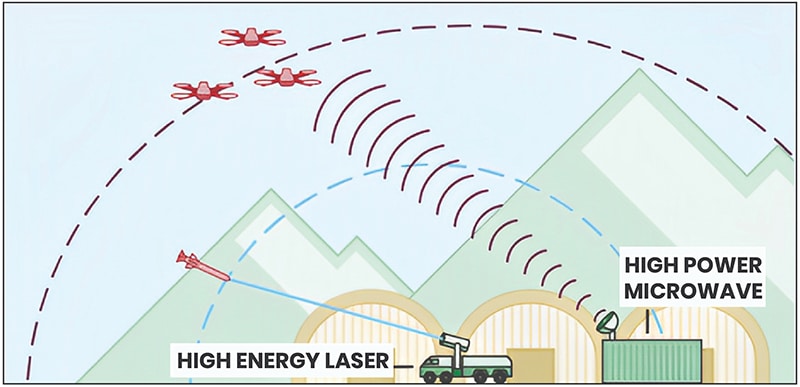
Although research has been underway for decades, the progress has been slow due to technical hurdles. Today, DEWs are viewed as futuristic systems suiting the regional security environments. Across the world, strategists are looking at these weapons as next-generation systems for air and missile defence, counter-drone operations, and protection against asymmetric threats. Beyond the battlefield, directed energy technologies hold promise in space security and industrial use. High-energy lasers find use in precision cutting, welding, and surface treatment. Particle beams are used for targeted medical treatments, sterilising food and water, and for long-distance communication in space. India needs to reduce dependence on other countries and develop an indigenous ecosystem for the next-generation DEWs. Various stakeholders such as DRDO labs, electronic component and defence equipment manufacturers, and startups and academia will need to work closely together.
DEWs: Types
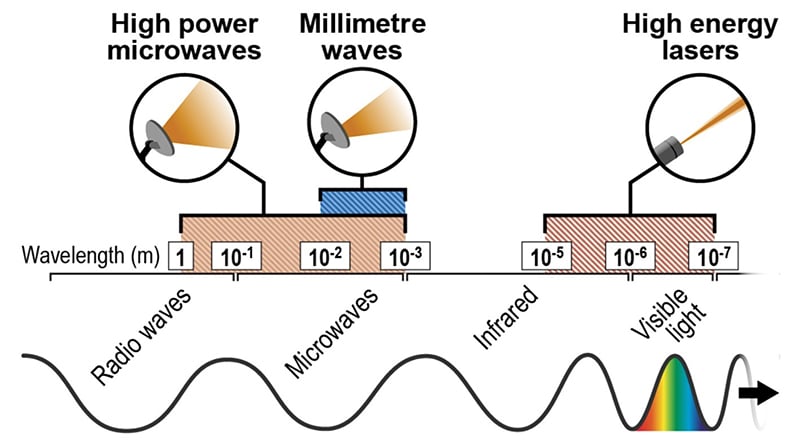
DEWs use the principle of electromagnetics (see Box 1) and are categorised according to their energy source. High-energy lasers, high-power microwaves, particle beams, and acoustic/hybrid systems each represent a distinct technological approach. Their operational advantages (Table 1) and technical characteristics (Table 2) vary significantly.

High-energy lasers (HELs)
HELs use concentrated beams of light to damage targets using intense heat. Unlike conventional bullets, laser beams travelling at the speed of light hit fast-moving threats like missiles or drones almost instantly. The beam stays focused for a few seconds to burn through the target’s outer shell or to disable sensors. They offer surgical precision and a nearly unlimited number of shots. However, their performance is weakened by environmental factors like fog, rain, or dust that scatter the beam.
High-power microwaves (HPMs)
HPMs work by firing intense pulses of radio-frequency energy to ‘fry’ the target’s electronics. The energy surge enters through openings like antennae or penetrates ‘back-door’ paths such as unshielded wiring and tiny seams in the casing. Once inside, the surge overloads microchips and sensors, crashing the flight logic or permanently destroying the hardware. Since the pulses cover a wide area, they can disable multiple threats using a single shot, creating an invisible ‘no-fly zone’.
Particle beam weapons
Particle beam weapons are the most advanced in terms of directed-energy technology. They work by accelerating streams of atomic or subatomic particles, such as protons, ions, or electrons, to near-light speeds and directing them to a target. On impact, the particles deliver immense energy that superheats materials, ionises matter, and disrupts electronic systems simultaneously. Particle beam weapons have the capability to intercept missiles during launch, disable satellites in orbit, or neutralise targets with precision. However, they need enormous power, complex particle accelerators, and advanced focus systems to keep the particle beams coherent over a long distance, making them far less practical than lasers or microwave-based weapons. They continue to remain at an experimental level.
Acoustic weapons
Acoustic weapons use specialised speakers, called transducers, to beam amplified sound waves at a target to create a ‘sound barrier’. These sound waves operate at frequencies or volumes unbearable to a human ear, causing discomfort, disorientation, or pain. Such weapons are used as a non-lethal option to manage crowds or keep unauthorised naval vessels away.
Hybrid systems
Hybrid systems combine technologies to create a ‘layered’ defence mechanism. For example, a system may use an HPM pulse to disable the drone’s navigation system and then apply a laser beam to destroy it physically. Another variant may integrate acoustic waves to disperse or deter the enemy and then deploy laser systems to disable their equipment.
| Box 1: The principle of electromagnetics |
| Electromagnetics is the interaction between electric and magnetic fields to propagate energy. Moving charges create magnetic fields, while fluctuating magnetic fields induce electric fields, enabling energy to travel as electromagnetic waves. While these waves are commonly used for radio communication or heating in microwave ovens, DEWs scale these waves for defence applications. |
| Table 1: Operational advantages | ||
| Type of DEW | Advantages | Challenges |
| High-energy lasers | Precision, speed-of-light strike, and reusable shots | High power demand, cooling, and weather effects |
| High-power microwaves | Effective against electronics and swarm defence | Limited range and shielding countermeasures |
| Particle beam weapons | Potential deep penetration and futuristic capability | Immense power requirement, stability, and portability |
| Acoustic/hybrid | Non-lethal options, and niche applications | Limited destructive power and short effective range |
DEWs: Advantages
DEWs are a transformative technology offering faster, precise, and cost-effective solutions to counter evolving threats and providing tactical and psychological advantages. A single system can be scaled from a handheld tactical device to a large naval platform. Travelling at the speed of light, they eliminate the ‘time-of-flight’ associated with conventional projectiles, reducing reaction time against high-speed targets like hypersonic missiles and drones. They allow operators to neutralise targets in sensitive areas, such as urban power plants or airports, causing minimal collateral damage. They offer an ‘infinite magazine’, because they draw power from onboard generators or energy modules rather than physical munitions, eliminating the logistical burden of transporting and storing massive quantities of ammunition. DEWs provide advanced electronic warfare capabilities, such as jamming to disrupt communication between drones and their operators or dazzling the sensors of spy satellites, temporarily blinding them. In space, DEWs provide a significant advantage, enhancing space situational awareness (SSA) (Box 2). Beyond ‘laser brooming’, which clears hazardous orbital debris, ground-based lasers safeguard sensitive assets by temporarily blinding or obscuring overhead surveillance systems. For public safety and crowd management, technologies like the active denial system (ADS) provide a critical, non-lethal intermediary ‘middle ground’ between verbal warnings and lethal force.

DEWs: India’s initiatives