Large language models (LLMs) are reshaping how engineers approach antenna design, simulation, and testing. Here is what that looks like in practice.
A colleague recently described asking an AI assistant to help debug a microstrip patch antenna simulation that had been producing inexplicably elevated cross-polarisation levels. He expected the tool to fail. Instead, it walked him through a systematic analysis of substrate permittivity tolerances, feed point asymmetries, and simulation mesh artefacts, correctly identifying the issue as likely being a combination of the second and third factors. It took eleven minutes. The same process would have taken most of an afternoon if done manually.
This is not a story about AI replacing RF engineers. It is a story about a tool that, until very recently, had little useful to offer antenna designers, beginning to earn a place in the RF design workflow. Large language models (LLMs) have arrived in the engineering world, and while they are far from infallible, their practical utility in specific RF design tasks is increasingly becoming difficult to ignore.
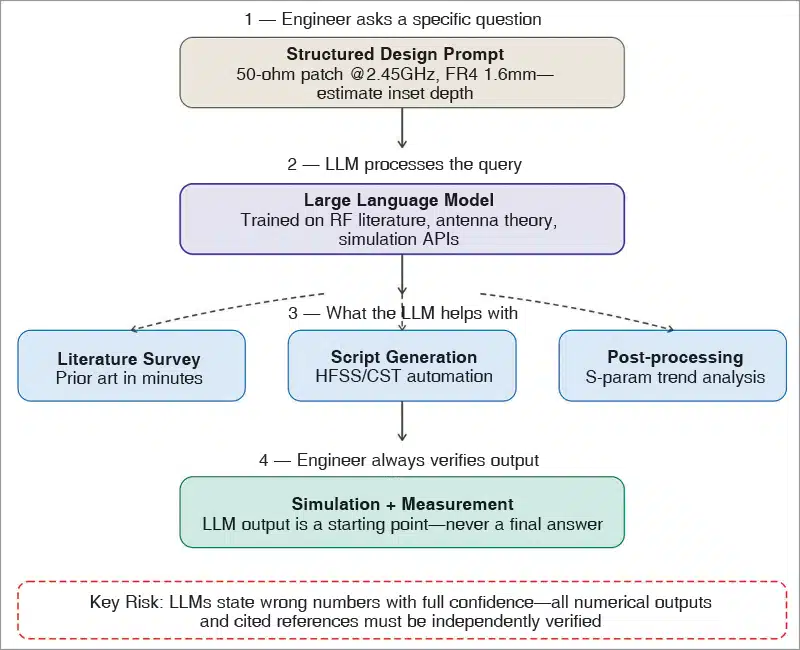
What LLMs are actually good at in RF work
The honest answer requires resisting two temptations: overselling the technology and dismissing it outright.
LLMs are not good at performing precise numerical calculations. They are not reliable substitutes for electromagnetic simulation software. They cannot replace the physical intuition that comes from years of building and measuring actual hardware. Anyone claiming otherwise is either mistaken or promoting an unrealistic view of the technology.

What they are genuinely good at is a different and complementary set of tasks. They are particularly effective at reviewing large bodies of technical literature and surfacing relevant precedents. Ask a well-prompted LLM to identify prior art on impedance matching techniques for dual-band handset antennas, and it can produce a structured, well-referenced survey in minutes rather than hours. It will not be perfect—hallucinations are a real risk, and all references must be verified—but the starting point it provides is significantly better than starting from scratch.
They are also effective at helping engineers think through the logical structure of a design problem. The process of articulating a constraint or a trade-off clearly enough for an AI to understand often helps engineers understand it more clearly themselves. Several RF engineers interviewed for this article described using LLM conversations as a structured form of rubber-duck debugging—the act of explanation forces clarity.
Practical applications in antenna design