




A robot uses a layer of muscle cells and light to swim, turn, and move through water for monitoring applications.
MIT engineers have built a swimming robot powered by a single layer of skeletal muscle cells. The robot uses light to control two fins, allowing it to swim, turn, and change speed in water. In tests, the robot travelled at up to four times its body length per minute and followed a light source through a water maze. The researchers say the design could reduce the amount of muscle tissue used in biohybrid robots and could be used for aquatic monitoring.
The robot is made from a gelatin methacrylate (GelMA) film about 0.5 millimetres thick. Two fins are formed from the film, with each covered by a layer of muscle cells thinner than a strand of hair. The cells were genetically engineered to contract when exposed to light.
Light directed at one fin causes it to contract and move the robot through the water. Switching the light between the two fins changes the robot’s direction and speed. The researchers focused on the material supporting the cells because it affects how much force reaches the robot. Earlier designs used fibrin, a gel that could shrink when the muscle cells contracted. This reduced the force transferred to the robot.
The team tested different gel materials, stiffness levels, and surface patterns. They found that square-bottomed grooves helped the cells align along the surface. The aligned cells fused into muscle fibres that produced more force and coordinated contractions. They also tested GelMA with different stiffness levels. Cells grown on stiffer GelMA produced more force and showed better alignment.
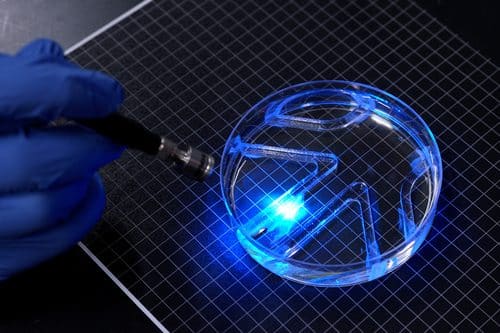
For the final robot, they formed square-bottomed grooves on the GelMA film and placed muscle cells on both sides. As the cells grew, they followed the grooves and fused into fibres, forming two independently controlled fins. The researchers placed the robot in a Petri dish filled with water and moved a light source above it. The robot responded to the light and moved through the maze.
The current robot is designed to demonstrate movement using a thin layer of muscle cells. The researchers plan to change its body design and increase its swimming speed. They also see potential for using the system in aquatic environmental monitoring, where high swimming speeds may not be required.
