





What if satellites could process data before sending it home? An Indian spacecraft is preparing to run AI workloads in orbit using onboard edge computing.
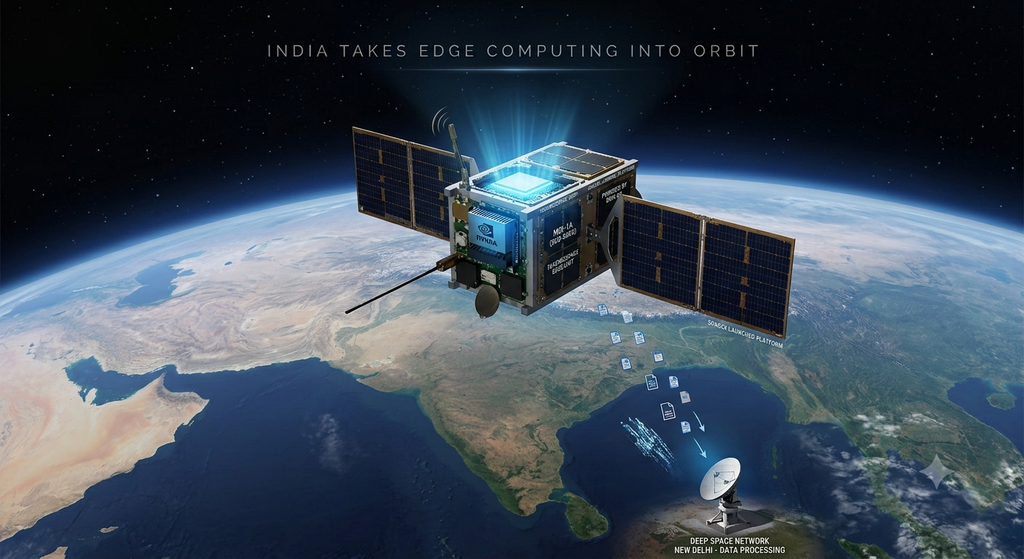
Indian space startup TakeMe2Space is preparing to launch MOI-1A, a sub-50kg satellite designed to process data in orbit rather than sending complete datasets to Earth. The spacecraft is scheduled to fly on SpaceX’s Transporter-18 rideshare mission and carries Nvidia Orin NX processors for onboard edge computing.
The approach moves part of the data-processing pipeline from ground infrastructure to the satellite itself. Instead of downlinking large volumes of raw imagery or sensor data, the spacecraft can analyse information while passing over a target area and transmit the resulting insights.
MOI-1A is designed to run containerised AI models uploaded by users, allowing different applications to perform inference directly in orbit. This could be useful for satellite imagery and other data-intensive workloads where transmitting the complete dataset to Earth can consume significant communications bandwidth.
At the centre of the system are Nvidia Orin NX edge-computing processors. The spacecraft has a reported power budget of about 150W, making computing performance per watt an important constraint compared with terrestrial data-centre systems. The design therefore represents a compact edge-computing architecture rather than an orbital equivalent of a conventional data centre.
TakeMe2Space previously demonstrated application uploads, AI inference in orbit and result downloads during a technology-demonstration mission in 2024. The company subsequently lost the MOI-1 spacecraft following a launch-vehicle third-stage failure.
The latest spacecraft is intended to extend that approach into an operational satellite platform. Future versions are planned to use larger spacecraft and networked architectures, potentially increasing available computing capacity and allowing workloads to be distributed across multiple satellites.
The concept points towards a shift in satellite computing, where spacecraft do more than collect and transmit information. By combining sensing, processing and selective downlinking, orbital edge systems could reduce the amount of data that needs to travel between space and ground while delivering processed results closer to where the data is generated.

