





A software-based automotive network simulation lets engineers develop firmware, analyse CAN traffic, inject faults, and test vehicle diagnostics without requiring physical ECUs or wiring.
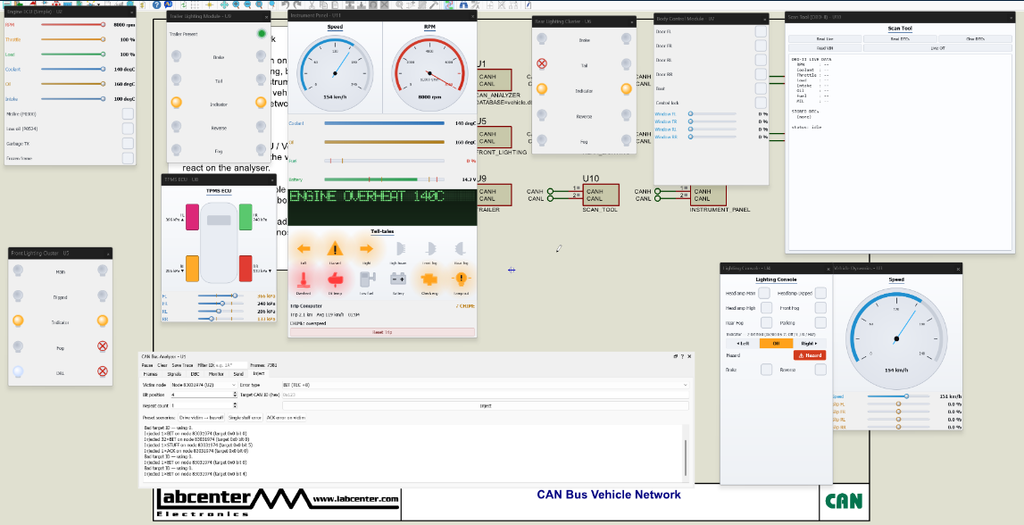
A new vehicle-network simulation environment enables engineers and students to develop and evaluate automotive Controller Area Network (CAN) firmware against a virtual vehicle comprising more than 20 interconnected electronic control units (ECUs). The Automotive CAN for Proteus VSM by Labcenter Electronics Ltd combines vehicle subsystem models, CAN analysis, diagnostics, fault injection, and cybersecurity testing within a software environment.
The simulation allows a user’s microcontroller to operate as an ECU on the virtual CAN bus while running real firmware. This makes it possible to test embedded code against simulated engine, transmission, instrument-cluster, body-control, lighting, braking and stability-control, tyre-pressure, and immobiliser systems without assembling multiple physical ECUs and transceivers.
The platform supports microcontrollers with integrated CAN interfaces, including the STM32F103 and pyboard. Other processor families can participate through simulated MCP2515 and MCP2518FD standalone CAN controllers connected through Serial Peripheral Interface (SPI). It supports both Classical CAN and CAN Flexible Data Rate (CAN FD), allowing different processor architectures to be used within the same virtual vehicle network.
The key features are:
- 20+ behavioural ECU models
- Real-time firmware co-simulation
- Bit-level CAN frame inspection
- Vector/PEAK trace compatibility
- Virtual ECU cybersecurity testing
For network development and debugging, the integrated CAN Bus Analyser captures and timestamps CAN frames and decodes signals using a loaded DBC database. Engineers can inspect individual frames down to the identifier, data, Cyclic Redundancy Check (CRC), and stuff-bit level. The analyser can also transmit frames independently of firmware and monitor node error counters and states. Captured traces can be exported in Vector and PEAK formats.
The system supports controlled fault testing by injecting five CAN protocol errors into selected nodes. Engineers can observe error-counter changes, bus-off behaviour, and recovery. Vehicle models can also be configured with node-level faults, including silent nodes, continuously transmitting nodes, frozen payloads, and incorrect identifiers. A simulated scan tool supports On-Board Diagnostics II (OBD-II) and Unified Diagnostic Services (UDS) for reading and clearing diagnostic trouble codes.
For automotive cybersecurity development, the platform provides simulated spoofing, replay, and flooding scenarios, alongside intrusion detection, authenticated messages, freshness counters, message authentication codes, and UDS seed-and-key security. Applications include automotive engineering education, embedded firmware development, CAN debugging, diagnostics, network testing, and cybersecurity training.
Click here for the original announcement.


