
Researchers have simulated an EV battery pack that bypasses ageing cells, extending battery life by more than 20 per cent in some configurations.
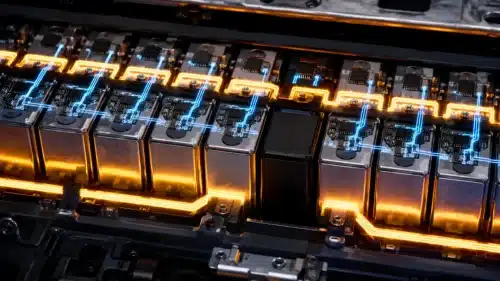
An electric vehicle (EV) battery pack could last longer if it could disconnect its weakest cells and continue operating with the rest. Researchers at Chalmers University of Technology in Sweden have evaluated this approach using computer simulations, finding that dynamically reconfigurable battery packs could extend battery life by more than 20 per cent under certain conditions. The architecture uses electronic switches and control software to change cell connections as the battery ages, potentially delaying replacement and reducing lifetime costs.
Conventional EV battery packs connect cells in fixed series and parallel configurations. Although battery management systems monitor cell voltages, temperatures and other operating parameters, they cannot normally bypass individual cells while maintaining the pack’s intended electrical configuration. Manufacturing variations and uneven operating conditions mean that some cells can deteriorate faster than others, restricting the usable capacity or performance of the entire pack.
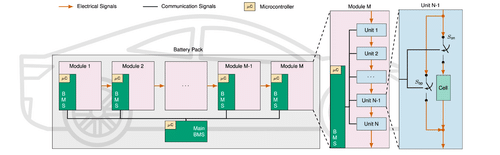
Dynamic reconfiguration addresses this limitation by adding controllable switches around individual cells. A battery management system can change which cells participate in the electrical circuit, bypassing a deteriorated cell while allowing the remaining cells to continue supplying power. This requires additional power electronics, control algorithms and a battery architecture designed to support switching during operation.
The researchers evaluated the approach across 240 scenarios, with 1,000 Monte Carlo simulation runs per scenario to account for variations in cell characteristics. The study considered 20 EV models from 15 manufacturers, different battery chemistries, pack configurations, operating temperatures and driving conditions. Both lithium iron phosphate (LFP) and nickel manganese cobalt (NMC) batteries were included.
The simulations showed that dynamic reconfiguration could extend battery life by more than 20 per cent in some configurations. The potential benefit varied with pack voltage, chemistry, thermal conditions and cell-to-cell differences. Higher-voltage systems generally showed greater improvements, making the approach particularly interesting for electric trucks and long-range passenger cars. However, the largest gains represent an upper bound under the modelled conditions, with individual-cell switching increasing hardware complexity and cost.
An 80kWh LFP battery pack provides an example of the potential economic benefit. Under the study’s baseline assumptions, the reconfigurable design delayed battery replacement by approximately 1.1 years. The model estimated lifetime cost savings of €941, equivalent to 5.61 per cent of the conventional pack’s lifetime cost, after accounting for additional electronics, energy losses, replacement costs and residual value. In the most favourable scenario, estimated savings reached €3,584. In the least favourable case, the reconfigurable pack cost €2,258 more over its lifetime. These results show that the architecture is not automatically cheaper in every application.
Battery capacity emerged as the strongest factor influencing economic viability. The researchers identified packs above approximately 50kWh, annual driving distances below 12,150km and additional upfront costs below 7.16 per cent as favourable conditions in their sensitivity analysis. These figures are model-derived thresholds, not universal cut-offs for every vehicle. Actual economics would depend on battery prices, vehicle usage, electricity costs, switching hardware and the replacement strategy.
The research involved Chalmers University of Technology, automotive supplier PHINIA and truck manufacturer Scania. Although the study used experimentally validated battery models, its reported lifetime improvements are simulation results rather than measurements from a long-term fleet trial. The authors’ work provides a framework for evaluating reconfigurable battery systems, but commercial deployment would require further engineering and validation.
For India, the findings are relevant to electric buses, trucks and other vehicles that use large battery packs. However, the 50kWh threshold should not be interpreted as a rule that automatically excludes smaller EVs or guarantees savings for larger ones. Vehicle utilisation, battery replacement costs and the price of the additional switching hardware would all influence the outcome.
The study also highlights a potential sustainability benefit: extending battery-pack life could delay replacement and preserve more of the battery’s remaining value. Whether reconfigurable packs eventually become commercially attractive will depend on how effectively manufacturers can implement cell switching without adding excessive cost, complexity or energy losses.
For more information, click here.