

Sensors replace older standards and help laboratories measure radio frequency power and calibrate equipment against national standards.
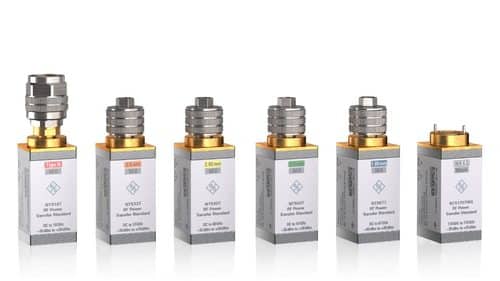
Rohde & Schwarz has introduced the R&S NTS thermoelectric RF power transfer standards for traceable radio frequency (RF) power measurements. The sensors are designed to replace thermistor mount standards that are no longer manufactured. Their passive analogue design allows them to serve as primary standards in microcalorimeters and as transfer standards for national metrology institutes (NMIs), accredited calibration laboratories, and industrial users.
Accurate power measurements are required for industrial production, quality assurance, and regulatory compliance. Quality management standards, product liability requirements, and environmental regulations require measurement equipment to be calibrated regularly, with traceability to national standards.
Thermistor mount standards have served as references for traceable RF power measurements for decades. However, production of new components ended years ago, leaving laboratories without replacement parts or support for newer frequency bands, including the D-band.
The product family provides a replacement for thermistor mount standards. Its design fits existing microcalorimeter setups without requiring additional base units. The sensors connect directly to commercially available, traceably calibrated DC nanovoltmeter, allowing laboratories to continue using familiar measurement procedures. Software support is also available to help users transition from thermistor-based standards to thermoelectric technology.
The thermoelectric power detector chip in the R&S NTS family was developed for RF-to-DC power substitution in metrology applications. Its design builds on more than two decades of Rohde & Schwarz experience with R&S NRP power sensors, adapted for higher accuracy requirements.
The detector uses two symmetrical RF and DC heaters to support RF-to-DC power substitution. The heater design provides linearity and reduces the operating-point influence on the calibration factor to the parts-per-million (ppm) range per milliwatt. Its impedance matching and flat frequency response help reduce measurement uncertainty across the operating range. The sensors support up to +20 dBm input power and provide fast settling times for precision calibration.
Other features include a four-wire DC heater connection for power substitution, low-impedance DC lines to reduce parasitic heating losses, and an integrated temperature sensor to compensate for thermal effects. All models have a push-pull DC connector and low thermal mass. Electronic device identification is available as an option to support automated calibration workflows.
Click here for the original announcement.