




Compact optical devices enable interference-resistant data exchange between battery cells and control systems, supporting high-speed communication, flexible PCB layouts, and reliable operation in automotive and industrial electronics.
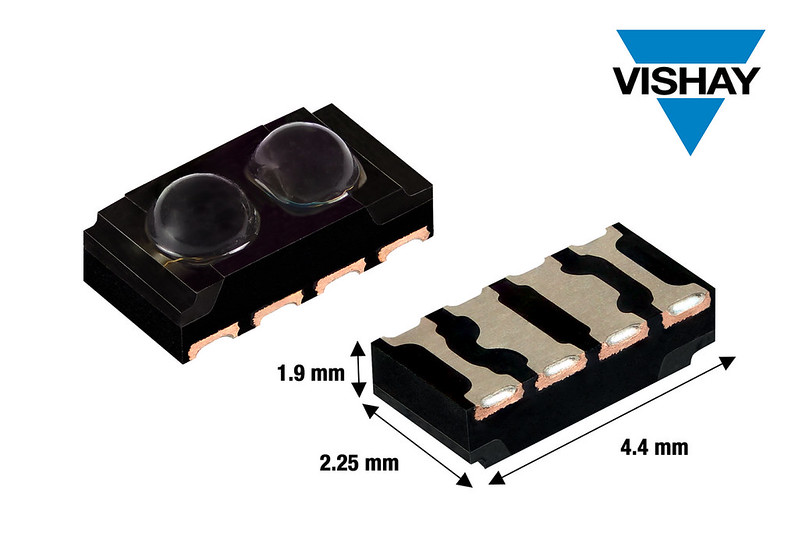
Automotive battery management systems and industrial controllers can use compact optical sensors to exchange data at speeds of up to 6Mbit/s without relying on radio-frequency communication. The devices combine an infrared (IR) emitter and a PIN photodiode in a single surface-mount package, enabling short-range, wear-free optical data links between electronic system nodes.
The four devices VCND2040X02, VCND2040SLX02, VCND2045X02, and VCND2045SLX02, from Vishay Intertechnology, are designed for battery management, energy storage, and industrial automation applications. Their optical communication links are immune to electromagnetic compatibility (EMC) and electromagnetic interference (EMI), as well as radio-frequency interference (RFI), making them suitable for electrically noisy environments. Optical links can also reduce exposure to certain wireless communication-based attacks.
The sensors measure 4.4 × 2.25 × 1.9mm, allowing designers to integrate communication links into space-constrained electronic assemblies. Their AEC-Q102 qualification supports automotive applications, including communication between battery cells and monitoring or balancing circuits in battery management systems.
The product family offers two emitter configurations. The VCND2040X02 and VCND2040SLX02 use a single-stack IR emitter, with typical rise and fall times of 18 nanoseconds (ns). The VCND2045X02 and VCND2045SLX02 use a double-stack emitter, reducing these times to 9ns for faster signal transitions. The faster variants are suited to applications requiring rapid data exchange between system nodes.
Each sensor incorporates separate optical lenses for the emitter and detector, alongside an integrated barrier to minimise crosstalk. This helps maintain signal integrity during optical transmission. The devices support free-space communication over short distances, while external optics can extend the link. Coupling the sensors with optical fibre can enable transmission over several metres, including through bends and confined routing paths.
The key features are:
- Typical radiant intensity of up to 65mW/sr.
- Typical radiant optical power of up to 12mW.
- Infrared emitter wavelength of 855nm.
- Typical detector photocurrent of 29µA under specified test conditions.
- Forward voltage of 2.5V for the VCND2045 series at 24mA forward current.
A wettable-flank lead-frame design allows the sensors to be mounted in either top-view or side-view orientations. The VCND2040X02 and VCND2045X02 are top-view versions, while the VCND2040SLX02 and VCND2045SLX02 provide side-view configurations. This flexibility can simplify component placement and PCB layout when optical alignment is constrained by enclosure geometry.
Beyond battery monitoring and balancing, the sensors can be used in energy storage systems, industrial automation, optical switches, optical encoders, and position-sensing equipment. Their compact form factor and interference-resistant communication make them relevant to designs requiring reliable signal transfer without mechanical contacts.
The devices are RoHS-compliant and halogen-free, with a moisture sensitivity level of 3. Their operating temperature range is −40°C to +110°C, supporting use in demanding automotive and industrial environments.
Click here for the original announcement.
