
A Bengaluru semiconductor startup is rethinking how it tackles chip-level interference, with automotive applications already providing a real-world test case. Its next move could bring security and timing functions together in a single module.
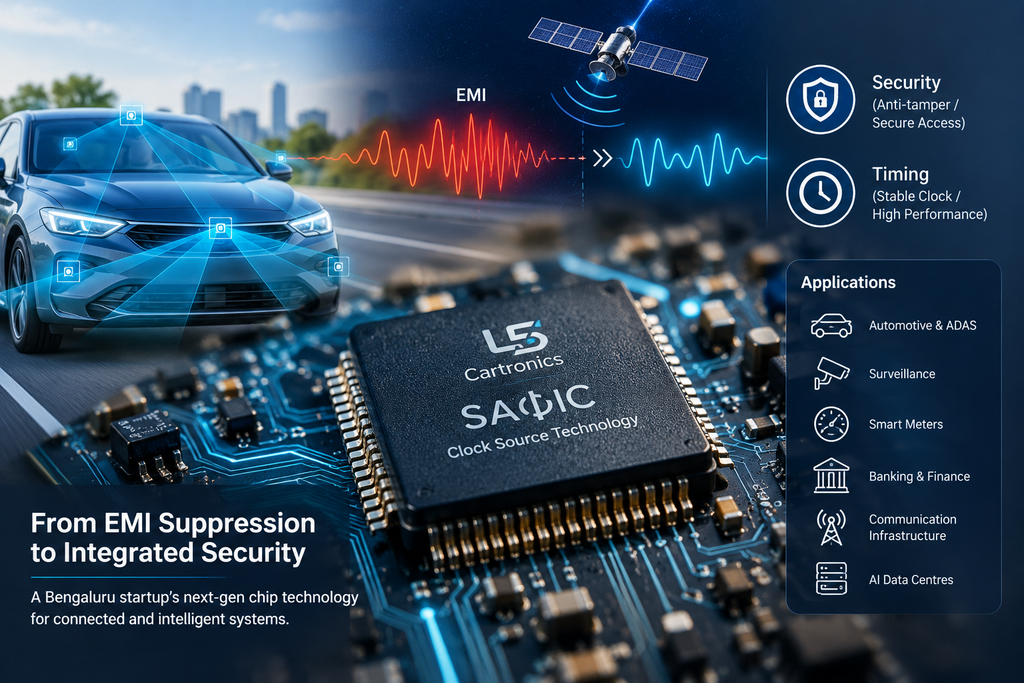
Electromagnetic interference (EMI) can turn into an expensive problem for electronics makers, forcing repeated design changes when products fail compliance tests. Bengaluru-based L5 Cartronics is taking a different approach: addressing the problem at the clock source itself, rather than relying on fixes added later in the design process.
The company’s proprietary technology SAΦIC has already been tested in demanding applications. Ranga Raj Bindignavle and Narendar (Buddy) Venugopal mentioned that “unlike traditional passive filters or digital signal processing that rely on standard Phase-Locked Loops (PLLs), SAΦIC is a proprietary non-PLL phase modulation technology. They mentioned that their technology helped resolve interference affecting a satellite communication link used alongside an automotive camera system. The example points to a challenge that is becoming harder to ignore as vehicles incorporate more cameras, connectivity and advanced driver-assistance systems (ADAS).
But EMI suppression is only part of the company’s plans. L5 Cartronics is also developing a security-focused chip module that combines multiple functions to help protect connected systems against unauthorised access. The technology is intended for applications ranging from surveillance and smart meters to banking and communication infrastructure, with an initial prototype targeted for mid-2027.
The startup is now working to bring its technology and intellectual property into India, while exploring domestic semiconductor manufacturing partnerships. It is also looking towards high-speed computing applications, including AI data centres.
How does its approach differ from conventional EMI fixes? And can an Indian fabless semiconductor startup turn a specialised chip technology into a broader opportunity across automotive electronics and hardware security?
The answers offer a peek at the technology, its real-world applications, and the company’s plans for building its semiconductor business in India. To know the responses to these queries and more, stay tuned for the full interview.