




A contact-engineered molybdenum disulfide transistor combines memory and signal processing for brain-inspired computing, demonstrating heartbeat classification with potential applications in energy-efficient AI hardware and electronic health monitoring.
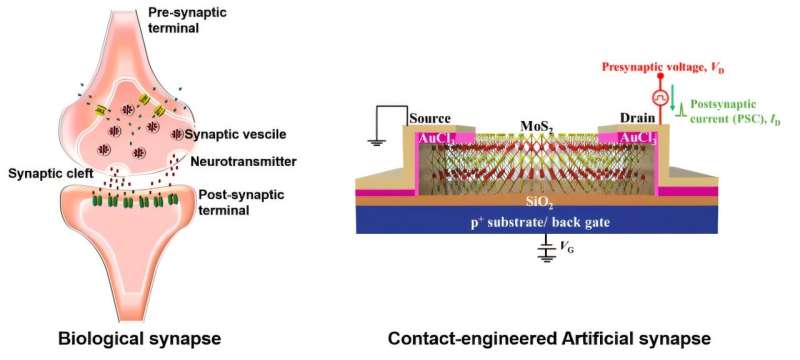
Researchers at the University of Tokyo have developed a molybdenum disulfide (MoS₂) memtransistor that combines memory-like behaviour with signal processing in a single semiconductor device. The technology could help simplify neuromorphic hardware, which mimics how biological brains process information, by reducing the need for separate memory and computing components.
The device uses a two-dimensional MoS₂ semiconductor, whose electrical properties can be controlled through its interfaces with metal electrodes. Instead of modifying the entire semiconductor channel, the researchers selectively treated the metal contacts using a solution-based gold chloride (AuCl₃) process.
This treatment changes the electronic conditions at the metal–semiconductor interface, where charge carriers enter the channel. Trapping and releasing electrical charges dynamically modifies the effective Schottky barrier, which determines how easily carriers cross the contact. This produces reversible changes in electrical resistance, allowing the device to retain a history of previous electrical inputs.
The researchers examined the device using temperature-dependent electrical measurements, Raman spectroscopy, X-ray photoelectron spectroscopy and atomic force microscopy. Their findings indicated that the memory behaviour was primarily controlled by the engineered contact interface rather than changes throughout the semiconductor channel.
The team tested whether the transistor could reproduce synaptic functions. By applying electrical pulses, they demonstrated gradual increases and decreases in conductance, corresponding to the strengthening and weakening of connections between biological neurons. The device also exhibited responses dependent on pulse amplitude and timing. These characteristics are important for neuromorphic systems, which use changing electrical conductance to represent and process information.
To demonstrate practical signal processing, the researchers used the device in a reservoir-computing system for electrocardiogram (ECG) classification. The system analysed 23,818 heartbeat segments from the MIT-BIH arrhythmia database using one physical memtransistor and 10 time-multiplexed virtual nodes. It achieved 93.9% classification accuracy when distinguishing normal heartbeats from ventricular ectopic beats, with an area under the receiver operating characteristic curve of 0.965. This demonstrates the potential for temporal signal processing, rather than clinical diagnostic readiness. The contact-engineering approach could support compact AI processors and low-power sensing electronics. However, large-scale integration, manufacturing consistency and long-term reliability require further investigation.


