

A wireless communication technique that encodes digital data in reflected thermal noise, potentially reducing transmitter energy consumption while enabling low-power connectivity for sensors and electronic devices.
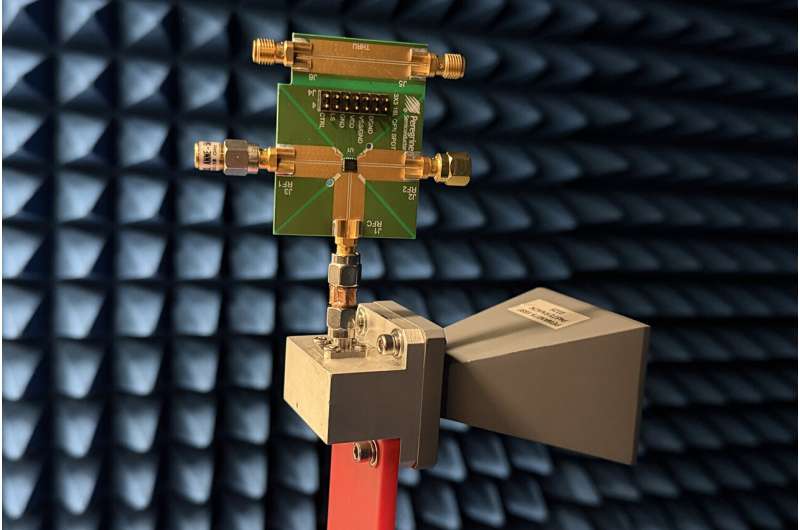
Researchers at Stanford University have demonstrated how thermal noise can carry digital information without a transmitter generating an active radio signal, offering a potential alternative for low-power wireless communication in sensing and electronics systems. The technique, called thermal noise communication, uses electrical noise reflected from an antenna to transmit binary data, potentially consuming up to 1,000 times less energy than conventional radio-frequency transmission.
The approach exploits thermal noise, the random voltage fluctuations produced by the motion of electrons in electrical conductors. While this noise is normally treated as interference that receivers must suppress, the researchers used it as a medium for carrying information.
The experimental transmitter switches between an open circuit and a short circuit, representing binary values of one and zero, respectively. These circuit states change how the antenna absorbs or reflects incoming thermal noise. A receiver then amplifies the reflected noise and distinguishes the different states to recover the transmitted bits.
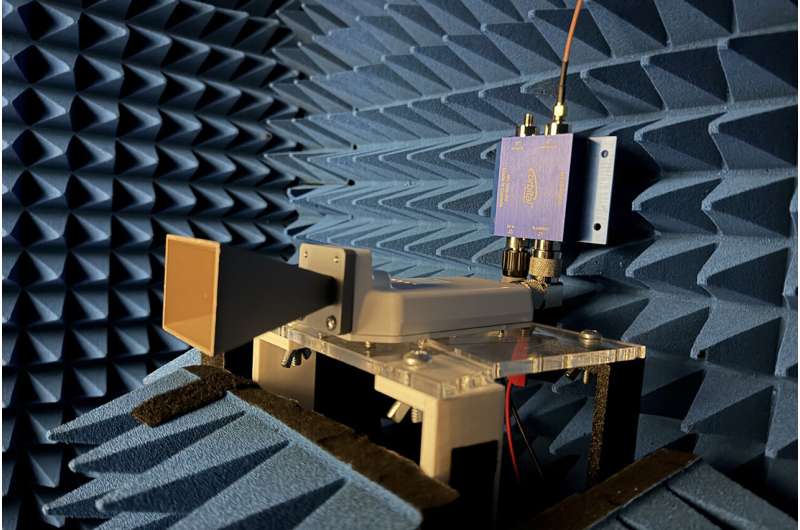
The key mechanism is that the receiver perceives the reflected noise as having different effective noise temperatures, described as hotter or colder. This difference does not require the transmitter to physically heat or cool anything. Instead, switching the circuit changes the noise reflected towards the receiver, allowing the information to be encoded without actively generating a radio-frequency carrier.
A model improves data transfer
One challenge was explaining how the system could distinguish information when the transmitter, receiver and surrounding environment were all at room temperature. To investigate this, the team constructed a shielded experimental chamber to prevent external signals from interfering with measurements.
The researchers developed a channel model describing the physical variables governing communication through thermal noise. Such models help engineers understand signal behaviour and optimise wireless links. Using the model to refine their setup, the team improved the data transfer rate by 100 times.
The technique could benefit applications that transmit small amounts of data while operating under tight power constraints. Potential uses include environmental sensors, low-power monitoring devices and systems operating near equipment sensitive to electromagnetic interference, such as medical instruments and radio astronomy observatories.Unlike conventional wireless transmitters, which expend energy generating a carrier signal, thermal noise communication relies on manipulating and reflecting existing electrical noise. This could help reduce both energy consumption and unwanted emissions.
However, practical deployment still faces challenges. The researchers are investigating how multiple transmitters can be connected into a network and how reliably the signals can be recovered in noisier, real-world environments.