

HomeEngineering Projects For YouDIY: 3D Scanner Using Just Arduino And Android Phone

DIY: 3D Scanner Using Just Arduino And Android Phone

The entire project is completely automated and available as open-source
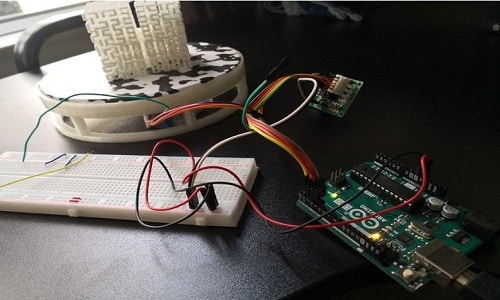
Connection using Arduino Uno (Image credit: https://blog.arduino.cc)

Thanks to advanced computational methods, 3D scanning can be used to create real-life, three-dimensional computer models of almost any object. To do so, one would need good programming skills along with some advanced hardware setup – things most of us aren’t willing to invest time in as it involves a time-consuming photo capturing process.

However, there’s an alternative way. To make a DIY 3D scanner, an Android phone, a stepper motor and an Arduino board are simply required. Best of all, the entire project is completely open-source.

- Advertisement -

Capturing images one at a time

A rotating base operated by a stepper motor is controlled by Arduino Uno and ULN2003 driver board. Upon this base, an object is placed that has to undergo 3D scanning. The communication is carried on WiFi through a simple TCP channel.
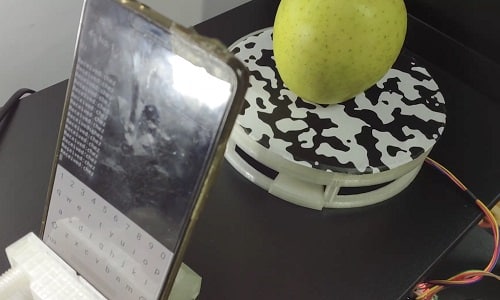
3D scanning an object (Image credit: https://blog.arduino.cc)

By taking approximately 180 images automatically via a Python script running on an Android phone, all of them are combined in the Meshroom, a free, open-source 3D reconstruction software, in order to create a 3D model that is identical to the actual object. As a result, this automated 3D scanner effectively saves huge amounts of time and cost.

- Advertisement -

All the source code and 3D model files are available on Thingiverse.

Source: Arduino blog


Vinay Prabhakar Minj
Vinay Prabhakar Minj is a technology writer and science communication specialist with a Master’s degree in Communication of Science and Innovation (Science Communication). He is a prolific contributor to Electronics For You, where he has authored over 1,000 articles covering electronics, semiconductors, embedded systems, IoT, and emerging technologies. With a strong foundation in science communication, Vinay focuses on translating complex engineering concepts into clear, accessible, and application-oriented content. His work spans topics such as sensor technologies, chip design, wireless systems, and next-generation electronics, making advanced innovations easier to understand for engineers, students, and industry professionals. Through his extensive contributions, he has built a reputation for delivering reliable, well-researched, and practical insights that help readers stay updated with the rapidly evolving electronics ecosystem. His writing bridges the gap between technical depth and real-world usability, supporting both learning and decision-making in the field.

SHARE YOUR THOUGHTS & COMMENTS

EFY Prime

Unique DIY Projects

Truly Innovative Electronics

Electronics News

Latest DIY Videos

Electronics Components

Electronics Jobs

Calculators For Electronics