To minimise dependence on electricity for recharging batteies, now researchers have developed a method to directly recharge using solar energy
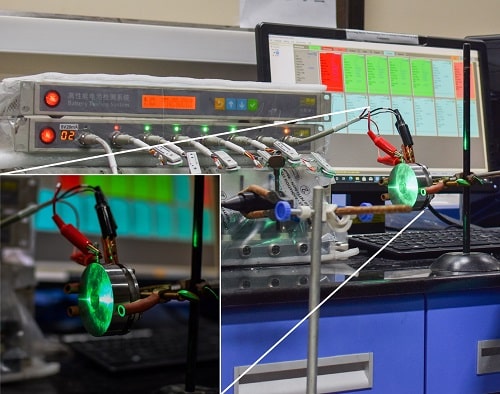
Lithium-ion batteries often need to be recharged by connecting them to an external electric power supply via a charger once the stored energy depletes.
To decrease dependence on electricity generated from non-renewable energy sources like coal, scientists have been exploring sustainable ways to recharge such rechargeable batteries.
Recently, a research team from the Tata Institute of Fundamental Research devised a compact lithium-ion battery with photosensitive materials that can be directly recharged with solar energy.
Photovoltaic cells were employed for converting solar energy into electrical energy. The stored energy in the battery was then used for powering electronic devices.

Avoiding Drawbacks
To prevent any losses during energy transfer, corrosion avoidance due to organic electrolytes etc., the help of photosensitive materials was taken that can incorporate lithium and result in a leak-proof, efficiently working solar battery.
Generally, one of the electrodes in solar batteries is physically mixed with a stabilising component for driving the flow of electrons through the battery. But that leads to limitations in optimal usage of surface area.
To avoid this, the research team created a heterostructure of photosensitive MoS2 (molybdenum disulphide) and MoOx (molybdenum oxide) to function as a single electrode. Being a heterostructure wherein the MoS2 and MoOx were fused, the electrode allowed for more surface area to absorb solar energy. When light rays hit the electrode, the photosensitive MoS2 generated electrons and simultaneously created vacancies called holes. MoOx kept the electrons and holes apart while transferring the electrons to the battery circuit.
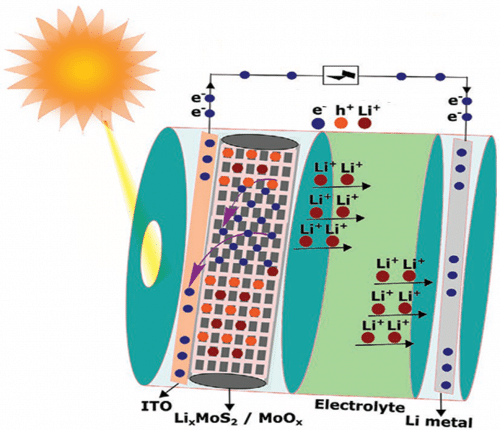
Completely assembled from scratch, the solar battery demonstrated good operation when exposed to simulated solar light.
The research team is currently working towards discovering the mechanism by which MoS2 and MoOx can work together with lithium anode for electric current generation. While the solar battery achieves a higher interaction of photosensitive material with light, it is yet to achieve the generation of optimum levels of current to fully recharge a lithium-ion battery. To solve this problem, the behaviour of heterostructure electrodes is being studied for addressing the challenges of modern solar batteries.
Read here for more