






Enter a contemporary data centre, industrial control room, telecom facility, or audio-visual control closet, and one common feature stands out: most, if not all, essential electronic equipment is housed in racks. Rack infrastructure has become the industry standard for housing electronics such as cloud computing servers, industrial control systems, networking switches, test and measurement equipment, edge AI devices, and broadcast electronics.
While the rack provides the basic structure for installing equipment, its overall performance depends largely on the accessories used with it. These include ventilation, cabling, cooling, maintenance, equipment accessibility, and provisions for future expansion.
Since electronic systems are becoming more and more compact and powerful, racks contain a combination of different items like servers, industrial PCs, PLCs, network gateways, power supplies, test equipment, audio-visual (AV) processors, storage, and embedded controllers. Some of these items cannot be attached directly to the rack rails.
To address these requirements, modern rack-mounting systems use shelves for equipment that cannot be rack-mounted, blanking panels to improve airflow, cable management devices to organise wiring, rack-mounted enclosures to protect electronic devices, and power distribution and cooling units. These accessories have become an integral part of modern rack infrastructure.
Why Rack Accessories Matter More Than Ever
Rack infrastructures are facing demands that have evolved tremendously over the last decade. The evolution of digital technology, artificial intelligence (AI), automation, edge computing, and networking is leading to greater equipment density in almost all industries.
A server rack that once housed only a few networking devices can now contain AI accelerators, GPU servers, storage servers, multiple power supplies, Ethernet switches, and security equipment. Automation cabinets are also becoming smaller while accommodating PLCs, industrial PCs, motion controllers, remote I/O modules, gateways, and power electronics. Similarly, telecommunication racks now house increasing volumes of networking equipment and 5G infrastructure, while modern audio-visual (AV) racks integrate media servers, digital signal processors, amplifiers, and network switches within a single enclosure.
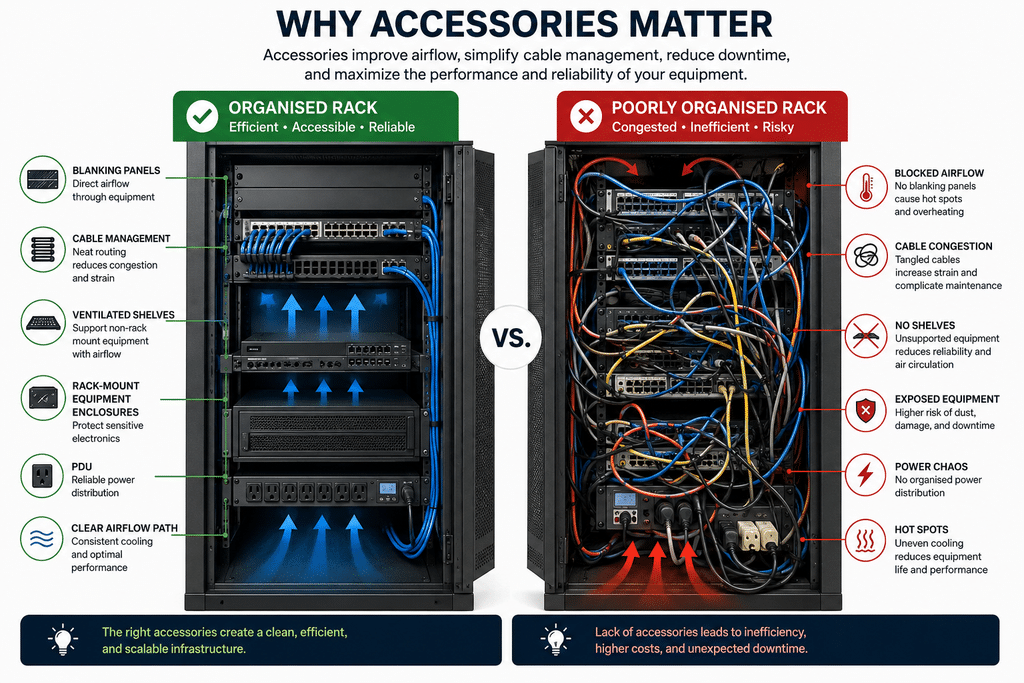
The higher the equipment density, the greater the heat generated. Poor airflow and inadequate cable management can create hot spots that reduce cooling efficiency and increase the operating temperature of electronic equipment. Maintenance also becomes more challenging, as servicing one device may require disconnecting cables or removing other equipment. “As AI workloads grow, innovation in rack infrastructure comes down to three things: faster data transfer, better thermal management, and reduced maintenance time through intelligent telemetry. Those are the areas where the biggest innovations are happening today,” said Ronak Kumar Samantray, founder of TakeMe2Space.
The expansion of the infrastructure makes the whole process even more complicated. Usually, racks get upgraded within a few years as new controllers, network components, storage, and monitoring equipment are added to the system. It means that equipment of various sizes needs special handling.
These challenges have made rack accessories an essential part of rack design. Shelves support equipment that cannot be mounted directly to rack rails, blanking panels improve airflow through unused rack space, cable management accessories minimise congestion, rack enclosures protect sensitive electronics, and cooling accessories help maintain safe operating temperatures. The better the cable management, the easier it is for engineers to locate and maintain cables. Organised cabling improves airflow, reduces the risk of errors during maintenance, and contributes to a more reliable rack system,” said Jash Jetly, Co-Founder & CEO, EVE NET
Rack Shelves: Supporting Equipment and Improving Accessibility
However, not all devices installed within a rack are designed to be rack-mounted. Although servers, switches, and networking devices are typically supplied with rack-mount brackets, many other electronic devices cannot be rack-mounted and require alternative mounting solutions.
Placing such equipment at the bottom of the rack creates several challenges. Equipment may shift during rack movement or maintenance, restrict airflow to adjacent devices, place undue strain on cables, and make servicing more difficult. Industrial environments subject to vibration pose additional challenges for unsupported equipment. Several factors determine the most suitable shelf for a particular application.
- Load capacity is often the first consideration. Industrial power supplies, uninterruptible power supply (UPS) modules, laboratory instruments, and communication equipment may weigh considerably more than compact networking devices. Selecting a shelf with sufficient structural strength prevents excessive stress on rack rails.
- Airflow is equally important. Where the equipment’s cooling path benefits from airflow beneath the chassis, a vented shelf can reduce obstruction compared with a solid shelf.
- Accessibility also affects maintenance efficiency. Equipment requiring regular calibration, servicing, or operator interaction often benefits from sliding shelves, while permanently installed devices can be securely mounted using fixed shelves.
Installation flexibility is becoming increasingly important as rack systems evolve. Because rack dimensions and equipment vary between manufacturers, shelves that offer installation flexibility are often required in mixed environments. A wide variety of rack shelves that cater to varying installation needs are discussed.
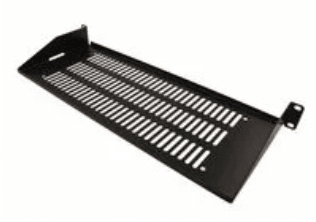
The HM1242-ND universal rack shelf features a steel construction and is designed for standard EIA-compliant rack systems. Rated to support up to 19 kg, it provides a mounting platform for equipment that cannot be installed directly on rack rails, including industrial controllers, telecommunications hardware, laboratory instruments, embedded computers, and power supplies.
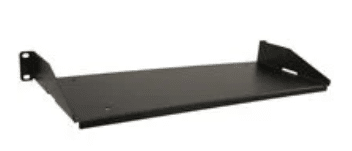
Where greater installation flexibility is required, the HM1239-ND can be installed either inside a rack as an equipment shelf or externally as a temporary work surface. Its 1U, 7-inch (17.78cm)-deep design provides a fixed platform for supporting non-rack-mount equipment while allowing flexible placement within standard 19-inch (48.26 cm) racks.
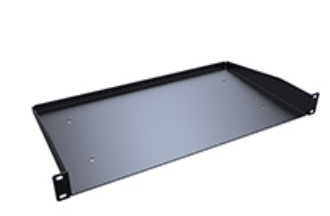
The HM2251-ND fixed shelf provides a mounting platform for equipment that cannot be mounted directly to rack rails in IT infrastructure, industrial control, audiovisual, and communications applications. Its fixed design supports equipment installed within standard EIA-compliant rack systems.
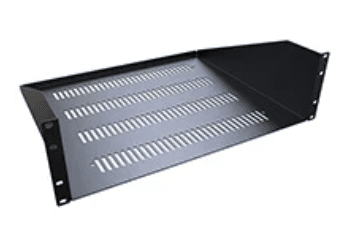
Some installations require additional equipment retention beyond standard shelf support. The HM756-ND is compatible with the optional RASCLAMP accessory, which secures equipment to the shelf for added stability. It has a load capacity of 91 kg. This is the vented version of Hammond’s 3U, 15-inch RAS shelf. A corresponding solid version is available separately in the RAS family.
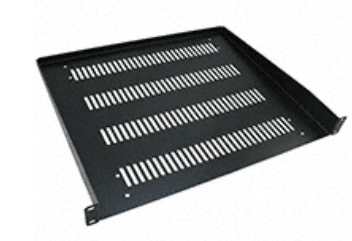
Similarly, the HM1590-ND is a fixed-vented steel rack shelf designed to support equipment that cannot be mounted directly to rack rails. Its vented construction promotes airflow around installed equipment while providing a stable mounting platform within standard EIA-compliant 19-inch (48.26 cm) racks with a load capacity of 19 kg.
Consider a manufacturing plant that uses a machine vision-based inspection system. A single rack may house an industrial computer, an Ethernet switch, a PLC, a UPS, a vision processor, a data acquisition system, and diagnostic tools. While some of these devices include rack-mount hardware, others are desktop-based and require shelf mounting. Universal shelves securely support these systems, vented shelves improve airflow beneath heat-generating equipment, and fixed shelves provide stable support for heavier devices.
A similar approach is widely used in telecommunications, broadcasting, laboratory facilities, and data centre applications, where components from multiple manufacturers and in different form factors must be integrated into a structured, accessible, and maintainable rack.
Rack Panels: Managing Airflow And Maximising Cooling Efficiency
Cooling is now among the most critical engineering challenges in modern rack infrastructure. Whether a rack houses AI servers, networking switches, industrial controllers, storage devices, or audio-visual equipment, almost all electronic equipment generates heat. As more equipment is installed within smaller spaces, effective thermal management becomes essential.
While some engineers focus on larger cooling fans or air conditioning systems, airflow within the rack must also be considered. In a well-designed rack, cool air enters through the front, passes through the equipment, and exits through the rear. ” A rack should have its thermal strategy built in. The longer GPUs can run without compromising performance or lifespan, the greater the uptime and revenue for a data centre,” said Ronak Kumar Samantray, founder of TakeMe2Space.
Unused rack spaces disrupt this airflow. If they are left uncovered, cool air escapes through these openings while hot exhaust air is drawn back towards the front of the rack. This can create hot spots, raise equipment inlet temperatures, and increase fan or facility cooling demand.
This issue is particularly significant in dense installations such as enterprise data centres, edge computing facilities, AI server deployments, and telecommunications infrastructure. Rack panels cover unused rack spaces to maintain proper airflow, reduce hot and cold air recirculation, and help prevent dust accumulation. They also contribute to a more organised rack layout. The following rack panels are designed for these applications. :
164-PBPS19001BK-ND is a 1U (1.75-inch) black steel rack panel designed to cover unused rack spaces.
Its solid, non-vented construction helps prevent air recirculation within the enclosure while providing a clean, finished rack appearance.
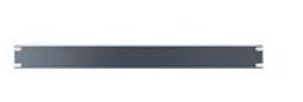
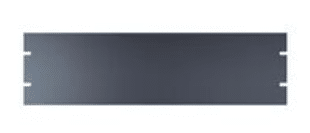
For installations where airflow control is particularly important, the 164-PBPS19005BK-ND steel blanking panel provides an effective solution. Installed across unused rack units, it helps reduce airflow leakage and prevent hot and cold air recirculation, supporting more efficient cooling within the cabinet. Its 14-gauge steel construction provides a durable solution for covering unused rack spaces in standard 19-inch (48.26 cm) rack systems.
For example, consider a server rack with virtualisation servers, storage systems, switches, and power supplies, where unused rack spaces remain between equipment groups. Although the cooling system supplies cold air to the rack front, some air escapes through these openings instead of flowing through the equipment. This allows hot exhaust air to recirculate, increasing temperatures and forcing cooling fans to work harder.
Installing blanking panels closes these gaps, directing airflow through the equipment and helping maintain consistent inlet temperatures while improving cooling efficiency. This approach is also used in industrial automation cabinets, telecommunications shelters, broadcast systems, and edge computing installations where thermal stability is important for equipment reliability.
Cable Management: Organising Wiring for Better Serviceability and Airflow
Cable management plays an important role when designing a rack since the quantity of connections can increase drastically due to increased complexity of systems. Imagine the rack for telecommunication that carries such devices as Ethernet switches, routers, fibre interfaces, power supplies and many other pieces of networking equipment. As new equipment is added and old equipment is exchanged, cables often get rearranged and become hard to trace and manage. Structured cable management provides organized system of cables and makes maintenance and further upgrade much easier.
Cable straps, routing components and hardware to support cables will ensure defined paths of cabling without unnecessary limitation of cables. This will be especially helpful in cases where connection configuration changes frequently. For example, reusable tie wraps will make it possible to rearrange cable bunches without using one-time use ties.
Managing Cable Bundles in High-Density Racks
Organization of cables is even more crucial when rack density is increased. There might be a multitude of network, storage and power cables that will be connected between the equipment installed on various heights of the rack. Accumulation of such cables in front of the equipment makes it difficult to recognize particular cables and take equipment out for servicing. TS series pre-cut hook and loop cable ties from Hammond are meant for reusable bundling of cables in rack, network, IT and AV installations. The TS96 model gives 96 inches long strap with 0.50 inch width that makes it possible to bundle more cables than usual without having a big spool. Since the system is hook and loop-based, it can be opened and used again when there is a need to add or remove the cable. It is especially handy when it comes to a network rack when switches are changed or there is a need to make additional connections.

Supporting Airflow and Thermal Management
Cable management is also an important aspect that helps in ensuring a well-organised flow of air. In the case of a high-density rack with server machines and network switches, the untidy placement of cables will lead to accumulation of the cables around the machine interfaces. This can lead to blocking of the space through which cooling air is supposed to flow. This ensures that cables do not become a hindrance to airflow. Industrial control racks with PLC, industrial PC, Ethernet switches, I/O modules, and power supplies have the same considerations. Proper cable management will ensure orderliness of the setup alongside other aspects like vented shelves and blanking panels. The cable management thus forms an integral part of the entire rack setup and cannot be considered merely an aesthetic element.
Reusable Cable Management for Changing Installations
One of the benefits of hook-and-loop cable management system is the ability to use it in situations where cable paths might need to be changed. This kind of situation is possible within a telecommunications or data-centre setting due to the changing nature of switches, connections or relocation of equipment. Hammond TS Series is made for such situations. Reusability means that changes to the installation can be done without the necessity of cutting the strap; moreover, the flexibility of the material prevents the problems with over-tightening inherent to the rigid cable ties. The pre-cut material also makes it unnecessary to deal with cutting material from bulk spools. For example, when there is an upgrade to the rack and the installer needs to add some Ethernet connections, he/she can just open the strap, put new cables inside and tighten the strap again without installing the whole new system of fasteners.
Managing Vertical Cable Runs
Cable volumes are not limited to individual rack modules. In some cases, cables can originate in overhead trays or ladder racks and descend down through the equipment to branch off to individual pieces. The TS Series is also suitable for organizing cable runs vertically and large cable volumes in racks, cabinets, ladder racks, and tray systems. Cables are kept in one bundle on their way while making them available individually when needed. In the example of a telecom rack, a large cable bundle might enter the rack from above before being distributed across multiple switches. It is more convenient to support the cable vertically rather than have it dangling over the front of the equipment.
Reducing Maintenance Effort and Cable Strain
Cable management is also an issue of ease of access to connections. Untended or inadequately organized bunches put unwanted pressure on the connectors as cables get pulled or handled during installation and maintenance operations. For instance, an engineer installing a communication module in an industrial automation cabinet would have to do so without disconnecting the nearby cables. If a bunch of cables was properly supported, the engineer would not be required to untangle the nearby cables to reach the connection. Due to the flexible fastening mechanism employed in the TS Series, cables can be tied without compressing them. Hammond has designed the straps for use in such areas as large cable bunches, vertical installations, structured cabling, IT rooms, network and telecommunication installations, and AV environments.
Designing Cable Management for Future Expansion
Cable management must also take into account the future changes. The rack that looks neat during the commissioning process may later be crowded when new switches, storage devices, communication ports, or control units are added. Allowing enough space in cable ways and having reusable cable tie systems will facilitate such changes. Instead of making a new bundle every time a new piece of equipment is added, one will be able to untie existing ties, insert new cables, and rearrange cable routing as needed. It means that cable management is a design feature and not just the process of installation. Together with the proper choice of rack shelves, panels, enclosures, and other accessories, cable routing helps to make rack systems which are easier to maintain, more adaptable to equipment changes and suitable for high density installations. To address this need, Hammond offers its TS Series, which is a simple and reusable cable management system. Pre-cut 96-inch system, hook-and-loop tie design, and applicability to rack, cabinet, vertical, ladder-rack, and tray applications make it a good choice where cable routing needs to be flexible in case of further changes in the installation.
Rack-Mount Enclosures: Protection, Flexibility, And Space Optimisation
While many electronic products are supplied with standard rack-mount brackets, several embedded systems require additional mechanical protection before integration into rack infrastructure.
Industrial computers, embedded controllers, communication gateways, RF equipment, custom electronics, FPGA development systems, power control modules, laboratory instruments, and networking appliances often use printed circuit boards or electronic assemblies that need enclosure protection. Enclosures provide mechanical protection, help prevent accidental contact with internal electronics, and provide a structured mounting environment. Environmental protection against dust or moisture should be assessed separately from the enclosure’s specified ratings.
The growing adoption of edge computing, industrial IoT, telecommunications equipment, and embedded AI platforms has increased demand for lightweight rack-mounted enclosures that combine protection with installation flexibility.
Material selection is critical in enclosure design. Steel provides high structural strength but can increase overall rack weight, especially when multiple devices are installed in the same cabinet. Aluminium offers a lighter alternative with good mechanical strength and corrosion resistance, making it suitable for telecommunications cabinets, portable racks, mobile command centres, broadcast systems, and edge computing deployments where reduced weight simplifies handling and installation.
Installation flexibility is another key consideration. Electronic assemblies may require different mounting arrangements, including standard front mounting, rear support, deeper installation, or customised internal configurations. To meet these requirements, Hammond Manufacturing provides a range of rack-mounted enclosure solutions.
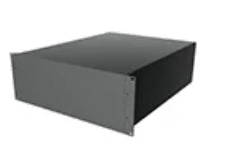
The HM2338-ND corresponds to Hammond’s RM4U1922SBK solid 4U rack/desktop enclosure. A separate vented variant is available where airflow through the enclosure is required. The enclosure can be used as a desktop unit or installed in a 19-inch (48.26 cm) rack using mounting brackets, providing flexibility for different installation requirements. Optional accessories, including rack-mount kits for deeper models, help accommodate various equipment configurations, making it suitable for electronic instruments, controllers, communication equipment, and industrial electronics.
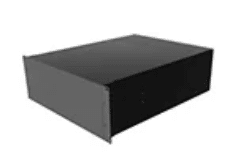
Similarly, the 164-RM4U1928SBK-ND features an aluminium construction with extruded aluminium side, front, and rear panels, providing a lightweight enclosure solution for housing rack-mounted electronic assemblies. Its 4U, 19-inch (48.26 cm) rack-compatible design supports applications requiring a durable enclosure for instrumentation, controllers, and other electronic equipment.
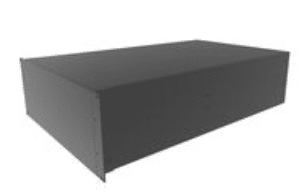
For designers requiring installation flexibility, the HM2339-ND provides a lightweight aluminium enclosure option that supports both 19-inch (48.26 cm) rack mounting and desktop use. Its aluminium construction and durable finish make it suitable for protecting electronic equipment in a range of applications.
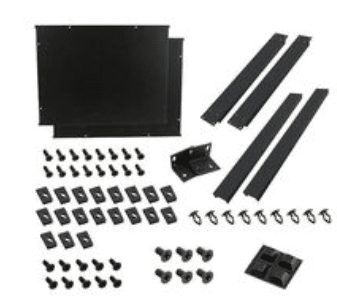
The HM996-ND demonstrates how rack-mounted enclosures can make efficient use of standard rack space while providing a compact, lightweight aluminium structure for housing electronic assemblies. Its 1U, 19-inch (48.26 cm) rack-compatible design makes it suitable for applications such as electronic instruments, controllers, and other equipment requiring rack integration.
Within a suitably protected telecommunications cabinet, lightweight aluminium rack enclosures can be used to house custom electronic assemblies. The outer cabinet must provide the required environmental and ingress protection for the installation. These cabinets often contain networking devices, fibre interfaces, industrial gateways, control electronics, backup power systems, and monitoring hardware.
Rack enclosures help reduce overall rack weight while providing organised installation, easier upgrades, and simplified field maintenance by allowing individual systems to be replaced without affecting nearby equipment. This approach is also used in industrial automation, embedded computing, laboratory instrumentation, broadcasting, and networking applications where reliable, serviceable electronic installations are required.
Future Trends In Rack Infrastructure Design
The evolution of rack infrastructure has been driven by advances in AI, edge computing, factory automation, high-speed networking, and distributed computing. Increasing equipment density and limited installation space have made rack accessories essential for improving the performance, maintainability, scalability, and reliability of rack infrastructure. “The fastest way to improve retrieval systems is by upgrading the hardware, especially the cables. The quick the data transfer, the better the retrieval performance. It is fundamentally a hardware issue, not a software one”, said Jash Jetly, Co-Founder & CEO, EVE NET.
The growing adoption of edge computing has led to the deployment of compact computing systems near factories, telecom stations, transport systems, hospitals, and smart cities. These space-restricted installations include network devices, factory automation devices, storage devices, and power supplies that are integrated into a compact rack enclosure. Flexibly adjustable shelves, lightweight rack-mount enclosures, cable management solutions, and airflow management solutions can facilitate these types of installations.
AI servers with GPUs, high-performance processors, and large memory capacity produce significantly more heat as compared to previous-generation machines, leading to an increased need for effective thermal management, including airflow-management measures such as blanking panels and vented shelves, together with active cooling where required.
Industrial automation systems are also becoming more complex, incorporating industrial PCs, machine vision processors, edge AI systems, industrial Ethernet switches, cybersecurity devices, and monitoring equipment alongside traditional PLCs and motor drives. Rack-mount accessories should therefore accommodate equipment of varying dimensions while helping organise installation space and simplify maintenance.
Modern infrastructure is becoming increasingly modular, allowing organisations to expand systems with minimal disruption. Standardised shelves, modular racks, cable management systems, and scalable power distribution support future expansion. Advanced infrastructure management techniques, including environmental monitoring, predictive maintenance, and remote diagnostics, also increase the demands placed on rack infrastructure, making efficient cooling, streamlined maintenance, and straightforward equipment replacement increasingly important.
Today, racks can be used not only to store equipment. In data centres, industrial automation systems, telecommunications networks, audiovisual systems, and laboratories, racks are expected to accommodate diverse types of equipment with increasing heat, mechanical, and operational loads. Shelves allow accommodating non-rack-mountable equipment; panels contribute to the control of airflow and the cooling process; rack-mounted enclosures ensure the protection of sensitive electronic parts while offering convenient installation. All the accessories allow increasing the level of equipment protection, efficient thermal management, servicing, and infrastructure sustainability.
While the computing platform development tends to evolve toward AI-based systems, edge computing, industrial automation, and denser networks, choosing the appropriate rack accessories will become increasingly important. The range of shelves, panels, rack-mounted enclosures, and other accessories offered by Hammond Manufacturing supports the development of organised, thermally efficient, and scalable rack infrastructure.
| S.NO | Digikey Part Number | Specs | Brand | Direct Links |
| 1 | HM1242-ND | Metal, Steel Shelf, Fixed 7.000″ L x 19.300″ W x 1.720″ H (177.80mm x 490.22mm x 43.69mm) Black | Hammond Manufacturing | click here |
| 2 | HM1239-ND | Metal, Steel Shelf, Fixed 7.000″ L x 19.000″ W x 1.720″ H (177.80mm x 482.60mm x 43.69mm) Black | Hammond Manufacturing | click here |
| 3 | HM2251-ND | Metal, Steel Shelf, Fixed 15.000″ L x 17.500″ W x 3.470″ H (381.00mm x 444.50mm x 88.14mm) Black | Hammond Manufacturing | click here |
| 4 | HM756-ND | Metal, Steel Shelf, Fixed 15.000″ L x 17.500″ W x 5.220″ H (381.00mm x 444.50mm x 132.59mm) Black | Hammond Manufacturing | click here |
| 5 | HM1590-ND | Metal, Steel Shelf, Fixed 15.000″ L x 17.500″ W x 1.720″ H (381.00mm x 444.50mm x 43.69mm) Black | Hammond Manufacturing | click here |
| 6 | 164-PBPS19001BK-ND | Metal, Steel Panel, Front 19.000″ L x 1.720″ W x 0.072″ H (482.60mm x 43.69mm x 1.83mm) Black | Hammond Manufacturing | https://www.digikey.in/en/products/detail/hammond-manufacturing/PBPS19001BK/16675656 |
| 7 | 164-PBPS19005BK-ND | Metal, Steel Mounting Panel 5.250″ H (133.35mm) Black | Hammond Manufacturing | click here |
| 8 | TS96 | Pre-cut 96-inch nylon hook-and-loop straps provide reusable, non-damaging, and easily adjustable cable bundling for rack, network, AV, and structured-cabling applications. | Hammond Manufacturing | click here |
| 9 | HM2338-ND | Extruded aluminium side panels 0.125″ (3.2 mm) thick Extruded aluminium front and rear panels 0.125″ (3.2mm) thick Flat aluminium top and bottom panels 0.064″ (1.6 mm) thick | Hammond Manufacturing | click here |
| 10 | 164-RM4U1928SBK-ND | Extruded aluminium side panels 0.125″ (3.2 mm) thick Extruded aluminium front and rear panels 0.125″ (3.2mm) thick Flat aluminium top and bottom panels 0.064″ (1.6 mm) thick | Hammond Manufacturing | click here |
| 11 | HM2339-ND | Extruded aluminium side panels 0.125″ (3.2 mm) thick Extruded aluminium front and rear panels 0.125″ (3.2mm) thick Flat aluminium top and bottom panels 0.064″ (1.6 mm) thick | Hammond Manufacturing | click here |
| 12 | HM996-ND | Aluminium Chassis, Enclosed 13.000″ L x 16.600″ W x 1.750″ H (330.20mm x 421.64mm x 44.45mm) Black | Hammond Manufacturing | click here |
| Quick Checklist And Key Considerations For Selecting Rack Accessories Selecting rack accessories involves much more than ensuring physical compatibility. The right accessories improve thermal performance, simplify maintenance, support future expansion, and protect valuable electronic equipment throughout its operational life. Checklist Before Selecting Rack Accessories: ✔ Evaluate Equipment Weight: Verify rack shelf load ratings before installation, accounting for both current and future equipment. Use reinforced or fixed shelves for heavier loads. ✔ Consider Airflow Requirements: Use vented shelves for heat-generating equipment, install blanking panels to seal unused rack spaces, and keep cables properly managed to maintain unobstructed front-to-rear airflow. ✔ Verify Rack Compatibility: Verify compatibility with standard 19-inch (48.26 cm) EIA racks, confirm rack depth before choosing shelves or enclosures, and reserve enough rack units (U) for future expansion. ✔ Plan for Equipment Accessibility: Use sliding shelves for easy servicing and equipment replacement, fixed shelves for permanent installations, and leave enough clearance for cable connections and maintenance. ✔ Organise Cabling: Where appropriate for EMC and safety requirements, separate power and signal/data cabling and avoid routing sensitive signal cables alongside high-current or high-noise conductors. ✔ Consider Environmental Conditions: For vibration-prone installations, use equipment-retention hardware and verify the rack, shelf, mounting hardware, and equipment are suitable for the expected vibration environment. ✔ Plan for Future Expansion: Reserve spare rack units, choose modular accessories for easy upgrades, and plan for future networking, storage, and computing expansion. |
Common Mistakes To Avoid
| • Selecting shelves based only on dimensions instead of load capacity • Leaving unused rack spaces open, resulting in poor airflow and hot spots • Overloading shelves beyond their rated capacity • Allowing cables to obstruct ventilation paths • Ignoring future expansion requirements when planning rack layouts • Installing equipment without considering maintenance accessibility • Mixing equipment depths without verifying shelf compatibility A small amount of planning during rack design can significantly improve equipment reliability, cooling efficiency, and long-term serviceability. |


