Build better EV power systems with these five DC-DC converter reference designs for charging and battery management.
DC-DC converter reference designs help engineers address the demands of efficient power transfer between battery systems, onboard electronics, and charging infrastructure, including high efficiency, high power density, and bidirectional operation. The five reference designs cover applications ranging from 12V/48V battery management and onboard power conversion to high-power isolated converters for DC fast charging.
60kW isolated DC-DC converter
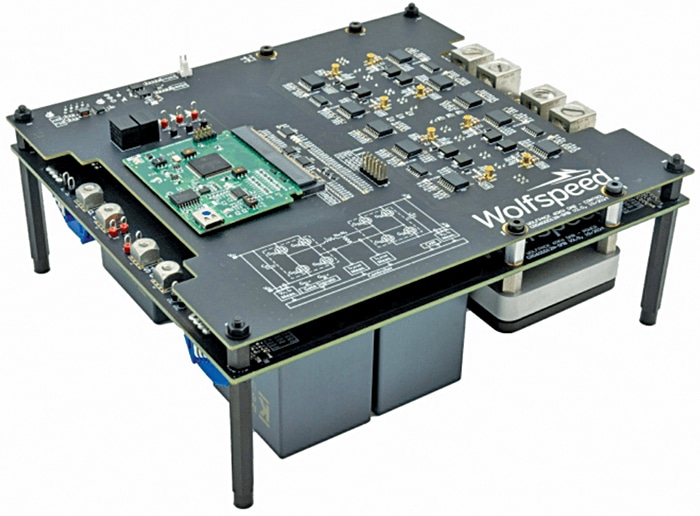
This reference design uses a dual active bridge topology and fourth-generation silicon carbide power modules for bidirectional power conversion at high efficiency and power density. It operates at a switching frequency of 100kHz with zero-voltage switching on both sides. The leakage inductance of the high-frequency isolation transformer handles power transfer, eliminating the need for an additional magnetic component. The converter achieves a peak efficiency of 99.2%, maintains efficiency above 98.8% above 20kW, and delivers a power density of 10.5kW/L, including the transformer. The evaluation platform includes isolated gate drivers, an embedded controller with programmable firmware, CAN communication, and protection features such as desaturation-based overcurrent protection, Miller clamping, and temperature monitoring. The modular design allows multiple converters to be connected in parallel to achieve higher power levels.
Applications. The design is suitable for renewable energy systems, energy storage, and EV fast-charging infrastructure.
OEM Brand. Wolfspeed
See more details about the 60kW Isolated DC-DC Converter
SiC-based polymorphic DC-DC converter
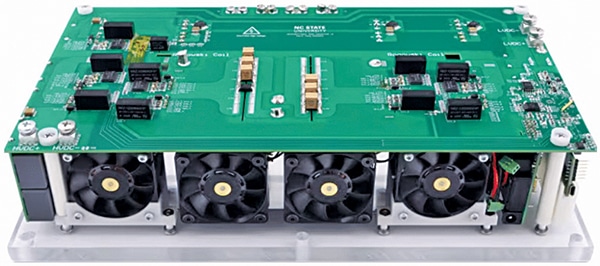
The reference design is a silicon carbide (SiC)-based isolated polymorphic DC-DC converter for 30kW applications. It uses 1200V SiC MOSFETs and SiC Schottky barrier diodes in an isolated asymmetrical dual full-bridge (phase-shifted full-bridge) topology to achieve 98.5% efficiency and a power density of 7.2kW/L. The converter supports a 4:1 output voltage range while maintaining zero-voltage switching across all operating conditions to reduce switching losses. It uses a carrier-based modulation method similar to that of a buck converter and a proportional-integral (PI) controller to regulate output voltage and current. Software-selectable constant-voltage and constant-current modes are also supported. The reference design allows engineers to evaluate the efficiency, voltage range, and switching performance of SiC devices in high-power DC-DC conversion systems.
Applications. The design is suitable for hybrid and electric vehicle chargers, fast DC chargers, renewable energy systems, industrial power supplies, data centres, telecommunications equipment, and battery backup systems.
OEM Brand. Microchip
See more details about the SiC-Based Polymorphic DC-DC Converter Reference Design
Bi-directional, dual active bridge
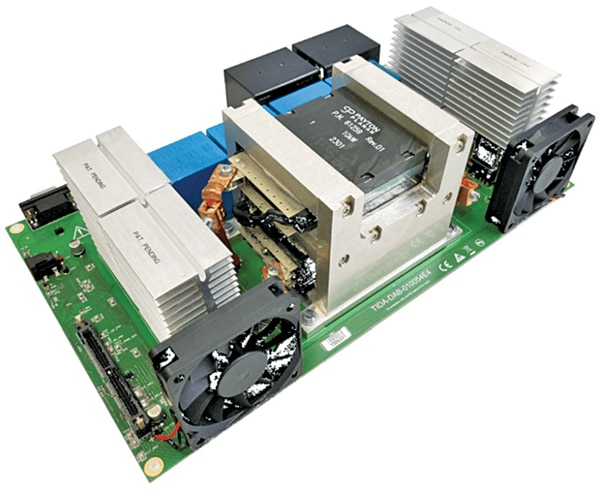
Texas Instruments’ (TI) reference design supports battery charging and discharging through single-phase-shift (SPS) and extended-phase-shift (EPS) control while enabling soft switching to reduce switching losses without auxiliary components. Its modular structure allows multiple converters to be combined for higher power levels. The converter delivers up to 10kW, with peak efficiency of 98.7% and 98% efficiency at full load. It operates with a primary voltage of 700V-800V DC and a secondary voltage range of 350V-500V DC under SPS or 250V-500V DC under EPS. The 100kHz switching frequency allows the use of a compact planar transformer. The design also includes isolated voltage and current sensing, a smart gate driver with integrated protection for silicon carbide MOSFETs, and a digital controller.
Applications: The reference design is intended for single-phase DAB converters used in DC fast chargers, energy storage systems, power conversion systems, and hybrid and electric vehicle powertrains.
OEM Brand: Texas Instruments (TI)
See more details about the Bi-Directional, Dual Active Bridge Reference Design
DC-DC converter with DAB topology
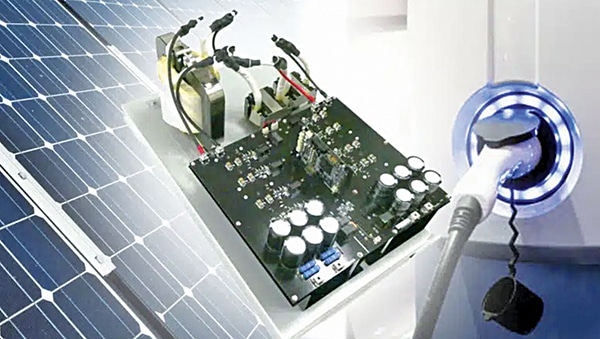
The reference design is a 5kW isolated bidirectional DC-DC converter for EV charging infrastructure and solar power systems. The design uses a dual active bridge (DAB) topology with full bridges on both the high- and low-voltage sides, enabling bidirectional power transfer by controlling the phase difference between the two bridge circuits. Compared with half-bridge topologies, the full-bridge DAB configuration supports higher power levels and enables soft switching through phase-shift power transfer, reducing switching losses and improving conversion efficiency. By using SiC MOSFETs instead of insulated gate bipolar transistors (IGBTs), the design achieves higher switching frequencies, lower switching losses, and higher conversion efficiency than IGBT-based designs.
Applications. The reference design is suitable for EV charging stations and solar power inverters.
OEM Brand. Toshiba
See more details about the DC-DC Converter Reference Design With DAB Topology
High-efficiency bidirectional DC-DC converter
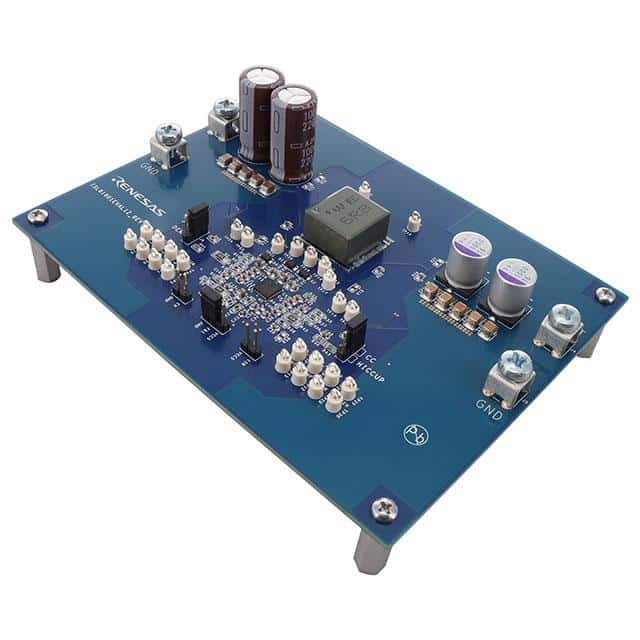
Renesas’ reference design for a bidirectional 12V/48V DC-DC converter transfers more than 3kW of power with over 95% efficiency, enabling power to flow between 12V and 48V battery networks. It steps down power from the 48V battery to supply 12V electronics such as lighting, infotainment, ECUs, sensors, and safety systems, while also boosting the voltage from the 12V side to charge the 48V battery when required. This supports regenerative braking, battery management, and load balancing. Based on the LV148 48V automotive power-supply standard, the reference design uses a bidirectional analogue controller instead of a DSP-based control system, reducing software complexity, PCB size, bill-of-materials costs, and development time.
It also features a multi-phase synchronous DC-DC topology that improves power density, reduces thermal stress, and supports faster transient response, while integrating power devices, gate drivers, microcontrollers, voltage regulators, and protection circuitry.
Applications. The design supports dual-voltage power systems in electric vehicles, hybrid electric vehicles, mild hybrid electric vehicles, and electric two-wheelers.
OEM Brand. Renesas
See more details about the Reference Design For High-Efficiency Bidirectional DC-DC Converter
These reference designs address different EV power conversion requirements using technologies such as dual active bridge topologies, bidirectional power conversion, and silicon carbide devices. Together, they demonstrate approaches for improving efficiency and power density while reducing development effort across EV charging, battery management, energy storage, and other power conversion applications.
Nidhi Agarwal is Senior Technology Journalist at EFY with a deep interest in embedded systems, development boards, and IoT cloud solutions.