




See how a reference design combines touch controls with vibration feedback to help build products and test different touch input methods.
Capacitive touch controls have become common in products such as home appliances, industrial equipment, medical devices, and consumer electronics. They replace mechanical buttons with flat touch surfaces, making products easier to clean, more durable, and more flexible in design. However, one challenge with touch interfaces is the lack of physical feedback. Users may not always know whether a touch has been detected, especially when wearing gloves or operating a device without looking at the display.
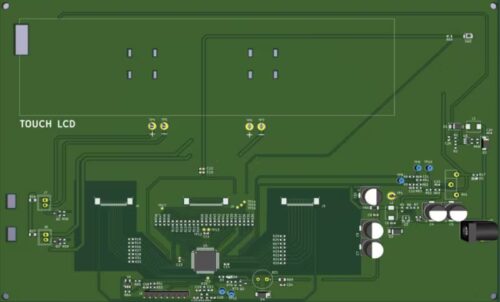
A reference design from Microchip shows how you can combine capacitive touch sensing with haptic feedback to create a more responsive user interface. It includes touch buttons, a linear slider, and a touch wheel, allowing engineers to evaluate different touch input methods in a single platform. The addition of haptic feedback provides a short vibration or pulse whenever a touch is detected, giving users confirmation that their input has been registered.
For design engineers, the reference design can serve as a starting point for developing products with modern touch interfaces. Instead of designing a complete touch system from scratch, engineers can study the hardware and software implementation, understand the tuning process, and adapt the design to suit their own products. This can reduce development effort and help shorten the time required to build a working prototype.
The touch buttons can be used to replace traditional push buttons for functions such as power, mode selection, start, or stop. The slider enables smooth adjustment of settings such as brightness, volume, fan speed, or temperature. The touch wheel provides intuitive circular control for applications that require continuous adjustment, such as audio systems, lighting controls, menu navigation, or appliance settings.
The haptic feedback feature is particularly useful in products where users need confirmation without relying on visual indicators. A short vibration can acknowledge a successful button press, indicate that a setting has changed, or notify users when a control reaches its minimum or maximum value. This helps improve the overall user experience while reducing accidental or repeated touches.
You can also use the reference design to understand how capacitive touch sensing performs under different operating conditions. The design supports evaluation of touch sensitivity, response time, and noise immunity, helping developers optimize performance for products that may be exposed to electrical noise, moisture, or varying environmental conditions.
The platform can be adapted for a wide range of applications, including washing machines, microwave ovens, induction cooktops, coffee machines, thermostats, smart home control panels, industrial human-machine interfaces, medical equipment, access control systems, and office devices. Since the touch controls are implemented on a flat surface, they also make it easier to create sealed enclosures that resist dust, dirt, and moisture.
Microchip has tested this reference design. It comes with a bill of materials (BOM), schematics, assembly drawing, printed circuit board (PCB) layout, and more. The company’s website has additional data about the reference design. To read more about this reference design, click here.

