
Imagine a world where microcontrollers (MCUs) and development boards operate without batteries. Energy-harvesting technology now makes this a practical reality. Several batteryless IoT sensors already capture power from ambient sources such as light, heat, vibration, and RF signals, enabling fully autonomous operation. Engineered for ultra-low-power performance, these devices typically consume only a few microamps to milliamps and employ multiple deep-sleep modes to maximise energy efficiency.
POC Video Tutorial
For prototyping, learning, or experimental work, engineers often need a general-purpose microcontroller rather than a specialised sensor. This design introduces a proof-of-concept system that demonstrates continuous operation of an MCU paired with an OLED display, entirely without a battery and without relying on sleep modes. Ambient energy is harvested, stored in a supercapacitor, and used to power both the MCU and the display continuously.
The system intentionally showcases a comparatively power-hungry configuration, including an always-active OLED display, yet still operates without a battery. During testing, the complete setup, comprising the MCU and OLED display with active processing, ran for up to five minutes on a single charge in normal operating mode.
When configured for ultra-low-power operation, the system continued to function for up to 25 minutes without an external power source, drawing only 6-7mA in total. Additional optimisation remains possible through more energy-efficient components, reduced display refresh rates, lower brightness levels, or improved duty-cycling techniques.
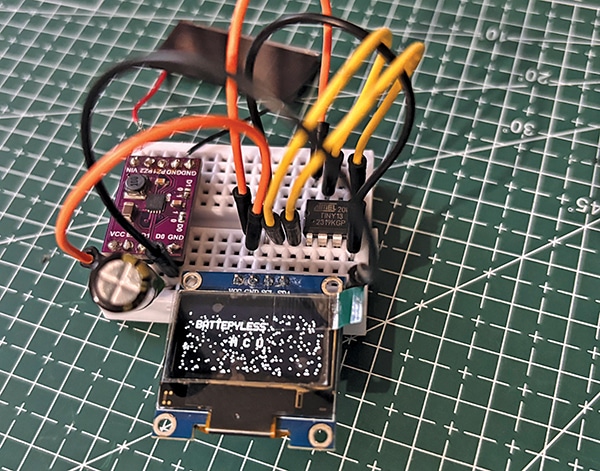
Fig. 1 shows the author’s prototype of an MCU and OLED display running entirely without a battery.
Bill of materials
During the testing phase, the LTC3588 energy-harvesting IC was used along with a supercapacitor to collect and store ambient energy. However, the supercapacitor’s charging time was relatively long. To overcome this limitation, two specialised energy-harvesting ICs were incorporated into an improved design. One IC was optimised for harvesting energy from direct sunlight and indoor ambient light, while the other was dedicated to electromagnetic induction and vibration-based energy harvesting.
Energy harvested from both sources was combined and stored in the supercapacitor, which continuously powered the microcontroller. This enhanced approach enabled approximately 20-25 minutes of uninterrupted operation without requiring a battery. The components required to build this system are listed in Table 1.
| Table 1 Bill of Materials | ||
| Components | Designator | Quantity |
| Piezo transducer | PZ1, PZ2 | 2 |
| Supercapacitor 2.7V, 6F | C1, C2 | 2 |
| 10µF capacitor | C3, C7 | 2 |
| 10nF capacitor | C4 | 1 |
| 1µF capacitor | C5 | 1 |
| 47µF capacitor | C6 | 1 |
| 1N5819 diode | D1, D2 | 2 |
| Inductor coil (6SWG copper enamelled wire around 60 turns air core) | L1 | 1 |
| 10µH inductor coil | L2 | 1 |
| SSD1306 OLED display | LCD1 | 1 |
| Push switch (normally open) | SW1 | 1 |
| Solar cell 3V, 50mA | PV1 | 1 |
| 9.9kΩ resistor | R1 | 1 |
| 2.26MΩ resistor | R2 | 1 |
| 1MΩ resistor | R3 | 1 |
| LTC3588 energy harvesting IC | U1 | 1 |
| LTC3105EMS energy harvesting IC | U2 | 1 |
| ATtiny13A microcontroller | U3 | 1 |
In many modern batteryless devices, numerous ultra-low-power MCUs are available. Some are BLE-based and consume extremely low power, often in the microamp range or even nanoamp range in deep-sleep modes, while operating at 3V or 1.8V supply voltages. For simplicity and easy availability, the ATtiny13A microcontroller was selected for this design.
According to the datasheet, the device offers very low power consumption across different operating modes. In active mode, it typically consumes around 190µA at 1.8V and 1MHz. In idle mode under the same conditions, the current drops to approximately 24µA. In power-down mode, with the watchdog timer disabled, current consumption is typically less than 0.1-0.3µA. These low-power characteristics make the ATtiny13A suitable for energy-harvesting and batteryless applications.
During prototype testing, the ATtiny13A operated at its maximum internal clock frequency of 9.6MHz with a supply voltage of 2.7V provided by the charged supercapacitor. At these higher frequencies and voltages, current consumption increased significantly, as power scales approximately linearly with clock frequency and supply voltage. The measured active-mode current ranged from 2.8-3.5mA.
The SSD1306 OLED display contributes a significant portion of the total power consumption. In sleep mode, current is below 10µA. With a completely black screen, it draws 1-2mA. Typical text or icon display (25-50% of pixels lit) consumes 8-12mA, while a full white screen can increase consumption to 20-30mA.
Testing showed that the combined ATtiny13A–SSD1306 system consumed 6-7mA continuously during moderate display activity. This allowed the 2.7V, 3F supercapacitor to power the system for up to five minutes in normal operation and up to 20-25 minutes in optimised low-power modes using reduced update frequency, lower contrast, or brief sleep intervals. Table 2 summarises the measured power consumption.
| Table 2 Power consumption of ATtiny13A+SSD1306 OLED | ||||
| Mode/Condition | ATtiny13A Current | SSD1306 OLED Current | Total System Current (Typical) | Notes/Conditions |
| Power-down (deep sleep) | 0.1-0.3µA | <10µA | ~10µA | Watchdog disabled; OLED in sleep mode |
| Idle mode | ~24µA (1MHz) | 1-2mA (black screen) | ~1-2mA | 1.8V/1MHz; OLED ON but no pixels lit |
| Active mode (low frequency) | ~190µA | 8-12mA (typical content) | ~8-12mA | 1.8V/1MHz; typical text/icons displayed |
| Active mode (prototype design) | 2.8-3.5mA | 8-12mA (typical content) | 6-7mA (measured) | 2.7V/9.6MHz; moderate OLED usage |
| Active mode – Maximum OLED load | 2.8-3.5mA | 20-30mA (full white screen) | 23-33mA | Worst case: all pixels ON, high contrast |
| Optimised low-power mode (intermittent) | ~0.5-1mA (average) | ~1-2mA (average) | ~1-3mA (average) | Duty cycling; OLED updated every 10-60 seconds |
Two approaches are possible.