What if your skin could compute in real time detecting heart failure risks instantly without sending data anywhere outside your body?
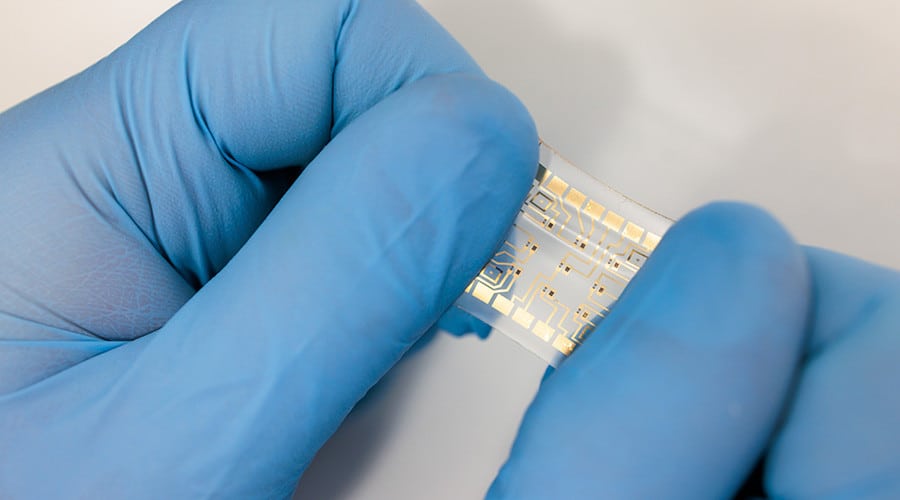
Researchers at the University of Chicago Pritzker School of Molecular Engineering, working with Argonne National Laboratory, have developed a skin-like computing patch that can run artificial intelligence directly on the human body. The system processes health data in milliseconds, removing the need to send information to external computers or cloud servers.
The technology enables real time health analysis at the point of sensing, reducing delays that can be critical in life threatening conditions such as cardiac arrhythmias. It brings the possibility of continuous, immediate monitoring that reacts instantly to physiological changes.
Unlike conventional wearable devices that only collect data and transmit it elsewhere for processing, this system performs computation locally. This eliminates communication lag, improves privacy, and allows time sensitive decisions to be made directly on the body, which is especially important for rapid events like ventricular fibrillation.
The patch is built from large scale arrays of stretchable organic electrochemical transistors that behave like synapse inspired computing elements. These components are printed onto flexible substrates using a new ultraviolet light patterning method that stabilizes gel like materials into precise transistor structures, enabling densities of around 10,000 devices per square centimeter. The system integrates neuromorphic computing principles, allowing it to run trained neural networks directly on flexible hardware while maintaining accuracy even under mechanical stretching.
In demonstrations, the device identified dangerous cardiac wave patterns with 99.6 percent accuracy using real heart data and maintained performance even when stretched beyond normal dimensions. It also analyzed multi parameter health inputs to estimate heart attack risk with strong predictive capability.
Researchers say the platform marks a shift toward fully integrated body compatible computing systems that combine sensing, analysis, and response in a single wearable layer, moving beyond passive monitoring toward active, real time medical intelligence.