

A ready-to-use reference platform that helps engineers accelerate the development of efficient mid-power inverter systems using advanced SiC technology.
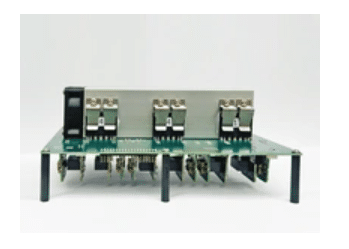
Designed around silicon carbide (SiC) technology, it significantly reduces the complexity and development time typically associated with high-power conversion designs. The REF68006 reference design from ROHM Semiconductor is positioned as a ready-to-use development platform for engineers building high-efficiency, mid-power three-phase inverter systems.
At its core, it is built as a complete evaluation kit (SCZ4009KTAHRC23-EVK-A09) that integrates a power board, gate driver board, and sensing board into a unified architecture. This modular approach enables design engineers to directly evaluate system-level performance rather than spending time assembling discrete subsystems. It is particularly useful in accelerating prototyping for applications such as HVAC systems, solar inverters, energy storage systems (ESS), pumps, and EV charging infrastructure.
The design leverages the company’s 4th-generation SiC MOSFETs in a DOT-247 package, which are optimised for high-efficiency switching and reduced power losses. SiC devices inherently support higher switching frequencies and improved thermal performance compared to traditional silicon-based solutions, making them well-suited for compact and energy-efficient inverter designs.
From a performance standpoint, the platform supports up to 10 kVA of apparent power, with a phase current rating of 20 A and an operating frequency of 18 kHz. These specifications place it firmly in the mid-power range, bridging the gap between lower-power industrial drives and high-power traction inverters. Engineers can use this as a baseline to scale designs depending on application needs.
A key advantage of this reference design is its comprehensive set of design resources. The company provides full schematics, bill of materials (BOM), PCB layout data, and user guides. This allows engineers to replicate or modify the design with minimal effort, reducing both design risk and time-to-market. Additionally, access to simulation tools and evaluation documentation enables deeper analysis of switching behaviour, thermal performance, and system efficiency before hardware implementation.
The design also incorporates carefully selected supporting components, including gate drivers, current sensing resistors, Schottky barrier diodes, and operational amplifiers. These components are optimized to work seamlessly with the SiC power stage, ensuring stable operation, accurate current sensing, and efficient switching performance.
Importantly,it addresses one of the key challenges in SiC-based systems—complex peripheral and thermal design. By offering a validated reference platform, it helps engineers bypass much of the trial-and-error typically involved in high-power inverter development. This makes it particularly valuable for teams transitioning from silicon to SiC technologies. For more information, click here.