




India’s first commercial four-legged robot is redefining industrial operations, executing hazardous tasks and powering advanced research with robots purpose-built for real-world environments.
In 2019, Aditya Pratap Singh Rajawat began exploring legged robots at IIT Kanpur, working alongside Prof. Shakti S. Gupta under the guidance of Prof. Mangal Kothari and collaborating with defence research labs. The initial work focused on creating lab prototypes. After graduating, he joined Jaguar Land Rover but remained closely connected with the IIT Kanpur team at the Mobile Robotics Lab. Together, they identified a gap in India: almost no deployable robots and only a few groups exploring advanced robotics. Seeing the opportunity, they decided to transform their lab prototypes into commercial products. In March 2023, xTerra Robotics was established in Kanpur. ‘x’ stands for any variable, while ‘Terra’ represents terrain, together symbolising robots designed to navigate any environment.
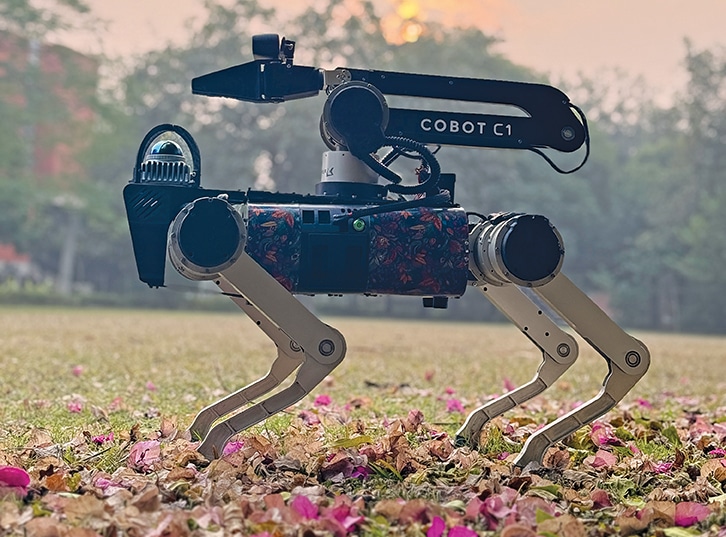
One of their key products is the Svan M2, a four-legged robot dog. This is being developed as India’s first commercial quadruped robot. Quadruped means four-legged, and it has been used across various research organisations in India for conducting research in human-machine collaboration, advanced control design, and adding autonomous applications for industries. This product is essential for replacing humans or supporting humans in dull, dirty, and dangerous tasks. With various sensors mounted on the robot head, it can detect gas leaks, identify anomalies on industrial factory floors, and support defence applications by enabling defence security and surveillance at borders.
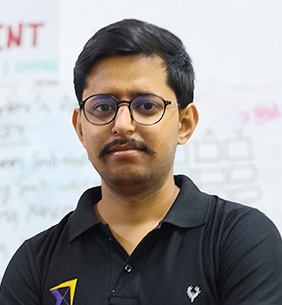
Building hardware comes with its own challenges. “We initially designed parts based on theoretical understanding or optimised approaches. When we took these designs to manufacturers, we realised that the required precision and accuracy were difficult to achieve. We then partnered with an aerospace-grade manufacturer who could deliver higher quality. Even then, the first iterations were not perfect. This created a feedback loop between us. Through multiple iterations, we were able to build something repeatable and consistent for production,” says Aditya.
Software development for these robots presents its own set of challenges. We have written everything from the first line of code to the complete system that runs on the robot. A major challenge is ensuring the software is highly responsive. The robot operates at hundreds of control cycles per second, often at 100 or even 500Hz, meaning the system performs 500 calculations every second. At this speed, issues can arise if processing is too slow or if communication between systems is delayed. The software must also be optimised for low-power computing, since putting the most powerful computer on the robot would consume too much energy,” explains Aditya.
On talking about the revenue, Aditya says, “Including Cobot C1 and Svan M2, we now have 12 customers. Our total revenue so far has crossed 10 million rupees.”
Most assembly and system integration work occurs in Kanpur, while manufacturing is outsourced to select partners in Bengaluru. The startup provides these partners with drawings and technical guidance, and over iterations with the last four or five robots, the manufacturers have become well-versed in building these components. These partners are now long-term collaborators for contract manufacturing.
One of the biggest challenges the startup faces is talent. Funding is also a major factor, and the company has struggled to secure it, though some agreements are now close to finalisation. Talent is harder to find. Most of the skilled workforce has been developed in-house, with employees hired and trained to deliver on complex robotics projects. There are very few professionals already experienced with these types of robots, so xTerra also works with research organisations such as IITs and NITs, supplying robots and training students while they are still doing B.Tech. Some students even interact directly with the team. This approach helps create a pipeline of trained talent for future hires, though the shortage remains significant.
“We have been supported by incubators. Our company was incubated at IIT Kanpur, and we have received support through programmes such as the Social Innovation Lab, which provides government grants for specific projects. We have also been supported by the I-Hub Foundation for Cobotics at IIT Delhi, a robotics-focused incubator, which provided a convertible note to support the production and development of Svan M2. In addition, the ITEL Foundation gave us a grant to support product development. So far, we have not raised any external funding outside of these incubators or government programmes,” says Aditya.
On discussion about how the ecosystem is helping them, Aditya says, “Our reseller network is growing. Right now, we have resellers in Kanpur and Gujarat who help us reach government and private customers. We haven’t scaled to many channel partners across India yet, but the ecosystem is growing, particularly driven by the drone industry. These partners and integrators can help bring our robots to industrial customers. We also see robotics-as-a-service becoming common, similar to drones-as-a-service. The growing Indian drone ecosystem is helping us reach the right customers at the right time.”
Aditya explains to EFY’s Nidhi Agarwal how these systems are being built for industry and defence applications. Read the full conversation with Aditya.
Currently, the company’s focus is primarily on R&D and building industrial-grade robots. Current production is close to five robots per quarter. Over the next year, the goal is to reach 50 robots per quarter for one product line. Additional product lines are in development, and the long-term target is to scale to 1000 robots per quarter by establishing a dedicated factory.


