




India’s quantum ambitions are finally moving beyond theory, as a small team builds open-access hardware designed, tested, and manufactured locally.
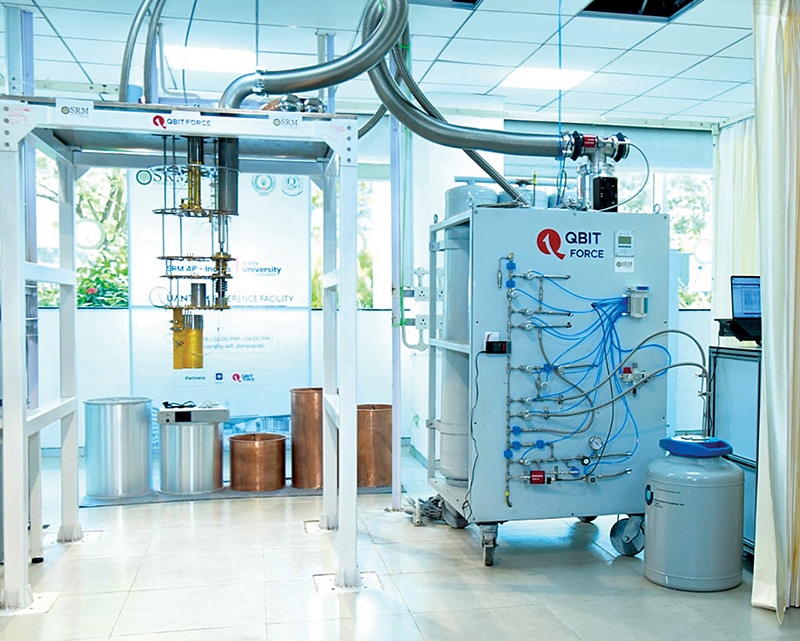
A small team of quantum engineers and physicists, led by a former IBM India head, has built something India never had before. Qbit Force, founded in 2025, created open-access superconducting quantum computer testbeds with more than 50 per cent indigenous components, including the country’s first domestically designed dilution refrigerator. The model resembles the Amul cooperative approach applied to quantum technology. In the 1970s, Indian farmers came together to solve milk shortages by working collectively. Today, Qbit Force brings together scientists, startups, students, defence labs, welders, goldsmiths, and forklift operators to build quantum hardware in an open, collaborative, and fully visible manner.
The reason for this startup is strategic and urgent. India has produced thousands of quantum-trained researchers through academic courses and online programs, yet no open-access quantum computer existed where they could physically test their own hardware components. Any Indian startup developing a cryogenic thermometer or quantum amplifier had no domestic testbed. Their only option was to fly to the Netherlands, pay up to 2500 euros per day, and endure long waitlists that prioritise EU customers. The United States, Japan, and China do not permit Indian researchers to access their facilities. More critically, defence organisations like the Defence Research and Development Organisation and the Bhabha Atomic Research Centre could not even import sensitive components because foreign suppliers demand end-use declarations that national security agencies cannot always disclose.
Qbit Force chose the superconducting qubit approach, which requires cooling to near absolute zero using a dilution refrigerator. Until this initiative, every dilution fridge in India was imported. The design challenge was immense. Building a dilution refrigerator, cryogenic wiring, and control electronics from scratch required extreme precision in both mechanical and electronic domains. Copper plates needed gold coating with surface finishes never attempted before in India. Welding processes had to maintain perfect circularity of the vacuum chamber despite extreme temperature variations.

The team combines deep industry expertise with fresh talent. Dr L. Venkata Subramaniam, who led IBM Quantum India for 27 years, left his corporate career to build Indian quantum products. Dr Gopal Joshi, a 40-year veteran from Bhabha Atomic Research Centre, oversees cryogenics and radio-frequency systems. Young researchers include Subhash Kalidindi, a University of Delaware post-doctoral fellow who returned to India, and Pallavi Kayala, a local Rajiv Gandhi University of Knowledge Technologies graduate who has become a major contributor to the team’s work.

Industry-academia tie-ups played a significant role. The qubit chips come from Prof. R. Vijayaraghavan at the Tata Institute of Fundamental Research and Dr Vibhor Singh at the Indian Institute of Science, both world-renowned researchers. The company has partnerships with SRM University, Indian Institute of Technology Tirupati, Tata Institute of Fundamental Research, Indian Institute of Technology Bombay, Inter-University Accelerator Centre, Indian Institute of Technology Hyderabad, and about 15 other institutions, including startups like Qubitech, Qute Electronics, Dimira, and Qkrishi. Memorandums of understanding (MoUs) for joint development are being signed. On the electronics front, the company uses superconducting transmon and trimon qubits, dilution refrigeration to millikelvin temperatures, cryogenic wiring, high-precision microwave pulse control, and power supplies accurate to six decimal places.
In terms of commercial progress, Qbit Force has deployed two testbeds. The Amaravati 1Q facility serves startups and industry partners focused on commercial component development. The SRM 1S facility at SRM University caters to academic research and education. Revenue is not publicly disclosed, but demand already exceeds supply, with multiple buyers waiting. Manufacturing is outsourced to Indian ecosystem partners such as Sidwal, known for ACs, metro cooling systems, and BrahMos missile cooling systems. The company does not own a plant. The strategy behind outsourcing is to stimulate the local supply chain and avoid huge capital investment early, thereby helping build a domestic quantum components ecosystem.
Processors from the Tata Institute of Fundamental Research and the Indian Institute of Science are made at only two to five chips per year, but the country requires at least 100 quantum computers to build a meaningful ecosystem. Plans for future growth include establishing an assembly-line manufacturing process by the end of 2026, fixing the supply chain, matching existing demand, and exporting systems abroad, as inbound queries are already coming from Europe and the Middle East.
The company is not looking for channel partners or distributors, as this is a B2G and B2A business focused on research partners. However, they are actively looking for new vendors, specifically any Indian manufacturer with CNC machines, lathes, or precision fabrication capabilities, as well as fabs to scale processor production. The selection criterion is existing manufacturing experience and a willingness to work at cryogenic-grade precision.
Finally, Qbit Force is actively seeking partnerships with academia. They already have about 15 academic partners and are willing to pay professors for joint technology development. They want universities to change curricula to train hands-on quantum hardware engineers, and several universities have already agreed. Dr Venkata Subramaniam concludes simply, “India has all the talent required. Now we must boldly build physical products. Let us not keep importing. Let us build.”


