In an exclusive interaction with EFY’s Saba Aafreen, Pravin Patel, Founder and Chairman of Brio Agri, discusses building hydroponics and controlled-environment agriculture in India, reimagining farming as a technology-driven infrastructure ecosystem where data is becoming the new fertiliser.
Q. Why did you start Brio Agri, and what gaps were you trying to meet?
A. Brio Agri was founded in 2014, initially offering commercial hydroponics training programmes while operating a small hydroponics farm for leafy vegetables. From the beginning, we viewed hydroponic agriculture not as traditional farming but as a technology-driven infrastructure ecosystem. Our focus has been on building precision food production systems and bringing the kind of transformation technology has enabled in other industries into agriculture. We have consistently worked towards making farming more efficient, predictable, and technology-driven as the sector undergoes significant change.
Q. What solutions is Brio Agri currently developing?
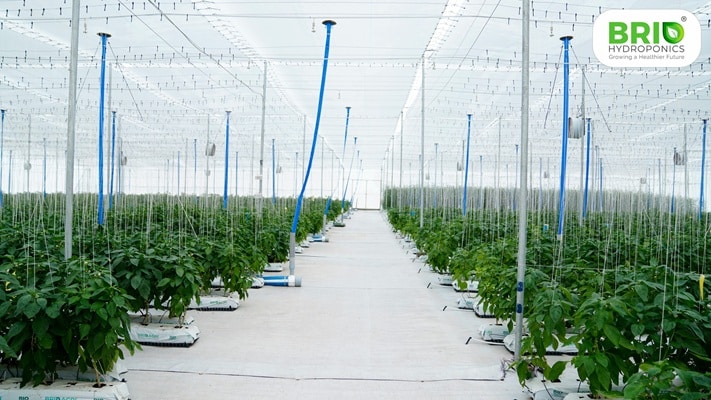
A. One of our flagship initiatives is a large-scale hydroponic park in Talod, Gujarat, designed as an integrated ecosystem for modern agriculture. The facility combines soil-less cultivation, climate-controlled farming, automation, and IoT-enabled monitoring of parameters such as temperature, humidity, pH, EC, and irrigation. Developed under our Unnati business framework, the project spans nearly 100 acres within a 180-acre development and is expected to be among India’s largest hydroponic parks.
Q. Can you explain the Unnati framework in simple terms?
A. The Unnati framework is a company-operated model built to develop large-scale agri zones. We are implementing it at our 180-acre Talod project in Gujarat, where around 100 controlled environment and hydroponic farming units are being established. It brings together the experience we have gained over the past 12 years into a single scalable operating model, making farm operations more predictable, efficient and easier to expand.
Q. What led you to adopt hydroponics and controlled environment agriculture?
A. Coming from a farming family, I have closely witnessed challenges such as labour shortages, climate uncertainties, and operational inefficiencies in traditional agriculture. These experiences convinced me that farming needs to become more technology-driven to be more predictable, efficient, and sustainable. Through controlled environment agriculture, we use IoT-based monitoring and automation to manage parameters such as climate, irrigation, water quality, EC, pH, CO₂, and light intensity. Our goal is not to replace farmers, but to empower them with better tools, greater control, and data-driven decision-making.

Q. How does hydroponics work, and what technology powers it?
A. Hydroponics grows plants without soil, using nutrient-rich water to deliver precisely controlled nutrition directly to the roots. The system relies on sensors, PLC-based controllers, automation, and IoT platforms to continuously monitor parameters such as temperature, humidity, pH, EC, CO₂, light intensity, and irrigation needs. This electronic architecture enables automated climate control, precision irrigation, and real-time crop monitoring with minimal manual intervention. In many ways, technology acts as the intelligence layer of the farm, helping farmers achieve more consistent yields, better resource efficiency, and data-driven decision-making.
Q. What sensors and monitoring technologies power your hydroponic farms?
A. Our farms use a combination of climate, water quality, and imaging sensors integrated with automation and IoT platforms. We continuously monitor temperature, humidity, leaf temperature through infrared sensing, as well as pH and EC levels to manage irrigation and fertigation with precision. Based on real-time sensor data, automated systems can regulate fogging, ventilation, cooling, and nutrient dosing without manual intervention.
IoT provides remote monitoring and control across the farm, while AI-based imaging systems analyse crop health, growth patterns, and fruit development to improve yield forecasting and production planning. Together, these technologies create a highly controlled, data-driven farming environment with greater precision, predictability, and operational efficiency.
Q. What role does AI play in your farming operations, and what decisions does it enable?
A. We use AI-based imaging systems that continuously scan crops to track growth, fruit size and plant health in real time, enabling yield forecasting and harvest planning by predicting output and timing to improve logistics and operational predictability. It also shifts operations from curative to preventive by detecting early signs of stress or disease before they are visible, allowing timely intervention and reducing losses. The system is trained on 12 years of internal crop data combined with real-time farm imaging, improving accuracy across conditions, and currently provides predictive insights and alerts, while autonomous control of irrigation and nutrient dosing is under development.
Q. How are LED grow light technologies evolving in Indian environmental conditions?
A. LED grow lights act as a replacement for sunlight in indoor and R&D environments, delivering precise light spectra required for photosynthesis while optimising energy use. They are particularly useful in controlled environments, leafy vegetable cultivation, vertical farming, and urban agriculture where space is limited, and precision lighting is essential. We have also seen their application in projects such as those at Anand Agricultural University and R&D initiatives in Kalol, Gujarat.
At Brio, we view LED lighting as a strong enabler for precision and labour reduction, but we are still at an early stage of large-scale commercial adoption compared to robotics and other systems. Integration is gradual due to existing agricultural practices and operational constraints, though we are actively deploying it in micro seeding and leafy greens while planning expansion into fruiting crops like tomato, capsicum, and cucumber in the future. Alongside this, we continue to combine robotics, sensors, and data-driven systems as agriculture becomes increasingly technology-intensive.
Q. What role does robotics play in your farming setup?
A. Robotics is increasingly helping reduce labour dependency while improving precision in key farm operations. We have deployed a robotic sprayer for vine crops that carries out preventive spraying within defined time windows, ensuring timely and accurate application that previously depended heavily on manual labour and scheduling. We are also introducing robotics in micro seeding for leafy vegetables, where precision placement of tiny pelleted seeds is critical, as manual seeding often leads to wastage and uneven germination. While full-scale robotics is not yet deployed across all fruiting crops, we are selectively integrating it where it delivers the highest operational impact.
Q. What software dashboard and remote monitoring capabilities has Brio developed for operators and investors?
A. Our system is built on automation, data logging, analytics, and remote monitoring. Before each crop cycle, whether it is English cucumber, capsicum, or leafy greens, the system is pre-configured based on crop-specific requirements, including pH, CO₂, light intensity, irrigation schedules, water temperature, and nutrient delivery parameters. These variables are continuously monitored and recorded throughout the cycle.
The software dashboard acts as a central platform for all farm data, enabling operators and investors to track performance, review detailed logs, and analyse outcomes against planned parameters. It can also be customised based on client requirements and investment models. For Brio-operated projects, the platform ensures full transparency, providing real-time and historical insights into crop performance, yields, operational activities, and challenges, enabling a fully data-driven and measurable farming ecosystem.
Q. How do you ensure uptime and fault tolerance in your automated farming systems?
A. With over 12 years in this space, we have built an in-house automation division where systems are customised based on crop type and cultivation cycle, with each crop having its own operational logic embedded into the control architecture. Whenever a fault occurs, whether sensor- or programming-related, the system generates real-time alerts for immediate response, while a manual override ensures operations continue without interruption and crop outcomes are not affected. We also follow preventive maintenance, regular calibration, and structured servicing to minimise failures and improve stability. Alongside this, IoT-enabled monitoring provides transparency, traceability, and predictive insights, helping us move from reactive fixes to preventive action and maintain consistent, reliable farm operations.
Q. How would you explain the role of hydroponics to farmers or investors who see it as an expensive or complex system?
A. We operate as a group of companies with four specialised entities, each focused on a specific part of the value chain. Hydroponic Industries handles marketing and outreach, a dedicated agronomy and production team manages crop operations, Brio Agri Infra takes care of EPC and infrastructure execution, and a commercial arm works with B2B and B2C partners such as merchant exporters, Reliance Fresh, BigBasket, Zomato, and Star Bazaar. This structure allows us to align channel partners, distributors and resellers to the right vertical while maintaining clear accountability across marketing, production, infrastructure, and distribution, which in turn improves execution efficiency and scalability.
Q. Are you currently working on any proprietary technology or patents related to automation?
A. We have done considerable work in this area, but have not yet formally registered patents, as our focus so far has been on practical ground implementation and building working systems rather than documentation or filings. However, we are open to moving in that direction as we scale. One key development currently in progress is an in-house IoT-enabled camera-based system that is close to completion, designed to digitise crop monitoring and support agronomy processes that are currently done manually. This will make field-level observations more data-driven and convert them into actionable inputs for decision-making, forming an important part of our future automation and precision farming framework.
Q. Where is Brio Hydroponics based, when was it founded, and what does your facility and project footprint look like?
A. We have been operating since 2014 and are based in Ahmedabad, Gujarat, where our main office and demonstration farm also function as a centre of excellence located near SG Highway, Shantigram, close to Town Square. Over the years, we have executed more than 150 projects across India, serving corporates, institutions, colleges, individual farmers, and investors, along with international deployments in countries such as Singapore, Oman, Dubai, the United States, Saudi Arabia, several African nations, and the Maldives. One of our key ongoing developments is the Talod project in Gujarat, a 180-acre site where we are building approximately 100 units of controlled environment and hydroponic farming systems, with the first phase already operational and expansion continuing in stages.
Q. How large is your R&D team currently?
A. Our R&D and automation division currently consists of a small core team of around four members. In addition, we work closely with agronomists and an IT company based in Gandhinagar, which supports us in optimisation, system development, and implementation across different projects. This hybrid structure allows us to stay lean while still leveraging specialised expertise for both agriculture- and technology-driven development.
Q. Do you have any institutional or academic collaborations?
A. Since 2014, we have worked with institutions like Ganpat University in Mehsana and Anand Agricultural University, along with state-supported skill development programs in agriculture. While early efforts involved extensive collaborations and training initiatives, our current approach is more structured and self-sufficient, with selective academic engagement. We also run our own internship programs for BSc and MSc agriculture students, offering hands-on exposure in hydroponics and controlled environment agriculture, and deploying trained talent across our projects and client sites to strengthen both operations and the wider skill ecosystem.
Q. What factors have helped you establish trust with enterprise customers?
A. The foundation of trust in our business comes from three core principles: transparency, accountability, and real-time communication, where we ensure stakeholders are kept informed through timely updates on ground operations. We follow structured monthly and quarterly reporting, and in many cases allow investor representatives to be physically present at project sites such as our Talod facility, where we manage the ecosystem end-to-end from production to market delivery, enabling direct visibility, continuous feedback, and faster resolution of operational challenges, which together strengthen trust through consistency and accountability.
Q. What is your long-term vision for technology-driven agriculture and smart farming in India?
A. Our vision is to make agriculture more predictable, scalable, and technology-driven by integrating CEA, hydroponics, IoT, AI, automation, sensors, and traceability systems into a unified, data-driven ecosystem. We believe the future of farming will depend more on engineering and data-based decision-making than land and labour, improving yield forecasting, reducing errors, and lowering labour dependency. At Brio, we are building integrated agricultural zones and aggregation models that improve efficiency and strengthen food security, including large-scale developments like our Talod hydroponic park, where these systems are deployed at scale.
Q. What final message would you like to leave for readers about how farming is perceived today?
A. One key point I always emphasise is the need to change the perception of farming. It is often seen as a difficult or uncertain profession, but in reality, farmers are directly contributing to food security and operate as entrepreneurs managing risk and production for society’s most essential need. Farming should be recognised with respect and dignity, as a meaningful profession where purpose and contribution come first, and while profit follows, the real value lies in the impact it creates. Agriculture is one of the largest industries globally, and everyone involved, from small farmers to technology-driven agripreneurs, plays a critical role that deserves pride and recognition.