An Indian startup is developing an AI-enabled BMS chip designed to simplify battery development and enhance monitoring for next-generation EV platforms.
India’s transition towards electric mobility and large-scale energy storage is accelerating rapidly, but one of the biggest bottlenecks lies deep inside the battery itself: the intelligence that monitors, protects, and optimises it. Semiconductor startup MOSart Semi was founded to address this gap by building an advanced Battery Management System (BMS) integrated circuit (IC) designed to make batteries smarter, longer-lasting, safer, and easier to deploy across multiple applications. In simple terms, the company aims to simplify battery management in the same way operating systems simplified computing by hiding hardware complexity so innovators can focus on performance and applications.
Adding one critical new feature, its patent-pending Tru-EIS, described by the company as a built-in ‘battery doctor’, continuously monitors the health of each cell throughout the battery’s lifecycle. This capability strengthens the BMS architecture by improving reliability and extending battery life significantly.
The idea behind MOSart Semi emerged from the founders’ experience in semiconductor and electronic systems design, where they repeatedly saw engineers struggling with fragmented BMS architectures. Today’s battery systems rely on multiple chips sourced from different vendors, each requiring separate firmware, configuration, and testing. As batteries grow larger and more complex, especially in electric vehicles and energy storage systems, this approach slows innovation and increases engineering costs.
The founders believed the industry needed a platform that simplifies electronics while enabling better battery intelligence and longer battery life. MOSart Semi was created to enable exactly that: a software-defined battery management solution.
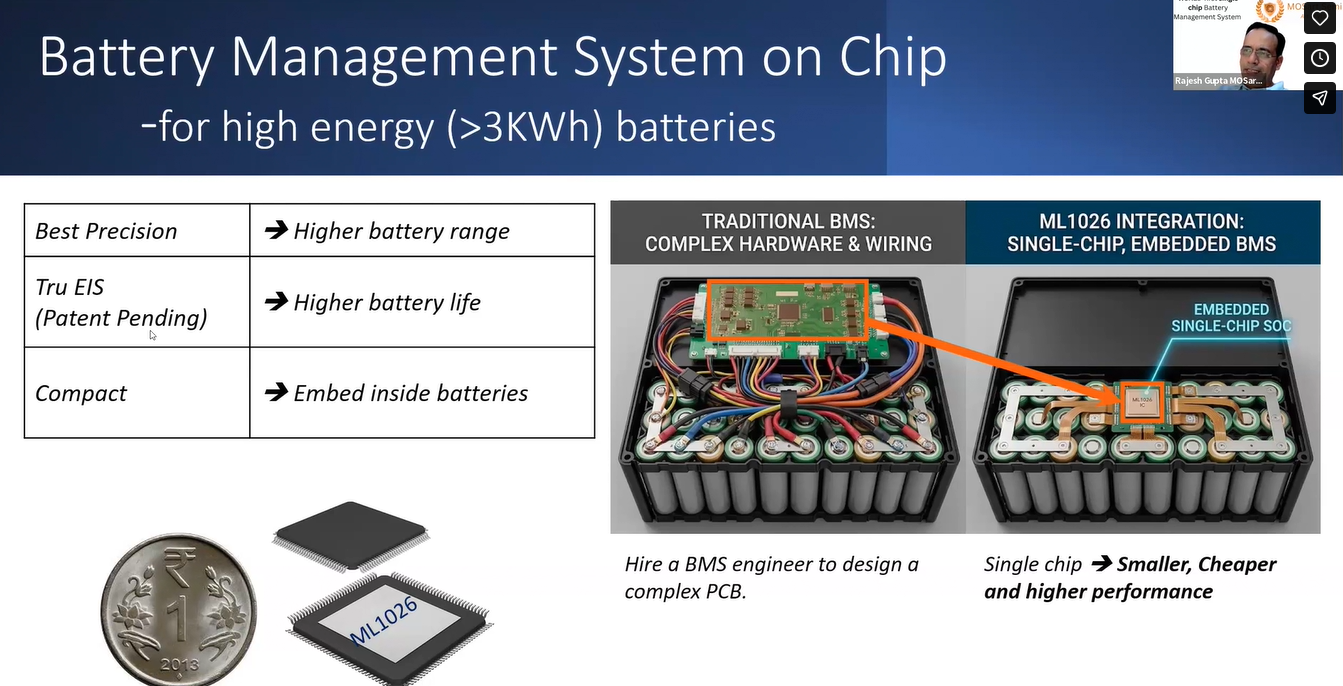
At its core, the startup is developing a custom semiconductor IC that integrates precision sensing, embedded processing, and AI-enabled diagnostics into a single chip. Instead of forcing battery developers to spend months understanding hardware-level complexities, the startup provides a hardware abstraction layer that automates IC management and configuration.
The technical challenge the team set out to solve is accuracy and reliability. Batteries operate across wide temperature ranges and fluctuating voltage conditions, and even small measurement errors can reduce performance or create safety risks. MOSart Semi’s chip, ML1026, is designed to achieve highly precise sensing, including around 0.1% current measurement accuracy across temperatures and voltage-sensing errors below half a millivolt.
In addition, Tru-EIS, described by the company as an ‘on-chip doctor’, continuously monitors the speed of chemical reactions within each cell to assess and regulate battery health. To validate these claims, the company designs dedicated testing boards and evaluates every device across multiple temperature points before certifying performance limits. All design work is carried out in-house by a core VLSI team currently comprising six engineers, though expansion to 50–60 engineers is planned once funding is secured.
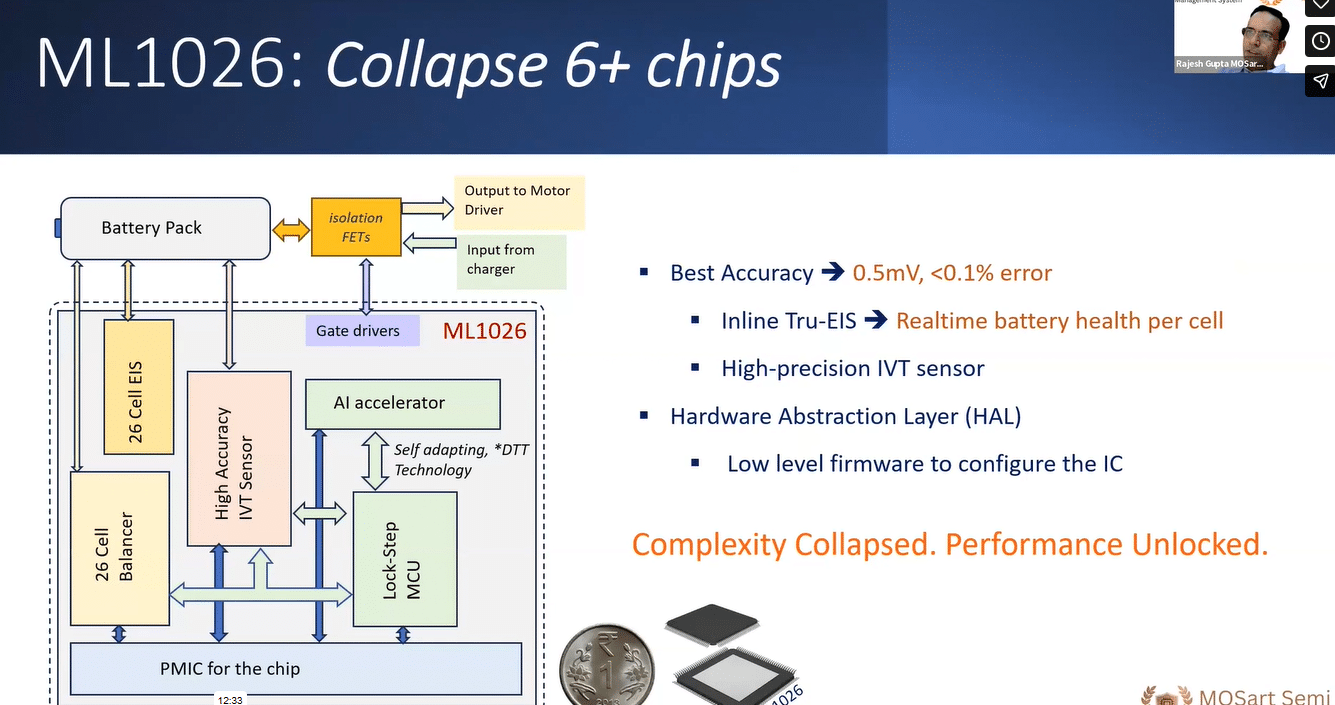
Rather than embedding fixed battery models, the company’s IC includes a lock-step microcontroller and memory optimised for battery-management compute, enabling battery manufacturers to implement their own algorithms and chemistry models. This allows the same chip to support multiple lithium-ion variants and future battery technologies, ensuring greater flexibility for customers. The IC supports standard communication interfaces such as CAN, Modbus, SPI, and I2C, allowing integration into existing vehicle and grid architectures without requiring communication-system redesigns.
The startup is primarily targeting high-energy battery systems above 3kWh, including electric vehicles, energy-storage installations, and industrial battery applications. Automotive qualification remains a priority because designing for stringent safety requirements allows the technology to scale more easily into less demanding markets.
The company operates under a fabless semiconductor model. Chip design and intellectual property remain in-house, while manufacturing will be outsourced to established semiconductor foundries. This strategy avoids heavy capital investment in fabrication plants while enabling global-scale production as demand grows. Revenue will ultimately come from IC sales, which offer strong scalability because semiconductor products can be mass-produced rapidly after successful deployment. At present, the company remains in a pre-revenue stage, as is typical for deep-tech semiconductor ventures that require years of upfront development before commercial returns begin.
Funding, therefore, represents one of the company’s biggest challenges. The startup is currently raising about $4 million (approximately ₹36 crore) to complete chip tape-out and move towards production. The company has received initial investor interest but continues to seek a lead investor to close the round. Government support remains limited following the expiration of India’s Design Linked Incentive scheme, though the founders are engaging with both state programmes and venture investors to sustain growth. To maintain operations during this phase, the company also conducts VLSI education programmes with institutions such as IIT Bhubaneswar and JNTU, Vijayanagaram. These initiatives generate modest revenue while helping MOSart Semi build a stronger semiconductor talent pipeline.
MOSart Semi is actively seeking ecosystem collaboration rather than traditional distribution partnerships at this stage. Ideal collaborators include electric vehicle OEMs, battery-pack manufacturers, and energy-storage integrators that can co-develop systems by combining the company’s chip expertise with real-world application knowledge. The founders believe stronger industry participation, improved policy incentives, and easier access to design tools could significantly accelerate India’s semiconductor innovation ecosystem.
The company’s long-term vision is not merely to sell BMS ICs but to enable a new generation of intelligent energy systems built on Indian semiconductors. If successful, MOSart Semi could help bridge a critical gap between India’s rapidly growing EV and green-energy ambitions and the advanced electronics required to power them safely and efficiently.