




A seamless 2D spintronics device made entirely from proximitized graphene opens new avenues in electronics research.
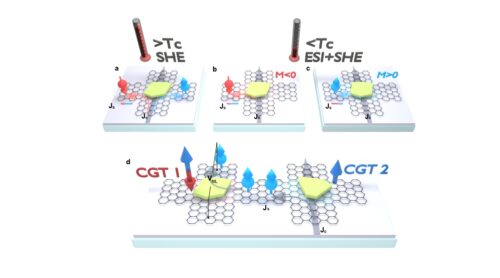
Researchers from CIC nanoGUNE, Spain, in collaboration with global institutions, have developed the first-ever two-dimensional spintronics device constructed exclusively from proximitized structures. This groundbreaking achievement features a graphene-based spin valve that utilises proximity to the Van der Waals magnet Cr2Ge2Te6. This advancement sets a new benchmark in spintronics research.
The evolution of spintronics has come a long way since the 1980s discoveries of spin injection and giant magnetoresistance, which led to a Nobel Prize in Physics for Albert Fert and Peter Grünberg in 2007. Traditionally, spintronics relied on material interfaces for spin manipulation. The new device bypasses these interfaces, offering a seamless design that enhances spin transport efficiency.
Graphene, known for its exceptional properties, has shown immense potential in spintronics due to its ability to transport spin information efficiently. By leveraging proximity effects—where adjacent materials alter the properties of graphene—researchers have enabled spin-orbit and magnetic exchange coupling within a single material. However, achieving seamless integration of these effects remained a significant challenge until now.
The Nanodevices group at CIC nanoGUNE, alongside collaborators from France, Belgium, and China, successfully created a lateral spin valve entirely from graphene. “We engineered a device where graphene is locally functionalised by proximity to Cr2Ge2Te, allowing for the coexistence of spin-orbit and magnetic proximity,” explained Haozhe Yang, lead author of the study. The device holds particular interest for researchers in spintronics and electronics, along with industries developing high-performance computing systems and energy-efficient memory technologies. Its design eliminates interfaces, reducing spin loss and simplifying device architecture.

This innovation could bring more potential for “proximitronic” devices, which rely solely on proximity effects for functionality. “The performance of this proximitized device is expected to attract significant attention from the electronics and spintronics community,” noted Félix Casanova, professor and co-leader of the study.
By demonstrating the feasibility of proximity-driven spintronics, this research establishes a foundation for future exploration and application of seamless 2D electronic systems, promising revolutionary advancements in technology.


