




New semiconductor enables robots to measure distance and speed simultaneously, unlocking faster real-time perception for automation and autonomous machines.
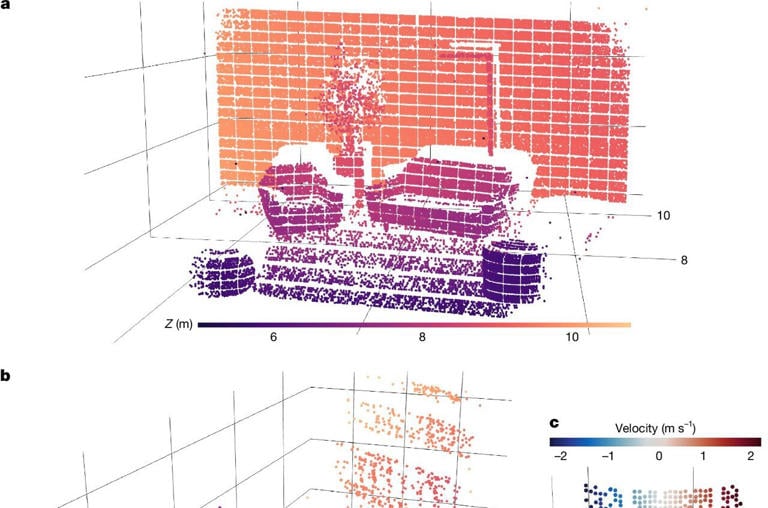
A newly developed semiconductor chip could significantly improve how robots perceive motion and navigate complex environments. Researchers have unveiled a compact sensing chip capable of giving robots “4D vision”, the ability to detect both the position and speed of objects simultaneously. Traditional robotic vision systems rely mainly on cameras or 3D sensors that estimate motion by comparing sequential frames. This approach introduces processing delays and limits how quickly machines can react to moving objects. The new chip addresses this limitation by measuring distance and velocity simultaneously, enabling robots to interpret dynamic scenes more accurately and respond faster.
The technology effectively adds a fourth dimensionvelocityto conventional three-dimensional spatial data. In robotics and sensing systems, 4D perception refers to capturing an object’s 3D position (X, Y, Z) along with its instantaneous motion or speed, enabling machines to track objects in real time. Researchers tested the chip in robotic sensing scenarios where machines must detect and track moving objects. Results showed the system could map a scene in three dimensions while simultaneously determining how fast objects were moving. This capability could help robots avoid collisions, track fast-moving targets, or interact more safely with humans.
Such improvements are increasingly important as robots move beyond controlled factory environments into warehouses, public spaces, and autonomous systems. Industrial robots, drones, and self-driving machines must often react to dynamic environments in which objects constantly change position and speed.By integrating distance and motion sensing directly onto a single chip, the new design also reduces system complexity. Conventional solutions often rely on multiple sensors or heavy processing to estimate velocity. A single integrated chip could simplify hardware architectures and lower power consumption in robotic platforms.
The breakthrough aligns with broader industry efforts to enhance machine perception. Emerging technologies such as 4D LiDAR and advanced imaging radar are also being developed to capture both spatial position and velocity for autonomous systems. If commercialized, chips with built-in 4D sensing could accelerate the development of smarter robots capable of reacting instantly to their environment. Applications could range from collaborative industrial robots and warehouse automation to drones and next-generation autonomous vehicles.


